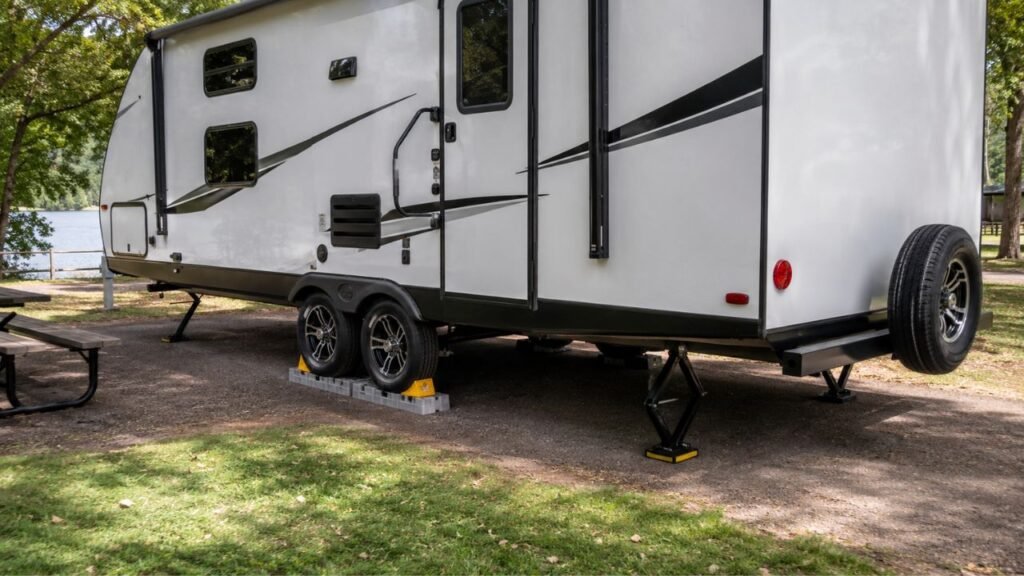
No, standard stabilizer jacks should not be used to level a trailer. They are designed to reduce rocking and movement after the trailer is already level. Using them to raise one side or corner can damage the jacks, mounting points, or trailer frame.
If your trailer is sitting unevenly, there is a safer way to fix it. I’ll show you how to level side-to-side and front-to-back, how stabilizers should actually be used, and what to check when your trailer still feels shaky afterward.
Key Takeaways
- Standard stabilizer jacks are not designed for leveling a trailer.
- Level the trailer before lowering the stabilizer jacks.
- Use leveling blocks beneath the tires for side-to-side leveling.
- Use the tongue jack for front-to-back leveling.
- Stabilizer jacks should be snug without lifting the trailer.
- Over-tightening stabilizers can stress the jacks and trailer frame.
- Wheel chocks should be installed before unhitching.
- Power stabilizers are not automatically leveling jacks.
- Dedicated hydraulic or electric leveling systems are different.
- Stabilizer blocks can reduce jack extension and trailer movement.
Can Stabilizer Jacks Level a Trailer?
Standard stabilizer jacks cannot safely level a travel trailer. Their purpose is to brace the trailer against movement once the wheels and tongue are already positioned correctly.
I understand why the confusion happens. When you crank down a stabilizer, you can feel it pushing against the trailer frame. Keep turning, and you may even see one corner rise slightly.
That does not mean the jack is designed for lifting.
Think of stabilizers as braces rather than lifting equipment. They take out unwanted movement when you walk around inside the trailer. They are not supposed to carry enough weight to change the trailer’s actual position.
If the left side of your trailer is low, raise the wheels on that side with leveling blocks. If the front is too low or high, adjust the tongue jack.
Once the trailer is level, your stabilizers can do the job they were designed to do.
Leveling vs. Stabilizing a Trailer
Leveling and stabilizing usually happen within minutes of each other during campsite setup. However, they solve completely different problems.
| Feature | Leveling | Stabilizing |
| Main purpose | Makes the trailer sit level | Reduces rocking and movement |
| Side-to-side adjustment | Leveling blocks or ramps | No |
| Front-to-back adjustment | Tongue jack | No |
| Changes trailer height | Yes | Normally no |
| Carries substantial weight | Proper leveling equipment can | Standard stabilizers should not |
| When it happens | Before stabilizing | After leveling |
| Common equipment | Blocks, ramps, tongue jack | Scissor jacks, power stabilizers |
| Main result | Flat trailer | Steadier trailer |
Leveling changes the trailer’s actual position. Stabilizing simply helps keep that position steady.
You can have a perfectly level trailer that still rocks when someone walks inside. You can also have a very stable trailer that is sitting noticeably crooked.
That is why you need to complete both jobs separately.
Why You Should Not Use Stabilizer Jacks for Leveling
A stabilizer may look strong enough to lift your camper, especially if it is a large scissor-style unit. The problem is how that jack and its mounting points were designed.
Stabilizer Jacks Are Not Designed for Heavy Lifting
Most travel trailer stabilizers are intended to resist relatively small movements.
When someone walks from the kitchen to the bedroom, the trailer suspension and tires move slightly. Stabilizers brace the frame and reduce that movement.
Trying to lift hundreds or thousands of pounds is a completely different job.
Even a strong-looking jack should not be treated as lifting equipment unless its manufacturer specifically approves it for that purpose.
The Stabilizer Jack Can Bend
Putting excessive load on the stabilizer can bend its arms, screw mechanism, foot, or mounting bracket.
This becomes even more likely when the jack is extended a long distance.
You might not notice the damage immediately. Later, the jack may become difficult to retract, wobble during operation, or stop folding properly.
You Can Stress the Trailer Frame
Trying to raise one corner can put concentrated force into that area of the frame.
Trailers are designed to distribute weight across the chassis, suspension, tongue, and approved support points. Forcing one stabilizer upward can change how those loads are distributed.
The result may be unwanted frame flex.
Doors Can Become Difficult to Open
One clue that you have introduced too much frame twist is a door suddenly becoming difficult to open or latch.
A trailer body can flex slightly when its support points change.
If a door worked normally before you tightened your stabilizers but suddenly sticks afterward, back off the stabilizers and check your setup.
Slide-Out Alignment Can Be Affected
Slide-outs depend on reasonably good chassis alignment.
If you dramatically twist the trailer by lifting one corner, the slide opening may also move slightly out of alignment.
That can increase unnecessary stress on seals, gears, tracks, motors, and slide mechanisms.
An Overloaded Stabilizer Can Become Unstable
Soft soil, loose gravel, steep jack angles, or small jack feet can make the situation even worse.
A jack carrying excessive load can shift or sink.
That is another reason I would never depend on standard stabilizers as primary lifting equipment.
How to Properly Level and Stabilize a Trailer
The easiest way to avoid jack problems is to follow the correct campsite setup order. Once you make it a habit, the entire process becomes straightforward.
- Position your trailer at the campsite.
- Check its side-to-side level.
- Identify which side needs to come up.
- Place leveling blocks or ramps beneath the low-side tires.
- Move the trailer onto the blocks.
- Check the side-to-side level again.
- Chock the trailer wheels securely.
- Disconnect from the tow vehicle.
- Raise or lower the tongue jack.
- Get the trailer level from front to back.
- Recheck your level.
- Place pads or blocks beneath the stabilizers if needed.
- Lower each stabilizer until it makes firm contact.
- Apply enough pressure to remove looseness.
- Stop before the stabilizers begin lifting the trailer.
- Walk through the trailer and check stability.
The important part is that the trailer’s position should already be correct before the stabilizers come down.
How to Level a Trailer Side to Side
Side-to-side leveling happens before unhitching. You are essentially changing the height of one set of trailer tires until the floor sits level.
Start by parking where you want the trailer.
Check your level and determine which side is lower.
If the driver’s side is low, for example, place leveling blocks or a ramp where those tires will sit. Then slowly move the trailer onto the blocks.
Useful equipment includes:
- Interlocking leveling blocks
- Curved leveling ramps
- Bubble levels
- Electronic trailer levels
- Wheel chocks
- Heavy-duty leveling boards
Do not try to correct a low side by cranking the stabilizers downward.
The trailer wheels should carry the trailer’s normal load while the leveling blocks simply raise those wheels higher.
Once the side-to-side position looks good, chock the trailer securely.
How to Level a Trailer Front to Back
Front-to-back leveling is usually much easier because the tongue jack handles this adjustment.
After finishing your side-to-side leveling, secure the wheels with chocks. Then disconnect the trailer from your tow vehicle.
Use the tongue jack to raise or lower the trailer tongue.
If the front of the trailer is low, raise the tongue. If the front is high, lower it.
Keep checking your level until the trailer is reasonably flat.
Unlike a stabilizer jack, the tongue jack is designed to support substantial tongue weight during hitching and campsite setup.
Once your trailer is level front-to-back, you can move on to stabilization.
How Tight Should Stabilizer Jacks Be?
Stabilizer jacks should be firm enough to remove looseness but not tight enough to noticeably raise the trailer.
Lower the jack until its foot touches the ground or jack pad.
Then apply a little additional pressure.
You want the jack firmly planted so it can resist movement when someone walks inside.
You do not want to keep turning until you see the trailer corner rising.
One helpful test is to watch the trailer frame while tightening. If you can clearly see that corner moving upward, back the stabilizer off slightly.
I also recommend walking inside after all stabilizers are deployed. If you still notice movement, check each stabilizer for solid contact rather than automatically tightening everything harder.
Can Stabilizer Jacks Lift a Trailer Slightly?
Yes, a stabilizer jack may physically raise a trailer corner slightly if you keep tightening it. However, being physically capable of doing something does not mean the jack was designed for that job.
This distinction is important.
Some upward force is naturally created when you make a stabilizer snug. You may even notice a tiny amount of suspension movement.
That is very different from intentionally using the stabilizer to correct an uneven campsite.
If you need another inch of side-to-side height, adjust the blocks beneath the tires instead.
Can You Use Scissor Jacks to Level a Trailer?
Scissor jacks can be confusing because similar-looking designs are used for several purposes.
A factory-mounted RV scissor stabilizer should normally be treated as a stabilizer unless the manufacturer specifically identifies it as lifting or leveling equipment.
The fact that a jack has a screw mechanism does not tell you how much load its mounting system can safely support.
Automotive scissor jacks provide a good example. They may be designed to lift a specific vehicle from specific lifting points.
Your trailer’s corner stabilizers are mounted differently and may have a completely different purpose.
Never assume two jacks are interchangeable simply because they look alike.
Stabilizer Jacks vs. Leveling Jacks
The names often get mixed together, but true leveling jacks and standard stabilizer jacks are built for different workloads.
| Stabilizer Jacks | Leveling Jacks |
| Reduce trailer movement | Change trailer height |
| Used after leveling | Used during leveling |
| Usually located near trailer corners | Installed as part of a leveling system |
| Not normally intended for heavy lifting | Designed to carry substantial loads |
| Common on travel trailers | Common on larger RVs and fifth wheels |
| May be manual or powered | Often hydraulic or electric |
| Should only be snug | May intentionally lift the RV |
A simple rule helps here.
A leveling system can often provide stabilization, but standard stabilizers should not be treated as leveling equipment.
What About Automatic RV Leveling Systems?
Some RVs have jacks that really are designed to lift and level the vehicle. These systems should not be confused with ordinary corner stabilizers.
Hydraulic Leveling Systems
Hydraulic systems use fluid pressure to operate heavy-duty jacks.
When installed as an approved leveling system, those jacks can support significant portions of the RV’s weight.
They can make leveling much easier, especially on larger RVs.
Electric Leveling Systems
Electric leveling systems use powered jacks and electronic controls.
Depending on the design, the system can automatically or manually adjust different areas of the RV until it reaches the desired position.
Again, these are purpose-built leveling systems.
Power Stabilizers Are Not Automatically Levelers
This is one distinction I want you to remember.
Adding an electric motor to a stabilizer does not magically turn it into a leveling jack.
Power stabilizers simply save you from manually turning a crank.
Unless your system specifically states that it is designed for leveling and lifting, treat it as a stabilizer.
What Happens If You Over-Tighten Stabilizer Jacks?
More pressure does not always create more stability. Once the jacks are firmly supporting the trailer against movement, additional tightening can start creating new problems.
Possible problems include:
- Bent stabilizer arms
- Damaged screw mechanisms
- Stressed mounting brackets
- Trailer frame flex
- Sticky entry doors
- Slide-out alignment issues
- Uneven load between stabilizers
- Jack feet sinking into the ground
- Premature stabilizer wear
If your trailer still rocks after the jacks are snug, investigate why it is moving rather than simply tightening harder.
Why Does My Trailer Still Rock After Using Stabilizer Jacks?
Some movement can remain even when your stabilizers are working correctly. Several parts of a travel trailer can flex independently of the stabilizer jacks.
The Stabilizers Are Extended Too Far
Long stabilizer extensions can allow more movement.
Think of a short table leg compared with a very long, thin one. The longer support has more opportunity to flex.
Adding solid blocks beneath the stabilizer feet can reduce extension.
The Ground Is Soft
A jack can feel tight when you first deploy it and then gradually sink into soil.
This commonly happens on grass, sand, soft dirt, and recently disturbed campground surfaces.
Wide jack pads help distribute the pressure.
Your Wheel Chocks Are Loose
The trailer may be stable vertically while still moving slightly forward and backward.
Good wheel chocks help limit tire movement.
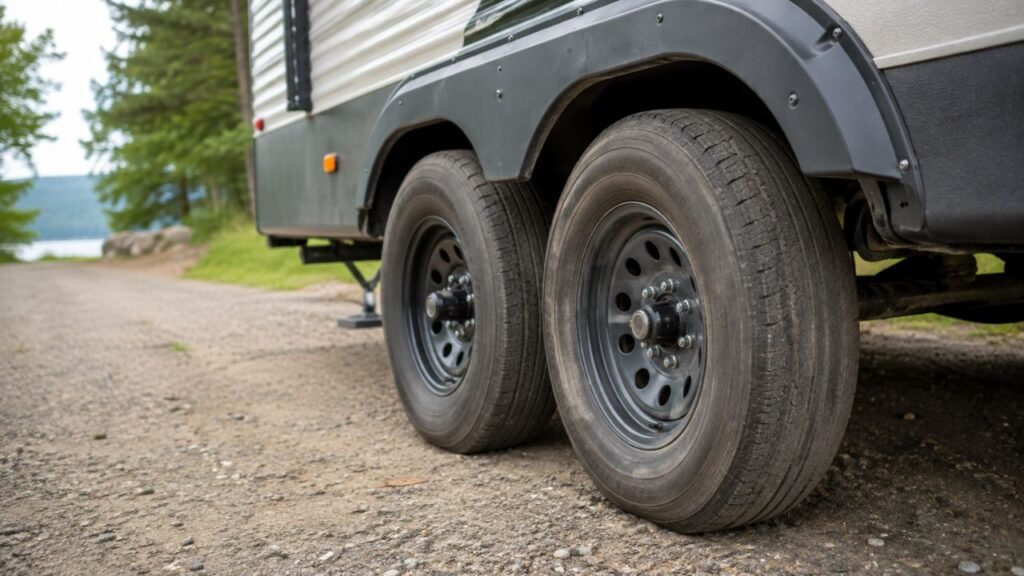
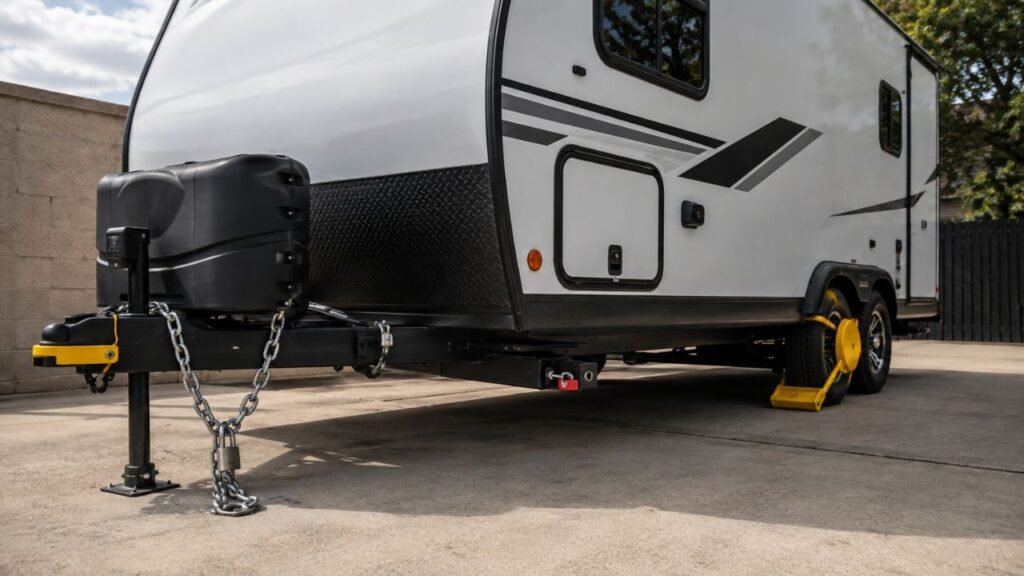
If your trailer has tandem axles, wheel-locking devices placed between the tires can also help reduce some movement.
The Tires and Suspension Are Moving
The trailer still sits on tires and suspension components after the stabilizers are deployed.
Those components can flex.
Standard corner stabilizers reduce that motion but do not completely eliminate every bit of movement.
Your Trailer Is Long
Longer trailers can sometimes flex noticeably through the center.
You may stabilize all four corners correctly and still feel movement near the middle.
Before adding any additional support, make sure the equipment and support locations are approved for your trailer.
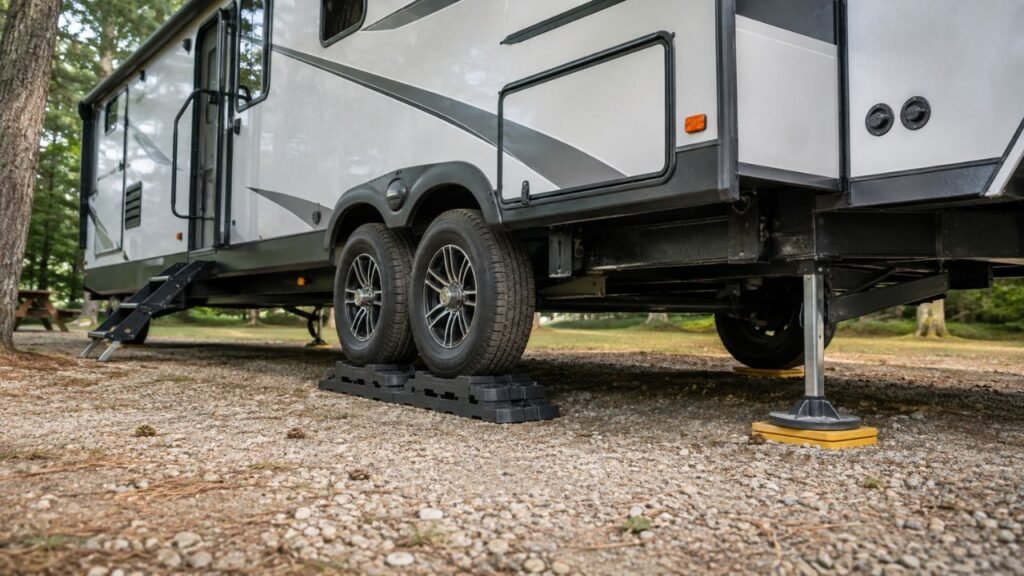
Should You Put Blocks Under Stabilizer Jacks?
Using solid blocks or jack pads beneath stabilizers is often a good idea. They can improve footing while reducing how far the jacks need to extend.
Benefits can include:
- Shorter stabilizer extension
- Less jack flex
- Better support on soft ground
- Reduced sinking
- Larger ground contact area
- Faster stabilizer deployment
- Easier campsite setup
Use blocks that are wide enough and strong enough for the job.
Keep them flat and stacked securely.
Avoid unstable towers of small blocks. A shorter, wider stack is generally more stable than a tall narrow one.
Can Stabilizer Jacks Be Used to Change a Tire?
Standard stabilizer jacks should not be used as your primary method for lifting a trailer during a tire change.
Changing a tire requires enough lift to remove significant weight from the wheel.
That is very different from stabilization.
Use properly rated lifting equipment at the trailer manufacturer’s approved lifting locations.
Also support the trailer appropriately before working near or underneath it.
Never depend on a stabilizer jack to keep a heavy trailer safely suspended.
Should You Extend Slide-Outs Before or After Stabilizing?
Your trailer should be properly positioned and level before extending the slide-outs. The exact stabilization sequence can depend on your trailer manufacturer’s instructions.
Generally, I want the trailer sitting correctly before adding the weight and leverage created by slide-outs.
Get the side-to-side level right.
Get the front-to-back level right.
Chock the wheels securely.
Then follow the recommended stabilizer and slide deployment procedure for your specific trailer.
This reduces unnecessary chassis twist while giving the slide system the alignment it expects.
Can You Level a Trailer Without Leveling Blocks?
Sometimes you may park on ground that is naturally level enough that no side-to-side adjustment is required.
However, when one side needs to come up, you need some appropriate method of raising the tires.
Purpose-made leveling ramps and blocks are convenient because they are portable and designed for campsite use.
Strong wooden boards may also be suitable when properly sized and positioned.
What I would not do is skip proper wheel leveling and use the stabilizers to compensate.
That simply transfers the problem to equipment that was not meant to solve it.
Common Trailer Leveling Mistakes to Avoid
You can prevent most leveling and stabilization problems by avoiding a few common setup habits.
- Using stabilizers to correct side-to-side level
- Raising one trailer corner with a stabilizer
- Forgetting wheel chocks
- Unhitching before completing side-to-side leveling
- Over-tightening stabilizer jacks
- Extending stabilizers farther than necessary
- Using unstable blocks
- Placing stabilizers directly on very soft ground
- Assuming every powered jack can level
- Deploying slides while badly out of level
- Ignoring unusual door alignment after setup
- Using stabilizers as tire-changing jacks
- Forgetting to retract stabilizers before departure
If something does not feel right during setup, stop and check it.
A few extra minutes at the campsite are much better than dealing with a bent stabilizer or damaged mounting bracket later.
Best Equipment for Leveling and Stabilizing a Trailer
You do not need an enormous collection of equipment to create a good campsite setup. A few basic tools cover most situations.
Leveling Blocks
Leveling blocks raise the trailer tires on the low side.
Stackable designs let you adjust the height depending on the campsite slope.
Curved Leveling Ramps
Curved ramps allow you to slowly move the trailer upward until it reaches the level position.
They can make small adjustments easier than stacking several blocks.
Wheel Chocks
Wheel chocks help keep the trailer from rolling after positioning.
Use them before disconnecting from your tow vehicle.
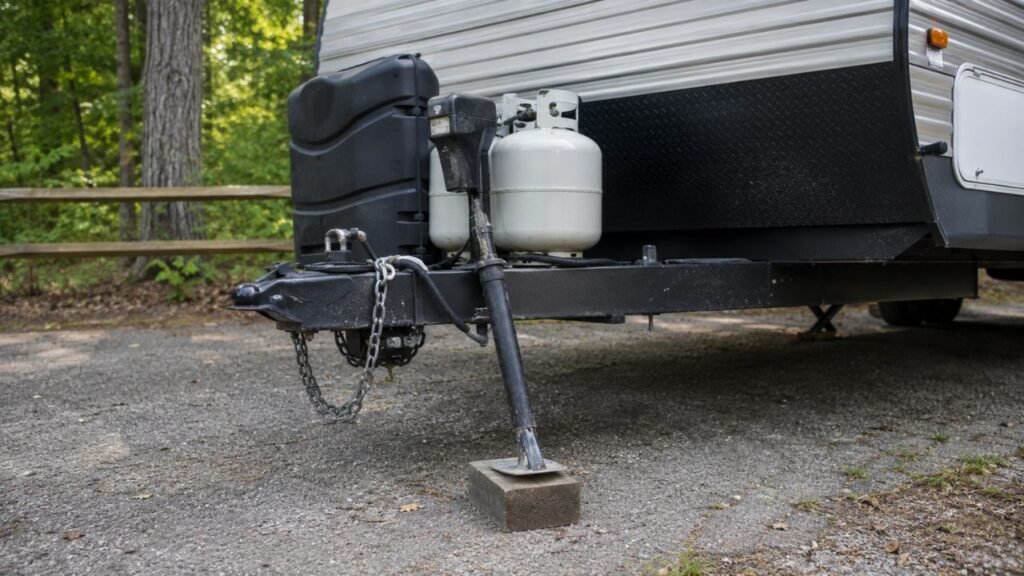
Tongue Jack
Your tongue jack handles front-to-back adjustment.
It also supports the tongue during hitching and unhitching.
Stabilizer Jacks
Stabilizer jacks reduce trailer movement after leveling is complete.
They should be firmly planted without being used to raise the trailer.
Jack Pads
Jack pads create a larger footprint beneath the stabilizer.
They are especially useful on soil, gravel, grass, asphalt, and other surfaces where a small jack foot may sink.
Trailer Level
Even a simple bubble level can make setup much easier.
Install or place the level where you can accurately check both side-to-side and front-to-back position.
Simple Trailer Leveling and Stabilizing Order
If all of this sounds like a lot to remember, use this simple sequence every time you arrive at camp.
- Park the trailer.
- Check the side-to-side level.
- Raise the low-side wheels with leveling blocks.
- Check the level again.
- Chock the wheels.
- Unhitch the trailer.
- Adjust the tongue jack.
- Check the front-to-back level.
- Place blocks beneath stabilizers if needed.
- Lower the stabilizer jacks.
- Make each stabilizer snug.
- Check for movement inside.
- Make small stabilization adjustments if necessary.
The important phrase is level first, stabilize second.
Remember that and you will avoid most of the mistakes we have covered.
Final Verdict
So, can stabilizer jacks level a trailer? Standard stabilizer jacks should not be used for that purpose.
Use leveling blocks or ramps beneath the tires to correct side-to-side lean. Then use the tongue jack to correct the front-to-back position. Only after the trailer is level should you lower your stabilizers.
When the stabilizers reach the ground, make them comfortably snug and stop there. You are trying to remove movement, not lift the camper.
If your RV has a dedicated hydraulic or electric leveling system, that is different. Those jacks may be designed specifically to support and level the RV. When in doubt, check the instructions for your exact jack and trailer before putting substantial weight on it.
Related FAQs
Can Stabilizer Jacks Raise a Travel Trailer?
A standard stabilizer may physically raise a trailer corner if you keep tightening it, but you should not use it that way. Stabilizers are intended to reduce movement, while proper leveling or lifting equipment is designed to carry heavier loads.
Can I Use Stabilizer Jacks on Uneven Ground?
Yes, but first level the trailer using the proper method. Once the wheels and tongue have positioned the trailer correctly, you can lower the stabilizers onto suitable pads or blocks.
Do You Level or Stabilize a Trailer First?
Always level your trailer first. Complete the side-to-side and front-to-back adjustments, secure the wheels, and then lower the stabilizers to reduce rocking.
Should Trailer Stabilizer Jacks Be Fully Extended?
No. Stabilizers only need to extend far enough to make firm ground contact. Using solid blocks beneath them can shorten the extension and often improve stability.
Can I Put Leveling Blocks Under Stabilizer Jacks?
Yes, suitable blocks can be placed under stabilizer feet to reduce extension and distribute pressure. Make sure they are strong, flat, wide, and securely positioned.
Can I Use a Drill on Trailer Stabilizer Jacks?
Many manual stabilizer jacks can be operated with a cordless drill and the correct adapter. Use a low-speed setting and stop when the jack becomes snug so you do not accidentally over-tighten it.
Should Stabilizer Jacks Carry Trailer Weight?
They can apply some supporting pressure during stabilization, but standard stabilizers should not carry a major portion of the trailer’s weight. The wheels, suspension, tongue, and approved leveling equipment handle those loads.
Do I Need Stabilizer Jacks on Level Ground?
Stabilizers can still be useful on perfectly level ground because leveling does not prevent movement. The trailer may rock on its tires and suspension whenever someone walks inside.
Can Power Stabilizer Jacks Level a Camper?
Power operation does not automatically mean a jack can level your camper. Most power stabilizers simply use an electric motor instead of a hand crank and should still only be used for stabilization unless specifically rated otherwise.
Can I Use Stabilizer Jacks to Change a Trailer Tire?
Standard stabilizer jacks are not suitable as primary lifting equipment for changing a tire. Use appropriately rated lifting equipment at the manufacturer’s approved lifting locations.
Why Does My Trailer Still Move With the Stabilizers Down?
Loose wheel chocks, soft ground, excessive jack extension, suspension movement, or a long flexible trailer frame can all contribute. Check those areas before tightening the stabilizers harder.
How Many Stabilizer Jacks Does a Travel Trailer Need?
Many travel trailers use four stabilizers, typically positioned near the corners. The correct number and placement depend on the trailer’s design, so follow the manufacturer’s original setup.

Scott Miller shares real-world RV road trip insights built from years of traveling open highways and backroads. He covers route planning, campground choices, and travel gear with a practical mindset. His content is written for RVers who value reliability over trends.