Trailer brakes usually lock up because the brake controller sends too much power, the breakaway switch activates, wiring feeds constant power to the brakes, or the brake assemblies are adjusted or damaged. Surge-brake trailers can also lock while reversing when the reverse lockout system fails.
If your trailer suddenly grabs, skids, or refuses to roll, you can usually narrow the problem down quickly. I’ll walk you through the common causes, what each symptom means, and the safest way to troubleshoot it.
Key Takeaways
- Excessive brake-controller gain can make electric trailer brakes lock quickly.
- A pulled breakaway pin may apply the trailer brakes continuously.
- Incorrectly wired 7-way connectors can send unwanted power to the brakes.
- One locking wheel usually indicates a wheel-specific mechanical problem.
- Over-adjusted brake shoes can drag, overheat, and eventually lock.
- Surge brakes may lock while reversing when their lockout system fails.
- A poor ground usually causes weak or erratic braking rather than full lockup.
- Repeated brake lockup should be repaired before continuing to tow.
Why Do Trailer Brakes Lock Up?
Trailer brake lockup happens when braking force becomes stronger than the tire can handle. Sometimes every trailer wheel locks together. Other times, only one wheel grabs while the others continue rotating.
Knowing which situation you have makes troubleshooting much easier.
Brake Controller Gain Is Set Too High
Brake controller gain determines how much braking power reaches your trailer.
If the gain is too high, the trailer brakes can apply aggressively. The tires may skid even during relatively gentle stops.
You may notice this problem more when the trailer is lightly loaded. A controller setting that worked with a loaded trailer may become excessive once you unload it.
High gain commonly causes:
- Sudden grabbing when touching the brake pedal
- Tire skidding during normal stops
- Harsh braking at low speeds
- Lockup when using the manual controller
Reduce the gain slightly and test again somewhere safe.
You want strong trailer braking without allowing the tires to skid.
Brake Controller Is Misconfigured or Faulty
Gain is not the controller’s only important setting.
Many controllers also use boost, sensitivity, trailer profiles, or proportional calibration. Incorrect settings can make the trailer brakes respond too aggressively.
A proportional controller may also perform poorly if incorrectly mounted or calibrated.
Start by checking the controller manufacturer’s setup procedure.
If the controller suddenly behaves differently without any setting changes, electrical testing may be necessary.
Breakaway Switch Has Been Activated
The breakaway system is designed to stop your trailer if it separates from the tow vehicle.
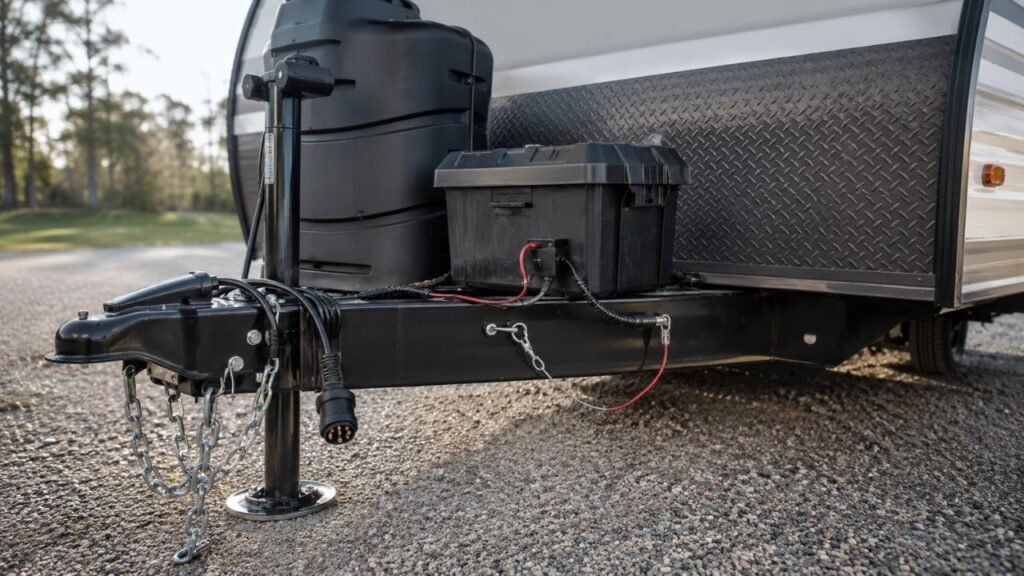
Pulling the breakaway pin closes the circuit and supplies battery power directly to the trailer brakes.
If the pin gets accidentally pulled, your brakes may remain applied.
Check that:
- The breakaway pin is fully inserted.
- The cable is not wrapped around hitch components.
- The switch housing is not damaged.
- Wiring near the switch is secure.
- The breakaway battery connections are correct.
A dead breakaway battery normally causes weak or unavailable emergency braking. It does not normally cause the brakes to lock by itself.
However, a damaged switch or incorrectly wired circuit can create unexpected brake operation.
Trailer Brake Wiring Has a Power Cross-Feed
Electrical brake wiring runs through some fairly exposed areas.
It may travel beneath the trailer, across suspension components, through junction boxes, and sometimes through the axle tube.
Over time, insulation can rub through.
One important distinction matters here.
A brake wire simply shorting to ground will often reduce braking or blow a fuse. Lockup is more likely when the brake-output circuit accidentally receives constant battery voltage.
That can happen through:
- Miswired trailer connectors
- Damaged junction-box wiring
- Crossed brake and auxiliary-power wires
- Pinched wiring contacting another powered circuit
- Poor aftermarket wiring repairs
If your brakes apply immediately after connecting the trailer plug, inspect this area carefully.
Trailer Brake Ground Is Poor
A poor ground deserves attention, but it is commonly misunderstood.
Weak grounds usually cause:
- Intermittent braking
- Weak braking
- Uneven brake operation
- Controller connection errors
- Brakes that work differently over bumps
A bad ground alone does not usually create maximum brake power.
However, electrical faults involving several damaged connections can make brake behavior unpredictable.
Check the ground wire between the trailer connector and frame. Also inspect the tow vehicle’s trailer connector ground.
Connections should be clean, tight, and free from corrosion.
Drum Brakes Are Adjusted Too Tight
Electric drum brakes require a small amount of shoe clearance.
If the shoes are adjusted too tightly, they may drag against the drum continuously.
Heat then builds as you tow.
Eventually, the brake may grab badly enough to lock the wheel.
Common signs include:
- Hot brake drums
- Burning smells
- Poor trailer rolling resistance
- Rapid brake-shoe wear
- One unusually hot wheel
- Brake drag after releasing the pedal
Do not ignore a hot trailer hub or drum.
Excessive heat can damage more than the brake components.
Brake Shoes or Internal Hardware Are Damaged
Sometimes the controller and wiring are perfectly fine.
The problem is inside the drum.
Electric drum brakes contain springs, shoes, adjusters, magnets, and mounting hardware. A damaged part can allow one brake assembly to grab unexpectedly.
Possible problems include:
- Broken return springs
- Loose brake hardware
- Seized adjusters
- Damaged brake shoes
- Severely worn shoes
- Contaminated friction material
- Distorted backing plates
This is especially likely when only one wheel keeps locking.
Brake Magnet or Brake Assembly Is Damaged
Electric trailer brakes use an electromagnet to begin applying the brake shoes.
A worn magnet can produce uneven braking. Damaged magnet wiring can create additional problems.
The magnet itself does not normally remain magnetized after power disappears. However, damaged brake components can remain mechanically applied.
If one brake consistently acts differently, inspect the complete assembly.
Replacing the entire backing-plate assembly is sometimes more practical than repairing several worn components individually.
Surge Brake Reverse Lockout Is Not Working
Surge brakes operate differently from electric trailer brakes.
When the tow vehicle slows, the trailer pushes forward against the coupler. This movement compresses the surge actuator and creates hydraulic brake pressure.
That same movement can happen while reversing.
Most modern surge-brake systems therefore use some type of reverse lockout.
If the lockout fails, the brakes may apply while backing.
Common causes include:
- Failed reverse lockout solenoid
- No reverse-light signal
- Damaged trailer plug
- Incorrect wiring
- Failed manual lockout mechanism
This is particularly noticeable when backing uphill.
Surge Brake Actuator or Hydraulic System Is Sticking
A surge-brake system can also remain applied after braking.
The actuator should move freely and release hydraulic pressure when the trailer stops pushing against the tow vehicle.
Problems can develop from:
- Corrosion
- Contaminated brake fluid
- Damaged master cylinders
- Restricted hydraulic hoses
- Seized wheel cylinders
- Sticking calipers
- Binding actuator components
If the brakes stay applied after moving forward, inspect the hydraulic system.
Trailer Brake Lock-Up Symptoms and What They Usually Mean
The exact moment your brakes lock can reveal a lot. Use the following symptoms as a starting point before taking anything apart.
| Symptom | Likely Cause | What to Check First |
| All wheels lock during braking | Controller gain too high | Brake controller settings |
| Brakes lock after connecting trailer | Electrical cross-feed | 7-way connector and wiring |
| Brakes stay applied without pedal input | Breakaway or electrical fault | Breakaway switch and brake circuit |
| Only one wheel locks | Mechanical brake problem | Brake assembly on that wheel |
| Brakes lock while reversing | Surge lockout failure | Reverse solenoid and wiring |
| Brakes grab at low speeds | Excessive gain or boost | Controller adjustment |
| Empty trailer locks easily | Excessive braking output | Reduce controller gain |
| One drum becomes very hot | Dragging brake | Shoes, springs, adjuster, bearing |
| Problems appear after rain | Moisture or connector corrosion | Plug and junction boxes |
| Brakes behave differently over bumps | Loose wiring | Frame and axle wiring |
Use this table as a guide rather than an absolute diagnosis. Several different faults can sometimes produce similar symptoms.
Why Do My Electric Trailer Brakes Lock Up?
Electric trailer brakes depend on controlled current reaching each wheel’s brake magnet. If that electrical signal becomes too strong or incorrect, brake application can become harsh.
Here are the main electrical causes worth checking.
Excessive Brake Controller Output
Start with the simplest possibility.
Reduce the gain and perform a slow test in a safe area. If the lockup disappears, your controller was probably applying too much brake force.
Do not reduce it so far that the trailer barely brakes.
The goal is balanced braking between the trailer and tow vehicle.
Incorrect Brake Controller Calibration
Proportional controllers measure vehicle deceleration.
If calibration is incorrect, the controller may misjudge how much braking force the trailer needs.
Some controllers automatically calibrate. Others require specific mounting or setup procedures.
Check the controller instructions before assuming the trailer brakes themselves are defective.
Constant Power Reaching the Brake Output Circuit
Electric trailer brakes should not normally receive maximum braking voltage continuously.
If the brake-output circuit becomes connected to constant 12-volt power, the magnets may apply immediately.
Inspect:
- Tow vehicle connector wiring
- Trailer junction box
- 7-way plug terminals
- Aftermarket brake-controller wiring
- Brake circuit near the trailer tongue
This problem needs correction before towing again.
Faulty Trailer Connector
Trailer plugs live in a harsh environment.
Water, dirt, road salt, oxidation, and physical damage can create electrical problems.
Look for:
- Green corrosion
- Bent terminals
- Loose pins
- Melted plastic
- Water inside the connector
- Improvised wire repairs
Clean minor corrosion appropriately. Replace severely damaged connectors.
Damaged Axle Wiring
Some electric brake wiring passes through the axle tube.
That protects the wiring externally, but movement inside the tube can eventually damage insulation.
If brake behavior changes over bumps or randomly appears and disappears, axle wiring deserves inspection.
Why Do My Trailer Brakes Lock Up When I Press the Brake Pedal?
If the brakes remain released until you press the tow vehicle’s brake pedal, start with the brake controller.
Excessive gain is a common cause.
Boost settings can also make initial braking much stronger. This may feel particularly harsh at lower speeds.
A lightly loaded trailer may need less brake output than the same trailer when fully loaded.
If controller adjustments do not help, inspect brake adjustment and electrical output.
You should not simply continue reducing gain to hide a mechanical problem.
Why Do My Trailer Brakes Lock Up at Low Speeds?
Trailer brake lockup at low speeds often points toward overly aggressive controller settings.
High boost settings can produce strong initial braking before much stopping force is actually needed.
An unloaded trailer makes this more noticeable because there is less weight pushing each tire against the road.
Over-adjusted drum brakes can create similar symptoms.
If the brakes grab during parking-lot driving, first reduce aggressive controller settings slightly. Then check mechanical adjustment if the problem remains.
Why Do My Trailer Brakes Lock Up When Backing Up?
Lockup while reversing is especially common with hydraulic surge brakes. The trailer pushes against the actuator while backing, which can create brake pressure just like normal stopping.
Several faults can prevent the reverse lockout from doing its job.
Surge Brake Reverse Lockout Failure
Many surge systems use an electric solenoid to prevent hydraulic pressure from reaching the brakes while reversing.
If that solenoid fails, backing becomes difficult.
The trailer may move slightly before the wheels begin dragging or locking.
Backup-Light Circuit Is Not Powering the Solenoid
The reverse lockout solenoid often receives power from the tow vehicle’s reverse-light circuit.
If that circuit is missing, the solenoid cannot activate.
Check the appropriate trailer connector terminal and wiring.
Manual Lockout Is Not Engaged
Some surge actuators use a mechanical lockout method.
If your trailer uses one, follow the manufacturer’s procedure before reversing.
Never improvise by permanently disabling the trailer’s brakes.
Electric Brakes Lock While Reversing
Electric trailer brakes do not normally need the same hydraulic reverse-lockout system.
If electric brakes suddenly lock while reversing, investigate the controller, wiring, connector, and breakaway circuits instead.
Why Is Only One Trailer Brake Locking Up?
When one trailer wheel locks while the others behave normally, I would look at that individual wheel first. A controller problem usually affects multiple brakes rather than only one.
Check for:
- Brake shoes adjusted too tightly
- Broken return springs
- Seized adjuster hardware
- Damaged brake magnet wiring
- Loose internal components
- Grease on brake shoes
- Damaged brake drum
- Local wiring problems
- Wheel-bearing problems
Inspect the brake on the opposite side of the same axle as well.
Brakes on one axle often experience similar wear and operating conditions.
Can a Bad Ground Cause Trailer Brakes to Lock Up?
A poor ground can definitely cause trailer brake problems. However, complete brake lockup is not its most typical symptom.
Ground problems more often create weak or intermittent braking.
You might also see connection warnings on the brake controller.
Still, trailer electrical systems should always have dependable grounds. Clean corrosion away and tighten loose connections.
Do not depend on the trailer hitch ball as the primary electrical ground.
Can a Bad Brake Controller Cause Trailer Brakes to Lock?
Yes, a defective brake controller can cause excessive or unpredictable braking.
Before replacing it, check the settings and wiring first.
Possible controller-related problems include:
- Excessive gain
- Excessive boost
- Incorrect trailer profile
- Failed internal electronics
- Improper calibration
- Incorrect brake-signal wiring
If another trailer works normally with the same tow vehicle, the problem is more likely on your trailer.
If several trailers behave badly with the same vehicle, investigate the controller and tow-vehicle wiring.
Can Over-Adjusted Trailer Brakes Lock Up?
Yes. Over-adjusted drum brakes can drag continuously and eventually grab.
A properly adjusted drum brake keeps the shoes close enough for quick engagement without continuously rubbing hard against the drum.
Too little clearance produces heat.
As components heat and expand, the brake may drag even more.
You may notice:
- Hot drums
- A burning odor
- Difficult wheel rotation
- Reduced towing efficiency
- Rapid shoe wear
- One wheel locking before others
Brake adjustment procedures vary by axle manufacturer, so follow the appropriate service information.
How to Diagnose Trailer Brakes That Keep Locking Up
Troubleshooting becomes much easier when you work through the system in order. Start with simple external checks before opening brake assemblies.
Step 1: Stop Towing and Let Everything Cool
Repeated brake lockup generates serious heat.
Pull somewhere safe and allow the brakes to cool before touching the wheels or drums.
Do not pour cold water onto an overheated drum.
Rapid cooling can damage hot components.
Step 2: Check the Breakaway Pin
Confirm that the breakaway pin is completely seated.
Inspect the cable and switch for visible damage.
If the switch appears melted, cracked, or corroded, replace it.
Step 3: Reduce Brake Controller Gain
Lower the controller gain slightly.
Then test the trailer at low speed in a safe, open location.
If lockup disappears, gradually increase braking force until you achieve firm stopping without skidding.
Step 4: Check Boost and Sensitivity Settings
Gain is not the only controller setting.
Reduce aggressive boost settings if your controller applies too much initial braking.
Confirm that you selected the correct trailer profile if your controller stores multiple setups.
Step 5: Inspect the 7-Way Connector
Disconnect the trailer and inspect both sides of the connection.
Look for corrosion, moisture, loose terminals, melted plastic, or damaged wires.
A badly miswired connector can place constant battery power onto the brake circuit.
Step 6: Inspect Trailer Brake Wiring
Follow the brake wires from the trailer junction box toward the axles.
Look for:
- Crushed insulation
- Exposed copper
- Loose connectors
- Frame abrasion
- Poor splices
- Damaged axle wiring
Pay extra attention where wiring moves with the suspension.
Step 7: Inspect the Ground Connections
Find the trailer’s main electrical ground.
Remove corrosion and ensure the terminal contacts clean metal securely.
Check the tow vehicle’s trailer ground as well.
Step 8: Determine Which Wheels Are Locking
This is an important diagnostic clue.
If every wheel locks together, suspect the controller, breakaway system, or shared wiring.
If only one wheel locks, suspect that wheel’s mechanical brake assembly.
Step 9: Inspect Brake Adjustment and Hardware
If internal inspection is necessary, support the trailer safely.
Use a suitable jack and correctly rated jack stands on approved lifting points. Chock the wheels remaining on the ground.
Never work beneath a trailer supported only by a jack.
Inspect shoes, springs, adjusters, magnets, drums, and bearings.
Step 10: Test the Electrical Brake Circuit
Electrical testing can confirm whether the brake circuit receives power when it should not.
A multimeter can help identify constant voltage or unexpected electrical connections.
If you are uncomfortable testing trailer wiring, have a qualified technician handle this step.
How to Adjust Your Brake Controller to Prevent Lock-Up
Brake controller adjustment should match the trailer’s actual loaded condition. Do not assume one gain setting will work for every trip.
A practical setup process looks like this:
- Load the trailer close to normal traveling weight.
- Begin with a moderate controller setting.
- Drive slowly in a safe open area.
- Use the controller’s manual brake control.
- Increase gain gradually.
- Stop increasing once trailer braking feels strong.
- Reduce gain if the trailer tires begin skidding.
- Test normal brake-pedal operation afterward.
- Recheck settings whenever trailer weight changes significantly.
Your controller manufacturer may specify a different calibration process.
Always follow those instructions when available.
How to Check Whether a Trailer Brake Is Dragging
A dragging trailer brake may begin as a mild problem before eventually locking.
Watch for these warning signs:
- One wheel feels much hotter than others.
- You smell overheated brake material.
- The trailer feels unusually difficult to pull.
- Fuel economy suddenly drops.
- Brake dust collects around one wheel.
- A tire occasionally skids.
- A raised wheel is difficult to rotate.
- A drum develops visible heat discoloration.
Be careful when checking wheel temperature.
A seriously overheated brake drum can cause burns.
An infrared thermometer is useful because it lets you compare wheel temperatures without touching the brake components.
Trailer Brakes Lock Up After Connecting the 7-Pin Plug
Brakes applying immediately after connecting the trailer is a major electrical clue.
The brake controller should not command full braking just because the trailer plug was inserted.
Possible causes include:
- Incorrect 7-way wiring
- Brake wire connected to constant 12-volt power
- Faulty breakaway wiring
- Damaged junction-box connections
- Incorrect aftermarket connector installation
Disconnect the trailer if the brakes apply immediately.
Correct the wiring problem before towing.
Trailer Brakes Lock Up After Replacing the Brake Controller
If the problem started right after installing another controller, return to the installation first.
Check for:
- Incorrect wire connections
- Excessive default gain
- Aggressive boost settings
- Incorrect proportional calibration
- Wrong trailer profile
Do not assume the new controller is defective immediately.
A simple setup or wiring mistake can create very aggressive braking.
Trailer Brakes Lock Up After Sitting for a Long Time
Storage creates a different set of trailer brake problems.
Moisture, corrosion, and lack of movement can cause brake components to stick.
Common storage-related problems include:
- Rusty brake drums
- Corroded adjusters
- Sticking brake shoes
- Damaged electrical connections
- Corroded trailer plugs
- Sticking surge actuators
- Seized hydraulic components
Some surface rust may disappear after light braking.
However, severe dragging, grinding, or repeated lockup deserves inspection before normal towing.
Are Trailer Brakes Supposed to Lock Up During Hard Braking?
Trailer brakes generally should provide strong braking without repeatedly locking the tires.
Tires can occasionally skid on loose gravel, wet surfaces, or other low-grip conditions.
Repeated lockup on normal dry pavement is different.
It usually means braking force is excessive, uneven, or mechanically incorrect.
A properly adjusted trailer should contribute significantly to stopping without constantly skidding behind the tow vehicle.
Is It Safe to Tow With Trailer Brakes That Keep Locking Up?
No. You should diagnose repeated trailer brake lockup before continuing normal towing.
A locked wheel reduces control and generates tremendous heat.
Continuing to tow can cause:
- Tire flat spots
- Tire failure
- Brake overheating
- Damaged drums
- Bearing damage
- Hub damage
- Reduced trailer stability
- Unpredictable stopping
A trailer that suddenly locks its brakes can also push or pull the tow vehicle unexpectedly.
That becomes especially dangerous during highway braking.
How to Prevent Trailer Brake Lock-Up
Regular inspection prevents many brake problems before they become noticeable on the road.
A few habits make the biggest difference:
- Adjust controller gain for actual trailer weight.
- Avoid unnecessarily aggressive boost settings.
- Inspect the breakaway system before trips.
- Keep the 7-way connector clean and protected.
- Repair damaged brake wiring promptly.
- Keep ground connections clean and secure.
- Inspect drum-brake adjustment periodically.
- Service brake assemblies at recommended intervals.
- Check wheel temperatures during long towing trips.
- Maintain surge-brake hydraulic systems properly.
- Inspect reverse lockout operation before difficult backing situations.
Do not wait for the trailer to start skidding before checking its brakes.
When Should You Have Trailer Brakes Professionally Inspected?
Many controller and connector problems are easy to identify. Persistent lockup, however, can involve brake hardware or electrical faults that deserve professional testing.
Have the system inspected if:
- Brakes remain applied unexpectedly.
- One wheel repeatedly overheats.
- Fuses repeatedly fail.
- Wiring shows heat damage.
- Brake drums are damaged.
- Internal brake hardware is broken.
- Surge brakes remain pressurized.
- The breakaway circuit behaves unpredictably.
- Controller adjustment does not solve the problem.
Brake problems directly affect stopping stability.
When you cannot confidently identify the fault, professional inspection is the safer choice.
Final Thoughts
When trailer brakes lock, first pay attention to exactly when it happens.
If every wheel locks when you touch the brake pedal, check your controller settings first. If the brakes engage immediately after connecting the trailer, focus on wiring and the breakaway circuit.
One locking wheel usually points toward that brake assembly.
Lockup only while reversing usually moves a surge-brake reverse lockout problem toward the top of the list.
Most importantly, do not treat repeated brake lockup as normal trailer behavior. The system should provide controlled braking without making your tires skid during ordinary stops.
Once you narrow the problem down by symptom, finding the actual fault becomes much easier.
Related FAQs
Why Do My Trailer Brakes Lock Up Suddenly?
Sudden lockup often happens because controller output is too high, the breakaway switch activates, or an electrical fault sends excessive power to the brakes. Start by checking the breakaway pin and controller settings.
Why Do My Trailer Brakes Lock Up When Empty?
An empty trailer places less weight on its tires, so the brakes can overpower available traction more easily. Reduce brake-controller gain to suit the trailer’s lighter operating weight.
Why Do My Trailer Brakes Lock Up in Reverse?
Surge brakes can lock in reverse when the reverse lockout solenoid or its electrical supply fails. Electric brakes locking in reverse usually indicate a controller or wiring issue.
Why Is One Trailer Wheel Locking Up?
One locking wheel usually points toward over-adjusted shoes, broken springs, damaged brake hardware, contaminated friction material, bearing trouble, or a wiring fault affecting that individual brake assembly.
Can a Bad Brake Controller Lock Trailer Brakes?
Yes. Excessive output, incorrect calibration, aggressive boost settings, improper wiring, or failed controller electronics can cause electric trailer brakes to apply too strongly.
Can a Breakaway Switch Cause the Brakes to Stay On?
Yes. A pulled pin, damaged switch, or wiring fault can keep the breakaway circuit energized and hold electric trailer brakes on until the problem is corrected.
Can Trailer Brake Magnets Get Stuck?
Brake magnets do not normally remain magnetically engaged without power. However, damaged magnets, wiring, shoes, springs, or other mechanical components can cause a brake assembly to remain applied.
How Do I Know If My Trailer Brakes Are Adjusted Too Tight?
Over-adjusted brakes often create excessive drag, hot drums, burning smells, poor rolling resistance, and premature wear. A raised wheel may also become noticeably difficult to rotate.
What Brake Controller Gain Should I Use?
There is no single correct gain setting for every trailer. Adjust it according to trailer weight, brake condition, road grip, and your controller manufacturer’s recommended setup procedure.
Should Trailer Brakes Lock When Using the Manual Controller?
The brakes should provide strong stopping force without routinely locking the tires. If they skid easily during manual activation, reduce the gain and verify brake adjustment.
Why Are My Trailer Brakes Getting Hot?
Hot trailer brakes commonly result from over-adjusted shoes, sticking hardware, hydraulic pressure that does not release, bearing problems, or electrical brakes receiving power when they should not.
Can a 7-Pin Connector Cause Trailer Brake Problems?
Yes. Corrosion, crossed wires, damaged terminals, moisture, or incorrect installation can interfere with the brake signal or accidentally feed power into the electric brake circuit.
Why Do My Trailer Brakes Grab at Low Speeds?
High controller gain, excessive boost, improper proportional calibration, or over-adjusted drum brakes can make trailer brakes feel especially aggressive during slow-speed braking.
Should Electric Trailer Brakes Work in Reverse?
Yes. Electric drum brakes can operate while the trailer moves backward. Unlike hydraulic surge systems, they generally do not require a dedicated reverse lockout mechanism.
How Often Should Trailer Brakes Be Adjusted?
Adjustment intervals depend on the axle and brake design. Inspect brake operation regularly and follow the axle manufacturer’s maintenance schedule, especially after heavy towing or noticeable braking changes.

Scott Miller shares real-world RV road trip insights built from years of traveling open highways and backroads. He covers route planning, campground choices, and travel gear with a practical mindset. His content is written for RVers who value reliability over trends.