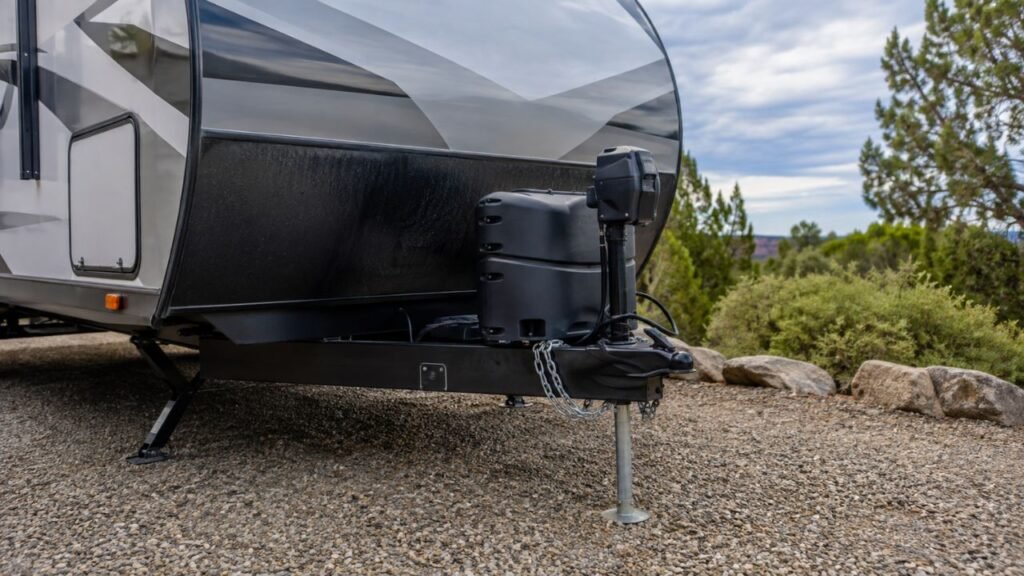
Your electric trailer jack may stop working because of a weak battery, blown fuse, poor ground, damaged wiring, faulty switch, excessive load, or jammed internal gears. Start with the battery and fuse before assuming the jack motor has failed.
I’ll walk you through each check in a practical order. You’ll also learn how to operate the jack manually and recognize serious mechanical damage.
Key Takeaways
- A working jack light does not confirm sufficient motor power.
- Check the trailer battery before replacing any jack components.
- Replace blown fuses only with the correct amperage rating.
- Many electric jacks ground through their mounting bolts.
- Rust or paint can interrupt the jack’s ground connection.
- Clicking often indicates low voltage or a jammed mechanism.
- Grinding usually suggests damaged gears or internal bearings.
- Never force the manual crank when the jack feels stuck.
- Support the trailer safely before removing or repairing the jack.
- Repeated fuse failures usually indicate a deeper electrical problem.
Quick Diagnosis: What Your Jack’s Symptoms Usually Mean
Your jack’s behavior can tell you where to begin troubleshooting. Use this table to narrow down the most likely problem.
| Jack symptom | Most likely cause | First thing to check |
| No light, sound, or movement | No power or blown fuse | Battery and inline fuse |
| Light works, but jack does not move | Weak voltage or poor ground | Battery under load |
| Jack clicks once | Weak connection or jammed motor | Terminals and ground |
| Jack clicks repeatedly | Voltage drops under load | Battery condition |
| Motor hums but does not move | Mechanical binding or overload | Manual override |
| Motor runs but leg stays still | Stripped internal gears | Gear assembly |
| Jack operates slowly | Low voltage or excessive resistance | Battery and wiring |
| Jack works only with the truck connected | Weak trailer battery | Battery and charging system |
| Jack works in only one direction | Faulty directional switch | Up-and-down switch |
| Fuse blows repeatedly | Short circuit or seized mechanism | Wiring and jack movement |
| Jack is stuck fully extended | Overextension or internal binding | Manual crank |
| Grinding noise appears | Damaged gears or bearings | Internal components |
Safety Checks Before Troubleshooting the Jack
Before touching the jack, make sure the trailer cannot move unexpectedly. A trailer tongue carries considerable weight and can cause serious injuries.
- Park on firm and reasonably level ground.
- Apply the tow vehicle’s parking brake.
- Chock the trailer wheels on both sides.
- Keep the coupler attached when stability is uncertain.
- Support the tongue before removing the jack.
- Disconnect battery power before opening electrical housings.
- Keep hands and feet away from the trailer tongue.
- Never crawl beneath an unsupported trailer.
- Wear eye protection when cleaning corroded terminals.
- Use only the fuse size specified by the manufacturer.
Do not continue operating a hot, smoking, or damaged jack. Disconnect its power and arrange proper inspection.
Start With the Trailer Battery
The battery is the most common reason an electric jack stops working. Even when other 12-volt accessories work, the jack may lack enough current.
Check the Battery’s State of Charge
A trailer jack motor requires considerably more power than a small light. Therefore, the jack’s utility light may operate while the motor remains completely still.
Check the trailer battery with a multimeter before replacing parts. A fully charged lead-acid battery commonly reads around 12.6 to 12.8 volts while resting.
However, the resting number does not reveal everything. A damaged battery may display normal voltage without handling a heavy load.
Press the jack switch while watching the meter. If voltage drops sharply, the battery may be discharged, worn out, or internally damaged.
Lithium battery voltage behaves differently from lead-acid voltage. Follow your battery manufacturer’s specifications when evaluating a lithium system.
Inspect the Battery Terminals
Loose or corroded battery terminals restrict current flow. That resistance becomes more noticeable when the jack motor starts working.
Inspect both positive and negative connections. Look for white powder, green corrosion, loose nuts, cracked terminals, or damaged cable ends.
Disconnect the negative cable first before cleaning the terminals. Reconnect the positive cable first when finishing the job.
Tighten each connection securely without damaging the terminal. Loose connections can create heat and cause intermittent jack operation.
Test the Jack With the Tow Vehicle Connected
Connect the trailer’s seven-pin plug to your tow vehicle. Start the engine, then test the jack without touching exposed wiring.
When the jack suddenly works, the trailer battery is probably weak. The battery may also be disconnected or failing to receive a charge.
This test does not prove every charging component works correctly. Some tow vehicle charge circuits deliver limited current through the seven-pin connector.
A missing fuse inside the tow vehicle can also disable that charge line. Check the vehicle’s manual before assuming the trailer battery is charging.
Check Whether the Battery Is Charging
A healthy battery will eventually discharge when nothing recharges it. Your trailer’s converter, solar controller, or tow vehicle charge line normally handles that job.
Check whether the battery disconnect switch is turned on. Some disconnect switches prevent the converter from charging the battery.
Plug the trailer into shore power and verify charging voltage. The exact reading depends on the battery type and converter charging stage.
If voltage never increases, inspect the converter and its protection devices. A qualified RV technician should inspect unfamiliar charging-system problems.
Check the Electric Trailer Jack Fuse or Circuit Breaker
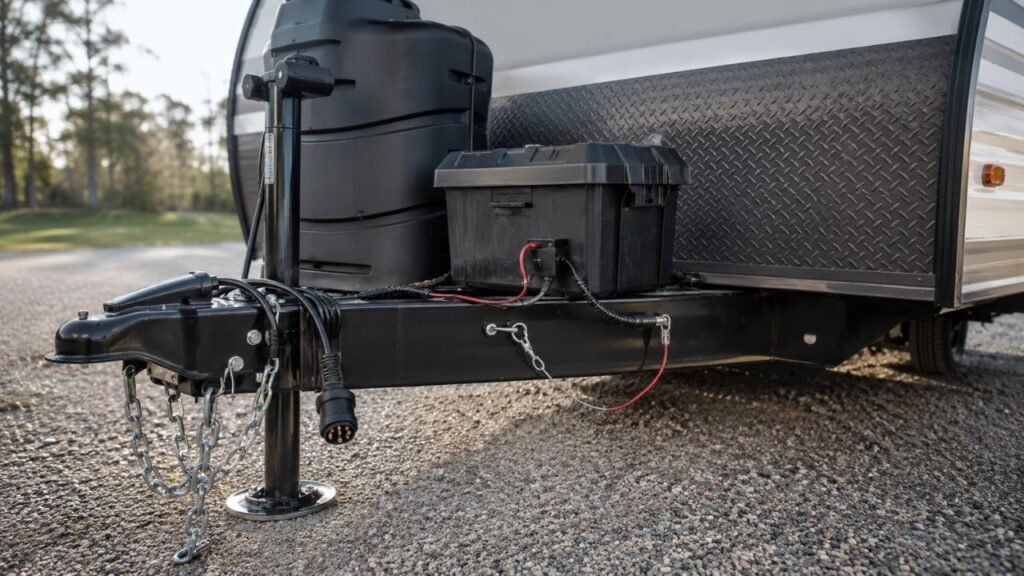
Most powered tongue jacks have an inline fuse or small breaker. It is normally installed along the positive wire near the trailer battery.
Find the Inline Fuse
Follow the jack’s power wire toward the battery. Look for a plastic fuse holder attached somewhere along that cable.
The holder may be tucked beneath the battery box. It may also be secured along the trailer’s A-frame.
Open the holder carefully and remove the fuse. Moisture and corrosion sometimes collect inside poorly sealed holders.
Inspect and Replace the Fuse Correctly
A blade fuse usually has a visible metal strip. A broken or burned strip means the fuse has opened.
A fuse can sometimes fail without appearing obviously damaged. Testing continuity with a multimeter provides a more reliable answer.
Replace it only with the same fuse type and amperage. Installing a larger fuse can overheat wiring before the fuse reacts.
Never bypass the fuse with wire or metal foil. That removes essential protection from the jack circuit.
Test a Resettable Circuit Breaker
Some installations use a small circuit breaker instead of a fuse. It normally has two threaded terminals marked battery and auxiliary.
Check both terminals for looseness, rust, heat damage, or melted insulation. Confirm voltage enters and exits the breaker.
A breaker can fail internally while still looking normal. Compare voltage on both sides while someone briefly operates the jack.
A large difference between the two sides indicates resistance. Replace the breaker with a correctly rated replacement.
Find Out Why the Fuse Keeps Blowing
Replacing one old fuse may solve the immediate problem. Repeated fuse failures usually mean something else is wrong.
Common reasons include:
- The jack has reached its full travel limit.
- The trailer’s tongue weight exceeds the jack’s capacity.
- The ram tube is bent or binding.
- Internal gears or bearings have seized.
- The positive wire is touching the trailer frame.
- Water has entered the motor or switch housing.
- A cable has been crushed against the A-frame.
- The motor is drawing excessive current.
- Someone previously installed the wrong fuse rating.
Do not keep installing new fuses without finding the cause. Repeated failures can eventually damage the switch, motor, or wiring.
Inspect the Jack’s Ground Connection
Many electric trailer jacks use only one visible power wire. Their negative connection travels through the jack’s mounting flange and trailer frame.
That design depends on clean metal-to-metal contact. Rust, paint, powder coating, dirt, or loose bolts can interrupt the ground path.
Inspect the jack’s mounting bolts and flange. Look for corrosion between the jack base and the trailer’s A-frame.
Disconnect battery power before loosening anything. Support the trailer tongue separately when working around jack mounting bolts.
Remove corrosion from the electrical contact areas without weakening the frame. Reinstall the jack securely using the manufacturer’s recommended fasteners and torque.
Some installations use a dedicated ground wire instead. Inspect its terminal, cable, frame connection, and battery connection carefully.
You can also perform a temporary ground test. Connect a suitable jumper between the jack housing and a verified battery negative point.
If the jack begins working, the original ground path needs attention. Install a permanent correction following the jack manufacturer’s instructions.
Inspect the Power Wire and Electrical Connections
A battery may be fully charged while power never reaches the motor. Damaged wiring and corroded connections commonly create this frustrating situation.
Trace the Positive Power Cable
Follow the cable from the jack head toward the battery. Inspect every visible section, connector, fuse holder, and breaker.
Look for:
- Split or missing insulation
- Pinched sections
- Melted areas
- Loose ring terminals
- Corroded crimps
- Sharp metal contact
- Previous temporary repairs
- Damaged fuse holders
Pay special attention where the cable passes around the A-frame. Normal towing vibration can slowly wear insulation against sharp edges.
Check for Corrosion Inside Connectors
A terminal may appear secure while corrosion hides beneath the insulation. Gently inspect crimped connectors for looseness or discoloration.
Green deposits usually indicate moisture has entered the copper strands. That contamination increases resistance and reduces available motor current.
Replace badly corroded connectors rather than simply cleaning their exterior. Use properly sized, weather-resistant connectors intended for automotive wiring.
Test for Voltage at the Jack
Set your multimeter to DC voltage. Place the negative probe on a known good ground.
Touch the positive probe to the jack’s power input. You should see battery voltage when the circuit is connected.
Next, operate the switch briefly while watching the reading. Voltage that disappears under load suggests a weak battery or high-resistance connection.
Keep loose clothing, fingers, and meter leads away from moving parts. Stop immediately if wiring becomes hot.
Perform a Voltage-Drop Test
A voltage-drop test finds resistance that basic continuity testing may miss. It tests the circuit while current is actually flowing.
Test the positive side between the battery positive terminal and jack input. Then test the ground side between the jack housing and battery negative.
A noticeable voltage drop points toward a bad cable, connection, fuse holder, breaker, or grounding surface.
Voltage-drop testing can become confusing without electrical experience. An RV technician can perform this test quickly and safely.
Why the Jack Light Works but the Motor Does Not
The jack’s built-in light uses very little electrical current. The lifting motor requires far more power when supporting the trailer.
A weak battery may still illuminate the light. Corroded terminals can also pass enough current for lighting but not lifting.
The same issue occurs with a poor frame ground. A small amount of power reaches the lamp, while the motor cannot receive enough current.
Do not use the light as your only power test. Check battery voltage, cable condition, fuse output, and grounding under load.
A working light with a silent motor may also indicate switch failure. However, confirm the external power supply before opening the jack housing.
Check the Up-and-Down Switch
The directional switch controls both extending and retracting. Dirt, corrosion, moisture, and worn contacts can prevent reliable operation.
Look for Dirt or Water Around the Switch
Inspect the switch boot and surrounding jack housing. A cracked rubber boot allows rainwater to reach the electrical contacts.
Road grime can also restrict switch movement. Clean the exterior gently without spraying water directly into the switch.
If water has entered the jack head, disconnect battery power. Allow a qualified technician to inspect the motor and wiring.
Test Both Directions
Operate the jack upward and downward briefly. Different results provide useful clues.
When one direction works normally, the battery and main power supply are probably functional. The switch may have failed on one internal contact.
However, mechanical loading changes between extending and retracting. A bent tube may bind more strongly in one direction.
Listen for clicking, humming, or motor noise. These sounds help separate an electrical switch issue from mechanical binding.
Inspect Loose Internal Connectors
Travel vibration can loosen small connectors inside the jack head. Loose spade terminals may create intermittent or one-direction operation.
Disconnect the trailer battery before removing any housing cover. Take clear photographs before disconnecting internal wiring.
Check for loose terminals, burned insulation, moisture, and melted connectors. Replace damaged connectors using correctly rated components.
Do not disturb sealed assemblies that the manufacturer does not service. Opening them may damage weather seals or affect warranty coverage.
Know When the Switch Needs Replacement
A switch may need replacement when power reaches its input but not the selected output.
The replacement must match the jack’s voltage and current requirements. A light-duty household switch is not suitable for this application.
Use an original switch or an approved equivalent. Incorrect wiring can reverse directions or create a short circuit.
Is the Trailer Jack Jammed or Overextended?
A jack with good electrical power may still refuse movement. Internal binding, overextension, or excessive load can stop the motor completely.
Check Whether the Jack Reached Its Travel Limit
Electric jacks have maximum extension and retraction limits. Continuing to hold the switch at either end can stress the motor.
Some models use limit switches. Others rely on mechanical stops or clutch systems.
Release the switch immediately when the jack stops moving. Do not continue pressing it while the motor hums.
Try moving the jack slightly in the opposite direction. This can sometimes release pressure from the mechanical stop.
Reduce the Load on the Jack
The jack must be strong enough for the trailer’s actual tongue weight. Its rating should also provide a reasonable safety margin.
A tongue jack does not lift the trailer’s entire weight. However, it may also lift part of the tow vehicle during hitching.
Raising the rear of the tow vehicle too far creates unnecessary strain. This practice can overload an otherwise suitable jack.
Support the tongue safely and reduce the load when possible. Then check whether the jack operates normally.
Inspect the Inner Tube for Bending
A bent inner tube may scrape, stick, or move unevenly. It can result from impact, towing while partly extended, or side loading.
Look along the tube from several angles. Check for dents, rust lines, unusual gaps, and polished scraping marks.
A bent tube should not be forced into the outer housing. Replacement is often safer than attempting to straighten a structural component.
Look for Dirt, Rust, and Lack of Lubrication
Exposed jack tubes collect dust, road salt, and moisture. This contamination can increase resistance and damage seals.
Clean the exposed tube according to the manufacturer’s instructions. Do not apply random grease because some products attract abrasive dirt.
Internal screw lubrication varies between jack models. Follow the manufacturer’s maintenance procedure rather than opening sealed components unnecessarily.
Troubleshooting the Jack by Sound
The sounds coming from your jack provide important diagnostic clues. Stop operating it when the noise becomes harsh or unusual.
- No sound: Check the battery, fuse, power cable, ground, and switch.
- One click: Look for weak voltage or a stuck motor.
- Repeated clicking: Check for voltage collapsing under load.
- Low humming: The motor may be overloaded or mechanically jammed.
- Grinding: Internal gears or bearings may be damaged.
- Free-spinning motor: A gear or drive pin may have failed.
- Motor slows gradually: Check battery strength and excessive tongue load.
- Buzzing near the breaker: Inspect loose or burned electrical connections.
- Popping fuse: Stop operating and check for a short circuit.
Do not repeatedly test a humming or grinding jack. Continued operation can turn a smaller repair into complete jack failure.
How to Manually Operate an Electric Trailer Jack
Most powered tongue jacks include a manual override. This feature lets you move the trailer when electrical operation fails.
- Park on firm ground and chock every trailer wheel.
- Keep the trailer coupled when additional stability is needed.
- Turn off or disconnect electrical power to the jack.
- Locate the manual override cover on the jack head.
- Remove the rubber or plastic protective plug.
- Insert the supplied crank handle or approved socket.
- Turn the handle slowly in the required direction.
- Reverse direction when the leg moves incorrectly.
- Stop when you feel severe resistance or binding.
- Retract the jack enough for safe towing or inspection.
- Remove the tool and reinstall the weather cover.
Cranking direction differs between jack models. Check the label or owner’s manual before applying significant force.
The crank should move with steady resistance. Severe binding may indicate a bent tube, seized screw, failed bearing, or broken gear.
Do not use a long breaker bar for extra leverage. Excessive force can strip gears or injure you when the tool releases.
Electric Trailer Jack Works Only When Connected to the Truck
When the jack works only with the truck connected, inspect the trailer battery first. The truck may be supplying enough extra voltage for operation.
The trailer battery could be discharged, disconnected, or worn out. Its terminals may also have corrosion or loose connections.
Check the battery disconnect switch if your trailer has one. A disconnect switch can isolate the battery while leaving certain circuits behaving differently.
The converter may also be failing to recharge the battery. Confirm charging after connecting the trailer to shore power.
Do not rely permanently on the tow vehicle for jack operation. A healthy trailer battery provides more dependable power at campsites and storage areas.
Electric Trailer Jack Clicks but Will Not Move
A clicking jack usually receives some electrical power. However, the motor may not receive enough current to start.
Begin with battery voltage and terminal condition. Then inspect the fuse holder, breaker, positive wire, and ground connection.
A jammed ram or overloaded jack can produce similar clicking. Try the manual override only after stabilizing the trailer.
When the manual crank moves normally, focus on electrical components. When it barely moves, suspect mechanical binding.
Avoid holding the switch during repeated clicking. That can overheat the switch, breaker, wiring, and motor.
Electric Trailer Jack Has Power but Will Not Extend or Retract
When the light and electrical supply appear normal, examine the switch and mechanical system. The exact symptom can narrow your next step.
The Jack Will Extend but Not Retract
A jack that extends normally but will not retract may have a failed directional switch contact.
Loose internal connectors can create the same problem. Water-damaged switch contacts are another common possibility.
Mechanical binding may also become worse while lifting the trailer. The motor works harder during retraction on many installations.
Support the trailer and test manual operation. Significant resistance suggests a mechanical problem rather than only a switch failure.
The Jack Will Retract but Not Extend
A jack that retracts but will not extend may have switch damage, wiring trouble, or limit-related binding.
Try operating it briefly in the working direction. Then attempt the failed direction again without holding the switch.
If the motor remains silent in one direction, inspect the switch circuit. If it hums, investigate mechanical binding or overload.
The Motor Runs but the Leg Does Not Move
A running motor with no leg movement usually indicates internal drive failure.
Possible causes include stripped gears, a broken drive pin, damaged couplers, or a disconnected screw mechanism.
Stop operating the motor once this symptom appears. Spinning damaged components may spread metal debris throughout the gearbox.
Some manufacturers sell replacement gear kits. Others recommend replacing the complete jack assembly.
Why the Electric Trailer Jack Moves Slowly
A slow jack is giving you an early warning. Correcting the cause now may prevent complete failure later.
Common causes include:
- A partially discharged trailer battery
- Loose battery terminals
- Corroded cable connections
- A damaged inline fuse holder
- A failing circuit breaker
- An unreliable frame ground
- Excessive tongue weight
- A bent inner tube
- Dirt on the exposed tube
- Dry internal gears or screw components
- Thick lubricant during cold weather
- A worn motor or bearing assembly
- An undersized replacement cable
- Heat buildup after repeated operation
Test the battery while the jack is moving. A large voltage drop usually points toward battery weakness or electrical resistance.
Stop the jack if speed suddenly decreases. Continuing under heavy strain can overheat the motor and damage the gears.
Can Cold Weather Stop an Electric Trailer Jack From Working?
Cold weather reduces a battery’s available performance. It can also make internal grease thicker and increase mechanical resistance.
A battery that worked during summer may struggle during freezing weather. Test and charge the battery before blaming the jack motor.
Clear ice and packed snow from the jack tube. Never use an open flame to thaw any jack component.
Operate the switch in short intervals. Stop when the motor slows, clicks, or sounds strained.
Can Rain or Water Damage an Electric Trailer Jack?
Electric jacks are designed for outdoor use, but they are not indestructible. Damaged covers and seals can allow water inside.
Inspect the manual override plug and switch boot regularly. Replace missing, cracked, or hardened protective pieces.
Water inside the switch can cause intermittent operation. Moisture inside the motor or gearbox may create corrosion and grinding.
A weather cover can provide extra protection during storage. Make sure it does not trap condensation around the jack head.
Never pressure-wash the motor housing or directional switch. High-pressure water can bypass seals and reach internal electrical parts.
When Should You Repair or Replace the Electric Trailer Jack?
Simple wiring and connection problems are often inexpensive to repair. Structural or internal failures may make replacement more practical.
| Jack condition | Repair may make sense | Replacement may be better |
| Blown fuse | Yes, after finding the cause | Rarely |
| Corroded battery connection | Usually | No |
| Loose mounting ground | Usually | No |
| Damaged power cable | Usually | When damage enters the motor |
| Faulty switch | Often | When parts are unavailable |
| Failed circuit breaker | Usually | No |
| Broken weather cover | Usually | When major water damage exists |
| Stripped internal gears | When a rebuild kit exists | Often |
| Bent inner tube | Sometimes | Usually |
| Water-damaged motor | Occasionally | Usually |
| Cracked jack housing | Rarely | Usually |
| Repeated internal failures | Possibly | More practical |
| Undersized jack | No lasting repair | Install a properly rated jack |
Replacement often makes sense when several components have failed. A newer jack may also offer better weather sealing and load capacity.
Choose a replacement based on actual tongue weight, mounting dimensions, lift height, and electrical requirements.
Do not select a jack based only on trailer weight. The jack supports tongue load, but adequate capacity still matters.
How to Prevent Electric Trailer Jack Problems
A few routine checks can greatly improve jack reliability. Most preventive work takes only several minutes.
- Keep the trailer battery properly charged.
- Test older batteries before long trips.
- Clean battery terminals before corrosion becomes severe.
- Tighten jack mounting bolts periodically.
- Maintain a clean grounding connection.
- Inspect the positive cable along the entire A-frame.
- Protect wiring from sharp edges and moving components.
- Keep the fuse holder sealed against moisture.
- Replace cracked switch boots and override covers.
- Stop pressing the switch at full extension.
- Stop pressing the switch at full retraction.
- Avoid lifting the tow vehicle unnecessarily high.
- Stay within the jack’s rated lifting capacity.
- Retract the jack completely before towing.
- Clean the exposed inner tube regularly.
- Follow the manufacturer’s lubrication schedule.
- Carry the manual crank handle inside the trailer.
- Keep correctly rated spare fuses available.
- Listen for changes in speed or motor sound.
- Correct slow movement before complete failure develops.
I also recommend testing the manual override before each travel season. You do not want to discover a missing crank during an emergency.
Final Verdict
When your electric trailer jack stops working, begin with the simple checks. Test the battery, inspect the fuse, and confirm a reliable ground connection.
Next, examine the wiring, breaker, and directional switch. These areas cause many failures that look like a bad motor.
Clicking, humming, grinding, repeated blown fuses, or severe manual resistance need closer attention. These symptoms may indicate overload, binding, or internal mechanical damage.
Do not force a stuck jack or work beneath an unsupported trailer. When the jack cannot safely hold or move the tongue, arrange professional service.
Related FAQs
Why Does My Electric Trailer Jack Have No Power?
A completely inactive jack usually has a dead battery, blown fuse, disconnected cable, failed breaker, poor ground, or damaged positive wire. Check battery voltage first, then follow the power cable toward the jack.
Why Does My Trailer Jack Light Work but Not the Motor?
The small light needs much less current than the jack motor. A weak battery, corroded terminal, or poor ground may power the light while preventing the motor from starting.
Where Is the Fuse for an Electric Trailer Jack?
The fuse is usually inside an inline holder on the jack’s positive wire. Look near the battery box or along the trailer’s A-frame.
Why Does My Electric Trailer Jack Keep Blowing Fuses?
Repeated fuse failures may indicate an overloaded jack, shorted wire, bent ram, seized gears, water-damaged motor, or operation beyond the jack’s travel limit.
Can I Run My Electric Trailer Jack From the Tow Vehicle?
The jack may operate while connected to a running tow vehicle, but charging circuits vary. Treat this as a temporary diagnostic test rather than a replacement for a healthy trailer battery.
Can I Use a Higher-Amp Fuse in My Trailer Jack?
No. A larger fuse can allow the wiring to overheat before protection activates. Always install the fuse type and amperage specified by the jack manufacturer.
Why Does My Electric Trailer Jack Only Click?
Clicking commonly results from weak voltage, loose terminals, poor grounding, a jammed ram, excessive tongue load, or a motor that cannot start.
How Do I Reset an Electric Trailer Jack?
Most electric jacks do not have a universal reset procedure. Disconnect power briefly, inspect the fuse or breaker, and follow the instructions provided for your specific jack model.
Can I Manually Crank an Electric Trailer Jack?
Most electric trailer jacks include a manual override. Stabilize the trailer, disconnect power, insert the correct crank, and turn slowly without forcing a jammed mechanism.
Why Is My Electric Trailer Jack Stuck Fully Extended?
The jack may have reached its mechanical limit, overloaded its motor, bent its tube, or jammed its internal screw. Try the manual override carefully after supporting the trailer.
How Do I Know If the Trailer Jack Motor Is Bad?
A failed motor may remain silent despite receiving proper power and ground. Burning smells, overheating, internal clicking, or failure after direct electrical testing also suggest motor damage.
Can a Poor Ground Stop an Electric Trailer Jack?
Yes. Many jacks ground through their mounting flange and bolts. Rust, paint, corrosion, or loose hardware can interrupt that electrical path.
Should I Lubricate an Electric Trailer Jack?
Lubrication requirements vary between models. Clean the exposed tube and follow the manufacturer’s instructions before adding grease or opening any sealed gearbox.
How Long Does an Electric Trailer Jack Usually Last?
Service life depends on load, weather exposure, maintenance, and operating habits. Proper capacity, clean connections, weather protection, and avoiding overextension can significantly improve longevity.
Can I Replace an Electric Trailer Jack Myself?
Many owners can replace a bolt-on jack using basic tools. However, the trailer tongue must be securely supported, and the replacement must match the mounting pattern, capacity, lift, and electrical requirements.

Scott Miller shares real-world RV road trip insights built from years of traveling open highways and backroads. He covers route planning, campground choices, and travel gear with a practical mindset. His content is written for RVers who value reliability over trends.