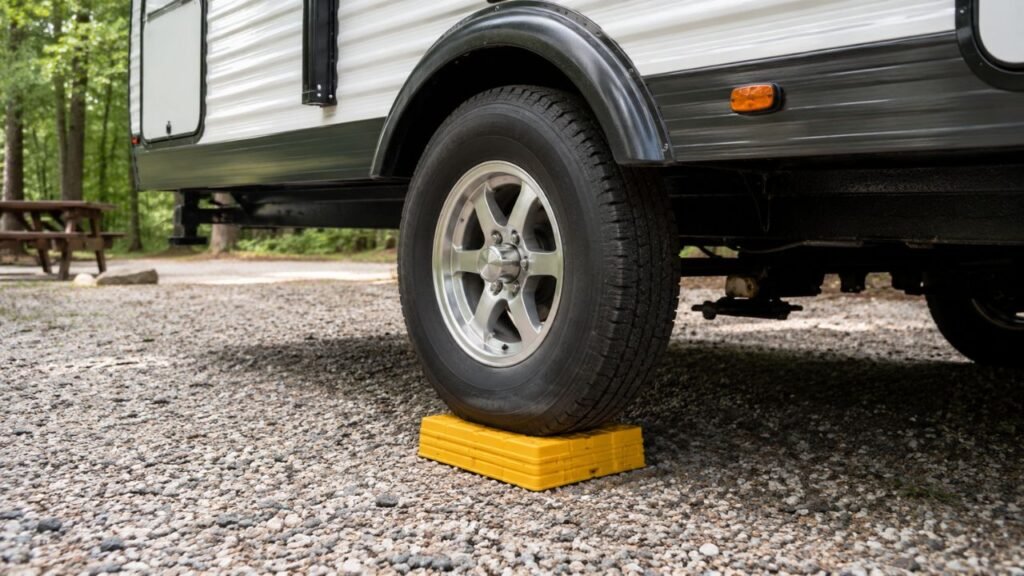
No, trailer tires should not hang unsupported over leveling blocks. The tire’s loaded tread and contact area should sit flat and securely on the leveling surface. A little natural sidewall bulge beyond the block is usually different from having actual tread hanging over the edge.
If your tire looks too wide for your blocks, I’ll help you figure out what is safe. We’ll cover proper tire support, block width, tandem axles, common mistakes, and simple ways to correct an unsafe setup.
Key Takeaways
- Keep the loaded tire tread fully supported by the leveling block.
- A small sidewall bulge is not necessarily dangerous overhang.
- Do not let a block edge press directly into the sidewall.
- Center each trailer tire on the leveling surface whenever possible.
- Use wider blocks when your existing blocks barely fit the tire.
- Support both tires properly when leveling a tandem-axle trailer.
- Never use bricks, loose stones, or unstable objects for leveling.
- Reposition the trailer if a tire sits too close to an edge.
Can Trailer Tires Hang Over Leveling Blocks?
Trailer tires should not sit with part of their loaded tread hanging unsupported from a leveling block. Ideally, the entire contact area rests on a flat surface.
However, there is an important distinction here.
Your tire may look slightly wider than the block because its sidewall naturally bulges near the ground. That does not automatically mean the tire is improperly supported.
What I would look at first is the tread.
If the tread contacting the ground is fully supported, the tire is centered, and no sharp edge is pushing into the sidewall, the setup may be perfectly fine.
The problem begins when actual tread extends beyond the support surface. That concentrates more trailer weight onto a smaller portion of the tire.
I would reposition the trailer rather than leave it that way.
How Much of the Trailer Tire Should Be Supported?
Your goal is simple: give the loaded part of the tire a flat, stable platform. You also want enough extra width that small positioning errors do not leave the tire hanging from an edge.
The Tread Should Sit Fully on the Block
The tread carrying your trailer’s weight should sit completely on the leveling surface.
You do not want two-thirds of the tread supported while the remaining section hangs in the air.
That creates uneven pressure across the tire.
A wider support surface spreads the load more evenly. It also makes positioning the trailer much easier.
I normally prefer having a little extra block width beyond the tread. That way, you are not trying to park the tire perfectly within a very narrow target.
Sidewall Bulge Is Not the Same as Tire Overhang
This is where the setup sometimes looks worse than it actually is.
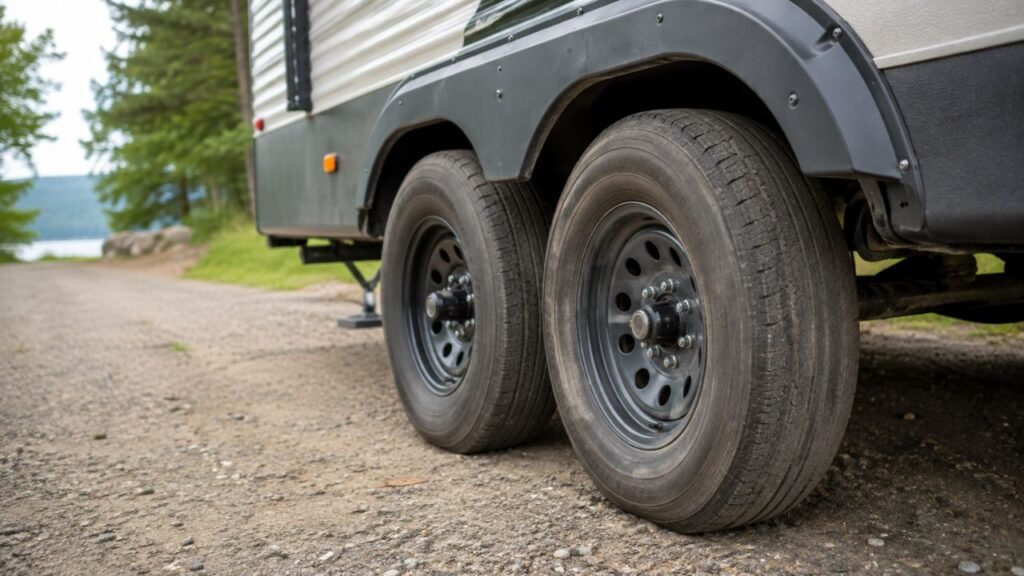
Trailer tires naturally deform slightly under load. The lower sidewall can bulge outward beyond the edge of the tread.
You may therefore see rubber extending slightly past the leveling block.
That does not necessarily mean the tire lacks support.
Instead, check where the tread contacts the block.
If that contact area sits flat and fully supported, minor sidewall bulging is generally different from actual tread overhang.
What I would avoid is having the edge of a block dig directly into the sidewall.
Centering the Tire Matters
Try to position each tire near the middle of the leveling block.
Centering gives you some extra room on both sides. It also reduces the chance of a tire moving off the edge.
Remember that your trailer may settle after parking.
The suspension can relax slightly. Soft soil can also compress under the blocks.
That small amount of movement matters much more when the tire already sits near an edge.
What Happens If a Trailer Tire Hangs Over a Leveling Block?
An unsupported portion of tread changes how the tire carries weight. The situation does not guarantee immediate damage, but it creates unnecessary stress and reduces your safety margin.
Increased Sidewall Stress
A leveling block should support the tire from underneath.
It should not act like a hard edge pushing upward into one portion of the tire.
If the tire sits partially off the block, the edge can create a concentrated pressure point.
That becomes more concerning when the contact occurs near the sidewall.
Trailer tires already carry substantial loads while parked. There is no benefit to adding unnecessary localized stress.
Uneven Tire Loading
Your tire is designed to spread its load across a contact patch.
When part of that contact patch hangs over a block, the supported section has to carry more of the load.
You may notice the tire deform differently on one side.
A brief positioning mistake does not automatically ruin the tire. Still, I would correct the setup before leaving the trailer parked.
Greater Chance of Slipping
A tire sitting near an edge has less room for movement.
That matters because trailers are rarely completely motionless.
People walking inside can create movement. Tanks changing weight can affect loading. Suspension components can also settle.
Soft ground may compress underneath the blocks.
If the tire is centered, these small changes usually leave plenty of room.
If it is already hanging over an edge, they can become a problem.
Leveling Blocks Can Tilt or Shift
The tire is not the only thing affected by poor positioning.
Putting most of the load near one edge of a block may cause that block to tilt.
Stackable plastic blocks are especially dependent on proper alignment.
The lower blocks also need solid ground underneath them.
If the stack starts leaning sideways, I would lower the trailer and rebuild it rather than trying to straighten individual blocks while they are loaded.
Possible Damage to the Leveling Block
Uneven loading can also increase stress on the leveling block itself.
Plastic blocks may crack when the load becomes concentrated near an unsupported edge.
Wood can split or crush.
This becomes more likely when blocks sit on rocks or uneven ground.
The safest setup spreads the load across both the tire and the leveling surface.
Trailer Tire Support: Safe vs Unsafe Setups
You can usually identify a good setup with a quick visual inspection. I use the tire tread, block position, sidewall clearance, and stability of the stack as the main checkpoints.
| Trailer Tire Setup | Recommended? | Why |
| Entire tread centered on block | Yes | Provides stable and even support |
| Slight sidewall bulge beyond block | Usually | Normal tire deformation can extend beyond tread |
| Small section of tread hanging over | No | Reduces full support beneath the tire |
| Block edge pushing into sidewall | No | Creates concentrated pressure |
| Tire sitting at extreme block edge | Avoid | Leaves little margin for movement |
| Block wider than tire tread | Ideal | Makes positioning and support easier |
| Tire sitting diagonally across block | No | Creates uneven loading |
| Tandem tire only partly supported | No | Can create inconsistent support |
Do not judge the setup only by whether some rubber extends beyond the block. Look at the actual tread contacting the leveling surface.
That is the part carrying the load.
How Wide Should Trailer Leveling Blocks Be?
There is no single leveling-block width that fits every trailer tire. Tire sizes, tread widths, axle loads, and leveling systems all vary. Your blocks should comfortably support your particular tires.
Measure Your Trailer Tire First
Start by checking your trailer tire size.
However, do not assume the width printed on the sidewall equals the exact tread width.
Those numbers describe tire dimensions according to the tire’s sizing system. They are not necessarily a direct measurement of the contact patch.
If you are buying new leveling blocks, physically measure your tire’s tread.
Then compare that measurement with the usable surface of the block.
Choose Blocks Wider Than the Tire Contact Area
I prefer a leveling surface slightly wider than the tire’s loaded tread.
That extra width gives you room for positioning errors.
You do not have to repeatedly move the trailer forward and backward trying to land on one exact spot.
Wider support also becomes helpful on uneven campsites.
Just remember that very wide blocks still need to remain flat.
Width does not compensate for poor ground underneath them.
Check the Leveling Block Weight Rating
Block width is only part of the decision.
You also need adequate load capacity.
Check the manufacturer’s rating for the leveling system you are using.
Pay attention to:
- Maximum supported weight
- Recommended stacking arrangement
- Maximum stacking height
- Tire size compatibility
- Number of blocks required
- Surface requirements
Do not assume that adding more lightweight blocks automatically creates a stronger platform.
Use the product within its intended limits.
What If My Leveling Blocks Are Too Narrow?
If your tire barely fits the blocks, I would fix the support surface instead of accepting overhang. Fortunately, there are several easy solutions.
- Replace your blocks with wider leveling blocks.
- Use wider purpose-built leveling ramps.
- Carry sturdy boards sized for your trailer tires.
- Build a broader base beneath compatible stackable blocks.
- Reposition the trailer when the tire lands near an edge.
- Carry different block sizes for difficult campsites.
- Check tire width before buying another leveling system.
- Avoid bricks, concrete blocks, and loose stones.
Sometimes the easiest solution is simply carrying one or two wider boards.
They can provide a larger footprint when the campsite surface makes your smaller blocks difficult to position.
Whatever you use, make sure it can safely carry the trailer’s load.
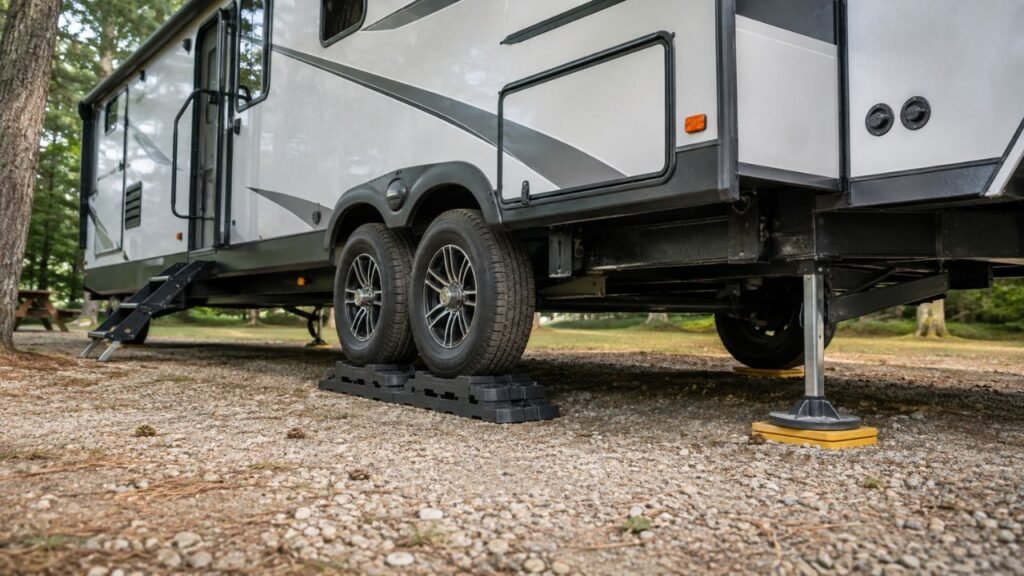
Can I Put Leveling Blocks Under Only Part of a Tandem-Axle Trailer Tire?
I would not intentionally position a tandem-axle trailer tire so only part of its tread sits on a leveling block.
The same basic rule still applies.
Each tire being raised should have a stable support surface beneath its loaded tread.
Tandem-axle trailers add another consideration because the suspension distributes weight between two axles.
Changing the height under one wheel can affect the loading of the neighboring wheel through the equalizer and suspension system.
That does not mean both tires always carry exactly equal weight. It means you should avoid creating an improvised setup that leaves one tire poorly supported.
When you are leveling one side of a tandem trailer, I recommend planning enough blocking for the tires being raised.
If you use a specialized ramp or leveling system, follow its specific instructions.
Should Both Tandem-Axle Tires Be on Leveling Blocks?
When you raise one side of a tandem-axle trailer, both tires on that side usually need appropriate support. The exact arrangement depends on your suspension and the type of leveling system being used.
When Raising One Side of the Trailer
Suppose the driver’s side of your trailer sits two inches lower.
You normally want to raise that side while maintaining stable support beneath the tires.
Using appropriately sized blocks under both tires creates a predictable platform.
I would not intentionally leave one tire partly supported while concentrating the leveling load beneath the other.
When Using Curved Leveling Ramps
Curved leveling ramps work differently from traditional stacked blocks.
You slowly drive onto the ramp until the trailer reaches the desired height.
Some systems use a separate ramp for each tire.
Others are designed around particular axle configurations.
Follow the instructions for your specific system because maximum height and positioning can vary considerably.
Watch the Space Between Tandem Tires
Before buying large ramps, check the distance between your tandem tires.
Some trailers have very little space between them.
A leveling ramp that works perfectly on a single-axle trailer may not physically fit between closely spaced tandem tires.
Measure first.
It can save you from carrying an expensive leveling system you cannot actually use.
Can Trailer Tires Sit on the Edge of Leveling Blocks Overnight?
I would reposition a trailer tire before leaving it sitting on the edge of a leveling block overnight.
The trailer may seem completely stable when you first park.
That can change after several hours.
Occupants walking around inside shift small amounts of weight. Fresh and waste tanks also change trailer loading.
The suspension can settle after towing.
Ground beneath the blocks may also compress.
None of these changes are normally dramatic.
The problem is that a tire already sitting on the edge has very little room available for additional movement.
Move the trailer a few inches and center the tire before settling in for the night.
It is a much easier fix.
How to Properly Position Trailer Tires on Leveling Blocks
Correct positioning does not require complicated equipment. Slow movements and careful block placement make the biggest difference.
- Check the trailer from side to side first.
- Determine which side needs to be raised.
- Estimate how much additional height you need.
- Place the leveling blocks on firm ground.
- Align the blocks with the tire path.
- Build the stack according to its instructions.
- Slowly pull or back onto the blocks.
- Stop when each tire is centered.
- Check that the tread is fully supported.
- Apply the tow vehicle’s parking brake.
- Chock the trailer wheels securely.
- Recheck the trailer’s level.
- Inspect the blocks for leaning or movement.
- Recheck everything after the trailer settles.
Take your time when driving onto the blocks.
A few inches can make the difference between a properly centered tire and one sitting partly off the edge.
Also remember that stabilizer jacks are not supposed to correct poor wheel positioning.
Level the trailer first.
Then use the stabilizers to reduce movement.
How Can You Tell If a Tire Is Too Close to the Block Edge?
A quick visual inspection usually tells you whether the tire needs repositioning. Look at the tread, sidewall, leveling stack, and how squarely the wheel sits on the block.
- Tread is visibly extending beyond the block.
- The block edge contacts the tire’s sidewall.
- The tire sits diagonally across the block.
- One side of the tire appears heavily compressed.
- Plastic blocks are noticeably flexing.
- The leveling stack leans sideways.
- Blocks separate or shift under the tire.
- One tandem tire sits differently from the other.
- The trailer rocks enough to move the tire.
- The support surface underneath the blocks is sinking.
If something looks questionable, reposition it.
You should not need to convince yourself that a leveling setup is probably safe.
A good setup should look stable and properly supported.
Are Wood Boards Better for Wide Trailer Tires?
Wood boards can work very well when you need a wider leveling surface.
Many trailer owners carry lumber because it is simple, inexpensive, and easy to size for their tires.
A wide board also gives you a larger target when backing onto the leveling platform.
That can be particularly useful with wide trailer tires.
However, wood has disadvantages.
It absorbs moisture and can become heavy.
Old boards may split around knots. Repeated exposure to rain can also weaken untreated lumber.
Inspect boards regularly.
Do not use pieces with deep cracks, rot, protruding screws, nails, or sharp splinters.
Wood is not automatically safer than plastic.
A good board works because it is strong, wide, flat, and properly supported.
Plastic Leveling Blocks vs Wood for Tire Support
Both plastic blocks and wood can safely support trailer tires when used correctly. The better option usually depends on tire width, storage space, campsite conditions, and your leveling habits.
| Feature | Plastic Leveling Blocks | Wood Boards |
| Weight | Usually lighter | Usually heavier |
| Storage | Compact | Takes more room |
| Stackability | Excellent | Moderate |
| Width | Product dependent | Easily customized |
| Water resistance | Usually very good | Can absorb moisture |
| Ground grip | Design dependent | Surface dependent |
| Cracking risk | Possible under improper loading | Can split or crush |
| Tire positioning | Easy with wider designs | Easy with wide boards |
| Cost | Varies | Usually inexpensive |
| Long-term durability | Good when properly used | Depends on wood condition |
I would choose based on proper support rather than material alone.
A wide, correctly rated plastic block is better than a weak board.
A strong, appropriately sized board may be better than a plastic block that is too narrow.
Does Tire Pressure Affect How the Tire Sits on Leveling Blocks?
Yes, tire pressure affects tire shape, but you should never change pressure just to make a tire fit your leveling blocks.
A properly inflated trailer tire still has some natural deflection under load.
That is normal.
An underinflated tire can flex considerably more at the sidewall.
It may also create a wider-looking footprint.
That does not make it safer on a narrow leveling block.
Instead, maintain the tire pressure appropriate for your tire and trailer loading.
Then choose leveling blocks large enough for the tire.
If your only way to fit the tire onto the block is changing tire pressure, the block is the part I would replace.
Can Leveling Blocks Damage Trailer Tires?
Properly sized and correctly positioned leveling blocks should not normally damage healthy trailer tires. Problems usually come from sharp edges, broken blocks, poor positioning, or unsuitable materials.
Sharp or Broken Block Edges
Inspect plastic leveling blocks before using them.
A cracked block may develop sharp edges.
Those damaged areas should not contact the tire.
I would replace badly cracked blocks rather than continue stacking them.
Damage can reduce their ability to distribute weight correctly.
Rough or Splintered Wood
Wood deserves the same inspection.
Look for:
- Protruding nails
- Exposed screws
- Sharp splinters
- Broken corners
- Deep cracks
- Rot
- Embedded stones
Sweep loose debris from the board before driving onto it.
A tiny sharp object becomes much more significant when thousands of pounds press a tire against it.
Leaving Tires Improperly Supported Long Term
Good support becomes even more important during long-term parking.
If your trailer will remain stationary for weeks or months, make sure each tire sits flat and securely.
Do not leave tread hanging over an edge for extended periods.
Check the support occasionally.
Soil conditions can change after heavy rain or repeated freeze-thaw cycles.
Even a setup that started perfectly can shift over time.
Common Trailer Leveling Block Mistakes
Most leveling problems come from a few repeat mistakes. Avoid these and your setup becomes much easier to manage.
- Using blocks narrower than the tire tread.
- Leaving part of the tread unsupported.
- Parking the tire at the extreme edge.
- Driving onto leveling blocks too quickly.
- Creating unnecessarily tall stacks.
- Stacking blocks incorrectly.
- Using cracked or damaged plastic blocks.
- Placing blocks on loose soil.
- Using bricks as leveling supports.
- Forgetting wheel chocks.
- Using stabilizer jacks to level the trailer.
- Ignoring tandem tire spacing.
- Exceeding the block’s load rating.
- Letting block edges contact the tire sidewall.
- Assuming a level trailer is automatically safely supported.
I always separate leveling from stabilizing.
Your tires and leveling blocks establish the trailer’s height.
Your stabilizers simply reduce movement after the trailer is already level.
When Should You Reposition the Trailer?
Reposition the trailer whenever you cannot clearly tell that the tire is properly supported.
I would move it if the tread hangs off the block.
The same goes for a tire sitting at an extreme edge.
Also reposition the trailer if the block stack begins leaning or shifting.
Do not ignore a block edge pressing into the sidewall.
For tandem trailers, check every tire on the raised side.
One properly positioned tire does not make up for another one sitting poorly.
Moving the trailer forward or backward a few inches may seem annoying after you have finally found your campsite.
Still, it is much easier than dealing with a damaged block or unstable trailer later.
Final Verdict
Trailer tires should not hang unsupported over leveling blocks.
The loaded tread should sit flat and securely on the support surface. I also recommend centering the tire so you have some extra room on both sides.
Do not confuse normal sidewall bulging with actual tread overhang.
Seeing a little sidewall beyond the block may be normal. Seeing tread hanging unsupported is your signal to reposition the trailer or use wider blocks.
If your existing blocks barely accommodate your tires, I would upgrade the support rather than repeatedly trying to land the wheel on the perfect spot.
A wider, stable leveling surface makes setup easier and gives you much more confidence once the trailer is parked.
Related FAQs
Is It Okay If My Trailer Tire Sticks Out Slightly Past the Leveling Block?
A small amount of sidewall bulge beyond the leveling block can be normal, but the loaded tread should remain properly supported. Reposition the trailer if actual tread hangs over the edge.
Should Leveling Blocks Be Wider Than Trailer Tires?
Leveling blocks should provide enough usable width to support the tire’s loaded tread comfortably. Having some extra width makes positioning easier and provides additional margin around the tire.
Can Trailer Tires Sit Halfway on a Leveling Block?
No. You should not intentionally park a trailer with only half its tire tread supported. Use wider blocks or reposition the trailer so the loaded tread sits fully on the leveling surface.
Can I Use a 2×8 Board to Level a Travel Trailer?
A suitable 2×8 board may work for some trailers if it provides enough width and strength for the tire and load. Inspect the board for cracks, rot, splinters, and other damage before use.
Can I Stack Leveling Blocks Under Trailer Tires?
Yes, stackable leveling blocks are designed for this purpose when used according to their instructions. Stay within the manufacturer’s height, load, and stacking limits.
Should Both Tires Be Supported on a Tandem-Axle Trailer?
When raising one side of a tandem-axle trailer, each tire being lifted should have appropriate support. Follow your particular leveling system’s instructions when using ramps or specialized equipment.
Can Leveling Blocks Cause Tire Blowouts?
Properly used leveling blocks should not normally cause tire blowouts. Problems become more likely when damaged blocks, sharp edges, severe overhang, improper inflation, or existing tire damage are involved.
How Do I Keep My Trailer From Rolling Off Leveling Blocks?
Center the tires carefully, place the blocks on firm ground, move onto them slowly, and install proper wheel chocks once the trailer reaches the correct position.
Can I Leave My Trailer on Leveling Blocks for a Week?
Yes, a trailer can remain on properly rated leveling blocks when the tires are securely supported and the ground remains stable. Check the setup occasionally for settling or movement.
Are Leveling Ramps Safer Than Stackable Blocks?
Both systems can work safely. The better choice depends on your tire size, axle spacing, campsite surface, required leveling height, and how correctly you use the equipment.

Scott Miller shares real-world RV road trip insights built from years of traveling open highways and backroads. He covers route planning, campground choices, and travel gear with a practical mindset. His content is written for RVers who value reliability over trends.