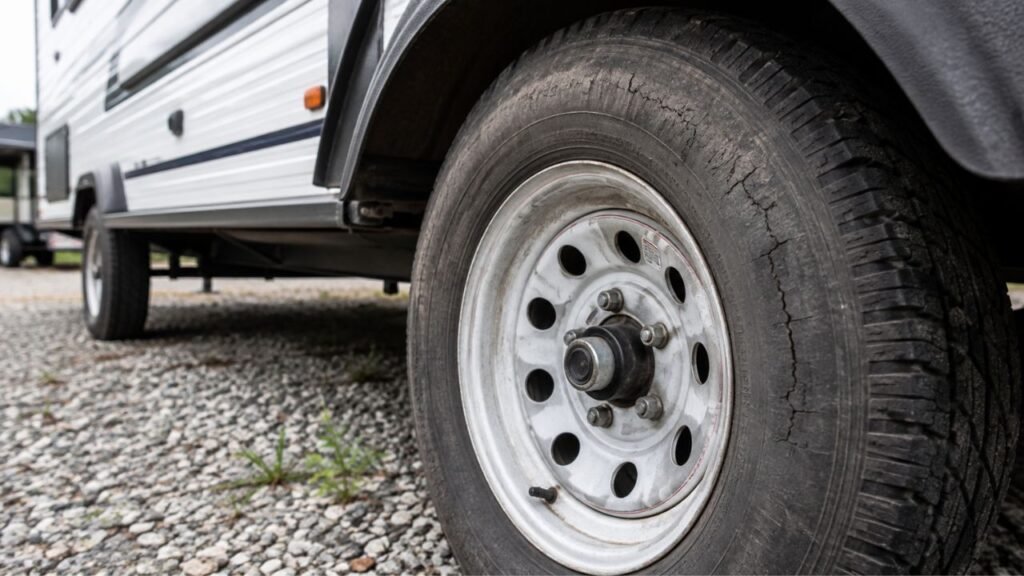
Trailer tires often crack early because they spend long periods parked while sunlight, heat, oxygen, ozone, and changing temperatures continue aging the rubber. Low tire pressure, heavy loads, poor storage, and excessive towing heat can make that deterioration happen even faster.
The frustrating part is that a cracked trailer tire may still have plenty of tread. Below, I’ll help you understand why that happens, how to judge the cracks you find, when replacement makes sense, and what you can do to help your next set last longer.
Key Takeaways
- Trailer tires commonly age before their tread actually wears out.
- Long periods of storage can contribute to premature rubber cracking.
- Direct sunlight and high temperatures accelerate tire deterioration.
- Underinflation creates excess sidewall flex and damaging internal heat.
- Deep sidewall cracks, bulges, or exposed cords should not be ignored.
- Good tread depth does not automatically mean a trailer tire is safe.
- Tire covers can reduce UV exposure during outdoor storage.
- Proper pressure, loading, storage, and inspection can extend tire life.
- Check tire age using the manufacturing date molded into the sidewall.
- Replace questionable tires before highway towing rather than testing them under load.
Why Do Trailer Tires Crack So Early?
The biggest reason trailer tires seem to crack surprisingly early is simple: trailers usually spend far more time sitting than moving.
Your tow vehicle may be driven almost every day. Its tires regularly flex, heat slightly, cool down, and move through different contact positions.
Your travel trailer, boat trailer, cargo trailer, or utility trailer could sit in exactly the same position for several months.
Meanwhile, the tires remain exposed to:
- Oxygen
- Ozone
- Sunlight
- Heat
- Cold
- Moisture
- Trailer weight
Rubber does not stop aging simply because the trailer is parked.
That is why I would never judge trailer tire condition by mileage alone.
A tire with only 3,000 miles can potentially be in worse condition than another tire with considerably more mileage but better storage and maintenance.
Trailer tires commonly reach an age-related limit before they reach a tread-wear limit.
What Actually Happens to Trailer Tire Rubber as It Ages?
Trailer tire cracking makes more sense once you understand what is happening inside the rubber. You do not need to know tire chemistry in detail, but three basic changes explain most age-related cracking.
Rubber Loses Flexibility Over Time
Fresh tire rubber is designed to remain flexible while supporting considerable weight.
As the tire gets older, exposure to oxygen, heat, ozone, and environmental conditions gradually changes the rubber.
It can become harder and less elastic.
Once that happens, the sidewall cannot tolerate repeated flexing as comfortably as it once could.
Small surface imperfections can then begin developing into visible cracks.
Protective Compounds Gradually Reach the Tire Surface
Tire rubber contains protective ingredients intended to slow damage caused by oxygen and ozone.
Normal tire flexing can help some protective compounds migrate toward the outer rubber.
That does not mean driving your trailer will somehow make an old tire new again.
It simply means a regularly used tire experiences a different aging environment than one sitting motionless outside for months.
Once rubber has already become badly cracked, normal use cannot reverse that damage.
Tiny Surface Cracks Can Become Structural Cracks
Early weather checking may begin as thin lines that barely seem noticeable.
Time, heat, loading, and repeated flexing can make those cracks grow.
A small crack is not automatically an immediate failure.
However, cracks becoming wider, deeper, more numerous, or appearing alongside bulges and pressure loss deserve much more attention.
That is why inspecting tire condition regularly matters more than waiting for the tread to disappear.
The Most Common Causes of Premature Trailer Tire Cracking
Trailer tire cracking usually comes from several factors working together rather than one isolated problem. Here are the conditions I would check first if your tires seem to be aging unusually fast.
Long Periods of Inactivity
Many trailers spend most of their lives parked.
A camper might be used six weekends annually. A boat trailer may sit throughout winter. A utility trailer could remain parked until another hauling job appears.
During that time, the tires remain under load without regular movement.
Long storage periods also mean more continuous exposure to environmental aging.
This is one reason extremely low-mileage trailer tires can still develop noticeable cracking.
UV Exposure From Direct Sunlight
Sunlight is particularly hard on exposed tire rubber.
Ultraviolet radiation gradually attacks the surface and contributes to weather checking and hardening.
You may even notice that tires exposed to afternoon sun look worse than tires on the shaded side of the trailer.
If your trailer spends months outdoors, UV protection should be part of your storage routine.
A basic tire cover cannot stop natural aging, but reducing direct sunlight certainly helps.
High Temperatures and Repeated Heat Cycles
Heat speeds up many processes that age rubber.
A trailer stored on hot pavement during summer can experience significant tire temperatures before it even moves.
Then towing adds another source of heat.
As the tire rotates, its sidewall flexes repeatedly. That flex generates heat inside the tire.
Normally, a properly loaded and inflated tire handles this.
Problems begin when high speed, low pressure, excessive weight, or existing deterioration pushes temperatures higher.
Ozone and Air Exposure
Ozone can attack the chemical bonds within tire rubber.
You cannot eliminate normal environmental ozone exposure, but tire manufacturers formulate rubber to resist it.
Age, weather, storage conditions, and lack of regular use can still allow visible ozone-related cracking to develop over time.
This is another reason an unused tire continues deteriorating even though it is not accumulating road miles.
Running the Tires Underinflated
Low pressure is one of the trailer tire problems I would take very seriously.
An underinflated tire bends more as it rolls.
That additional sidewall flex creates heat.
Now combine that heat with an already aging sidewall, heavy trailer, hot summer pavement, and highway speed.
You can see how several relatively small problems can quickly become one major tire problem.
Check trailer tire pressure when the tires are cold, preferably before beginning your trip.
Use the pressure specified for your trailer and tire setup rather than guessing from appearance.
Overloading the Trailer or Individual Tires
A trailer can be below its overall maximum weight and still overload one tire.
That happens because weight is rarely distributed perfectly.
An RV might have:
- A large slide-out on one side
- A full water tank near one axle
- Heavy batteries
- Appliances concentrated in one area
- Cargo loaded unevenly
One wheel position may therefore carry substantially more weight than another.
An overloaded tire runs hotter and experiences greater structural stress.
That extra stress can accelerate deterioration that has already begun from age and exposure.
Driving Faster Than the Tire’s Rated Speed
Every trailer tire has operating limits.
Sustained high speed creates more heat than slower towing.
Do not assume every ST trailer tire has the same speed rating.
Modern trailer tires can carry different ratings depending on their construction and manufacturer.
Look at the markings on your actual tires and follow the manufacturer’s specifications.
If you routinely tow long interstate distances, speed rating should be part of your tire selection rather than an afterthought.
Poor Storage Conditions
Where you leave your trailer matters.
Long-term storage becomes harder on tires when they are exposed to:
- Direct sunlight
- Standing water
- Mud
- Damp ground
- Constant temperature swings
- Debris around the tires
- Improper inflation
I prefer a firm, level, reasonably dry storage area whenever possible.
The goal is not to create a laboratory-perfect environment.
You are simply trying to reduce unnecessary exposure.
Tire Age and Rubber Quality
Not every trailer tire ages at exactly the same rate.
Construction quality, rubber formulation, storage before purchase, climate, loading, and maintenance all influence tire life.
A tire might already be several months old when you buy it.
That is why I recommend checking the manufacturing date rather than assuming the tire’s age starts on the installation date.
Why Do Trailer Tires Crack Even With Plenty of Tread Left?
This is where trailer tires confuse many owners.
Tread depth tells you how much tread has physically worn away.
It does not tell you everything about the condition of the rubber underneath.
Imagine a travel trailer driven only 2,000 miles annually.
After four years, the tires might have accumulated only 8,000 miles.
The tread could still look excellent.
Yet those tires have also experienced four years of:
- Summer heat
- Winter cold
- Oxygen exposure
- UV radiation
- Static loading
- Storage
- Highway heat cycles
That aging happens whether the trailer travels 2,000 miles or 20,000 miles.
So when you inspect trailer tires, think about two separate things:
Tread wear tells you how much rubber you have used.
Cracking and aging tell you what condition that remaining rubber is in.
You need both pieces of information before deciding whether a tire is trustworthy.
Is Trailer Tire Cracking the Same as Dry Rot?
Most trailer owners use the term “dry rot” to describe cracking caused by aging and environmental exposure.
The name can be slightly misleading because the tire is not simply losing moisture and drying out like an old piece of wood.
What you are really seeing is weathering and chemical deterioration of the rubber.
UV radiation, oxygen, ozone, heat, and time gradually change its properties.
The rubber becomes harder and less capable of tolerating normal flexing.
Visible cracking is one result.
So if somebody tells you a trailer tire has dry rot, they are usually referring to age-related weather cracking rather than a completely separate tire problem.
Where Does Trailer Tire Cracking Usually Appear?
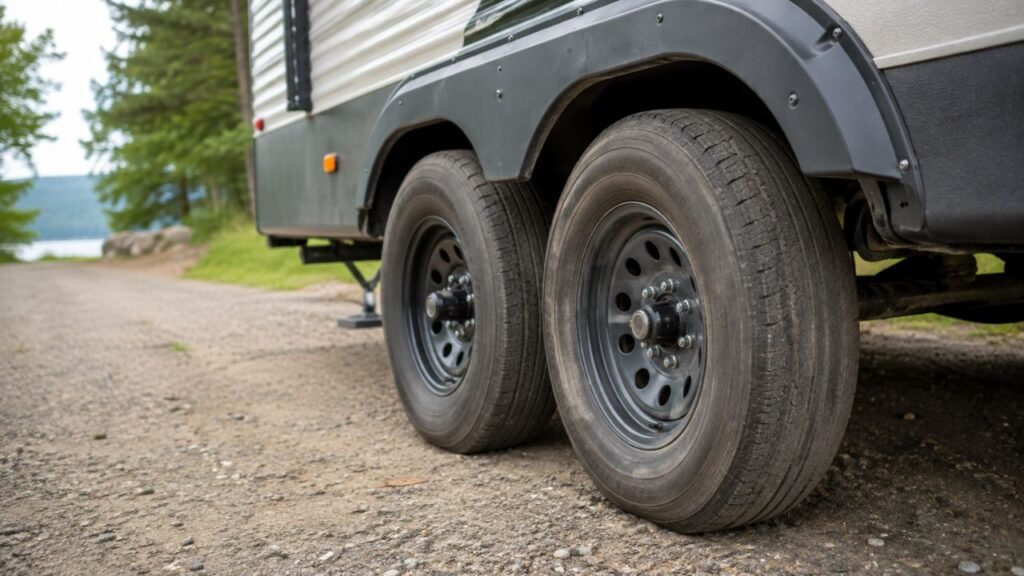
Cracking is not limited to the obvious outer sidewall. Give each tire a proper inspection rather than checking only the section facing you.
Common locations include:
- Outer sidewalls
- Inner sidewalls
- Around raised sidewall lettering
- Near the tire bead
- Around the shoulder
- Between tread blocks
- Inside tread grooves
- Around previous cuts or abrasions
The inner sidewall deserves special attention.
It receives much less casual inspection because you cannot easily see it while walking around the trailer.
A flashlight can help.
If access is difficult, safely inspecting the tire while the trailer is being serviced may reveal problems that were invisible from outside.
How Can I Tell Whether Trailer Tire Cracks Are Dangerous?
Not every tiny surface line means your tire is about to fail. At the same time, I would never dismiss cracking without looking at its depth, location, extent, tire age, and surrounding damage.
Fine Surface Lines
Very light surface checking can appear as rubber ages.
If you notice a few shallow lines, inspect the entire tire carefully.
Check its age, pressure history, tread condition, and storage exposure.
Then monitor whether the cracking progresses.
I would be more conservative if that tire is headed for a long summer highway trip while carrying a heavily loaded camper.
Cracks That Catch Your Fingernail
If a crack is obvious enough that your fingernail catches in it, I would treat it much more seriously than faint surface checking.
Depth matters because the concern is no longer purely cosmetic appearance.
The tire should be inspected closely before further towing.
When replacement cost is weighed against the consequences of a highway blowout, gambling on a badly weathered tire rarely makes sense.
Cracks With Exposed Cords or Fabric
If you can see reinforcement material beneath the rubber, stop treating this as normal weathering.
The tire has suffered significant damage.
Do not continue towing on it.
A trailer tire’s internal cords are critical to its structure.
Once those components are exposed, the tire is no longer something I would trust under highway load.
Bulges, Bubbles, or Distorted Sidewalls
A bulge is different from ordinary cracking.
It can indicate that the tire’s internal structure is damaged and pressure is pushing outward where the casing has weakened.
Do not “keep an eye on it” for another season.
A bulged trailer tire should be replaced before towing.
Cracks Combined With Pressure Loss
Slow pressure loss deserves investigation even when the tire looks decent.
Possible causes include:
- Cracked valve stems
- Valve core leaks
- Bead problems
- Wheel corrosion
- Punctures
- Structural deterioration
Repeatedly topping up a leaking trailer tire is not a repair.
Find the cause before the next trip.
Trailer Tire Cracking Severity Guide
The appearance of the crack is only part of the decision. Tire age, pressure retention, loading, and planned towing conditions should also influence what you do next.
| What You See | What It May Mean | What I Would Do |
| Very fine surface checking | Early weather aging | Monitor closely and check tire age |
| Several visible sidewall cracks | Progressing weather deterioration | Arrange a closer inspection before long towing |
| Cracks that clearly catch a fingernail | More significant deterioration | Strongly consider replacement |
| Exposed fabric or cords | Structural damage | Do not tow on the tire |
| Bulge or bubble | Possible internal separation | Replace the tire before towing |
| Cracking with repeated pressure loss | Possible casing, bead, valve, or puncture issue | Diagnose the leak before use |
| Cracking on an older tire | Age-related deterioration | Compare condition against manufacturer replacement guidance |
| Tread separation or visible distortion | Serious structural problem | Replace immediately |
Do not use this table as permission to continue driving on a questionable tire.
When you cannot confidently determine whether cracking is superficial, have a tire professional inspect it before highway towing.
How Old Are My Trailer Tires?
Tire age is one of the first things I check when unexplained cracking appears. The useful part is that you do not need paperwork from the previous owner because the manufacturing information is molded into the tire.
Find the DOT Date Code
Look along the tire sidewall for its DOT identification markings.
The complete code may appear on only one side of the tire.
If you cannot find the date while standing outside the trailer, check the inner sidewall.
Read the Last Four Digits
Modern tire date codes use four digits.
For example:
1824
The first two numbers represent the manufacturing week.
The final two represent the year.
So 1824 means the tire was produced during the 18th week of 2024.
That gives you a much better picture than relying on the date you purchased the trailer.
Check Every Tire Separately
Never assume every tire on your trailer has the same manufacturing date.
Replacement tires may have been installed individually.
One tire may also have been old inventory before installation.
Check:
- Every road tire
- The spare tire
- Recently installed replacements
Spare tires deserve special attention because they may spend years untouched while continuing to age.
How Long Do Trailer Tires Usually Last Before Cracking?
There is no reliable universal number that tells you exactly when every trailer tire will crack.
Climate alone can make a big difference.
A lightly used trailer stored indoors in moderate temperatures has a very different life from an RV parked year-round in strong sun and then towed heavily during summer.
Tire life is affected by:
- Manufacturing date
- Tire construction
- Storage
- Climate
- UV exposure
- Inflation history
- Load
- Speed
- Mileage
- Maintenance
- Road damage
Instead of choosing one arbitrary replacement age for every trailer tire, check the guidance provided for your specific tire.
Age becomes particularly important when it appears alongside cracking, hardening, repeated pressure loss, bulges, or other deterioration.
I would rather replace an aging trailer tire a little early than discover its real limit during a 65 mph towing trip.
Why Do Trailer Tires Sometimes Crack Faster Than Car Tires?
Trailer and passenger vehicle tires live very different lives. The biggest differences involve storage time, load, maintenance habits, and how frequently the tires are used.
Trailers Spend More Time Parked
Your car might leave the driveway twice every day.
Your camper could remain in storage for five months.
That difference alone changes the tire’s aging environment considerably.
Trailer Tires Carry Heavy Static Loads
Trailer tires continue supporting much of the trailer’s weight while parked.
They may sit on the same contact area for weeks or months.
That does not automatically cause dry rot, but long stationary periods are part of the tougher storage environment trailer tires experience.
They Receive Less Frequent Maintenance
Most drivers notice a low car tire quickly.
A warning light may appear, steering can feel different, or the vehicle is simply driven often enough that somebody notices.
Trailer tires might not receive attention until the night before a trip.
By then, a slow leak could have existed for months.
Seasonal Storage Exposes Them Longer
RVs, boats, recreational equipment, and seasonal trailers often spend months outside.
That means long exposure to sunlight and weather without frequent inspection.
This is one reason I recommend making tire inspection part of both your storage routine and your pre-trip routine.
Does Leaving a Trailer Parked in One Spot Damage the Tires?
Leaving a trailer parked for months can contribute to tire problems, but I would not blame cracking entirely on the tire touching one spot on the ground.
Cracking is primarily connected to rubber aging and environmental exposure.
Long-term parking simply creates conditions where those aging processes continue while the tire receives little movement or inspection.
Stationary tires can also develop temporary flat spotting.
The likelihood depends on tire construction, temperature, pressure, load, and storage duration.
If your trailer will remain stored for a long period, maintain proper inflation and follow the trailer manufacturer’s storage recommendations.
Can Low Tire Pressure Cause Trailer Tires to Crack?
Low pressure can contribute significantly to tire deterioration.
The problem becomes most serious once you begin towing.
When pressure is too low, the tire sidewall flexes excessively with every rotation.
That flex creates heat.
The hotter the tire gets, the more stress its internal materials experience.
An already old or weathered sidewall has even less margin for that additional stress.
Before every towing trip, I recommend checking tire pressure while the tires are cold.
Do not rely on kicking the tire or judging its shape.
Trailer tires can look reasonably normal while being considerably underinflated.
Also avoid releasing air simply because pressure rises during a trip.
Pressure naturally increases as tires warm.
Cold inflation should be set according to the specifications for your trailer and tires.
Can Overinflation Cause Tire Cracking?
Overinflation is not normally the main cause of trailer tire dry rot.
However, incorrect inflation can still create other problems.
Too much pressure may affect:
- Ride harshness
- Tire contact with the road
- Impact sensitivity
- Tread wear patterns
More pressure is not automatically better.
Do not exceed tire, wheel, or manufacturer limits hoping to prevent heat or cracking.
Your goal is correct inflation for the actual towing setup.
Does Trailer Weight Make Tire Cracking Worse?
Weight can make an already difficult tire environment even harder.
A heavily loaded tire experiences more stress.
If it is also underinflated, the heat generated during towing can rise quickly.
Do not stop your weight check at trailer GVWR.
Also consider:
- Axle ratings
- Individual tire load ratings
- Actual loaded weight
- Side-to-side imbalance
- Water and waste tank locations
- Battery placement
- Cargo distribution
Travel trailers can be particularly uneven because large appliances and slide-outs are not always centered.
If one side runs consistently heavier, those tires may experience greater heat and stress even though the overall trailer weight appears acceptable.
Can Axle or Suspension Problems Cause Cracks?
Axle and suspension problems are more commonly associated with unusual tread wear than classic age-related sidewall cracking.
However, they can create additional tire stress.
A bent axle, worn suspension bushing, loose bearing, or alignment problem can force the tire to scrub instead of rolling cleanly.
That creates heat and abnormal loading.
If cracking appears alongside severe uneven tread wear, I would inspect more than the tire.
Look at:
- Leaf spring bushings
- Shackles
- Equalizers
- Wheel bearings
- Axle condition
- Toe and camber
- Wheel alignment
There is little value in fitting expensive new tires if a mechanical problem immediately begins damaging them again.
How to Prevent Trailer Tires From Cracking Early
You cannot stop tire rubber from aging forever, but you can remove many of the conditions that make it age unnecessarily fast. These are the habits I would prioritize.
Keep Tires Properly Inflated
Check pressure cold before towing.
Do this with an accurate gauge rather than relying only on appearance.
If one tire repeatedly loses more pressure than the others, investigate the cause.
Do not make constant topping-up part of your normal routine.
Protect Tires From Direct Sun
Shade helps when a trailer is stored outdoors.
If you can choose your parking position, reducing prolonged direct sun exposure is worthwhile.
Covered storage provides even better protection.
Use Tire Covers During Long Storage
Tire covers are simple, but they serve a useful purpose.
Their biggest advantage is limiting direct UV exposure.
Choose covers that fit properly and allow reasonable ventilation.
Remember that a tire cover cannot stop internal aging or fix poor inflation.
Think of it as one layer of protection.
Keep the Trailer on a Clean, Firm Surface
A firm, reasonably dry storage area is preferable to leaving tires in mud or standing water.
You do not need an expensive storage pad just to protect your tires.
The goal is consistent support and fewer harsh environmental conditions around the rubber and wheels.
Avoid Overloading the Trailer
Know what your trailer actually weighs once it is loaded for travel.
Do not estimate based only on the empty weight printed in a brochure.
Water, batteries, camping equipment, tools, food, propane, and personal belongings add weight surprisingly quickly.
Respect the Tire’s Speed Rating
Check your individual tire’s rating.
Do not assume a replacement tire automatically has the same speed capability as the old one.
Heat rises with sustained speed.
Give the tire some operating margin rather than constantly towing at its limit.
Inspect Tires Before Every Long Trip
I would much rather find a cracked tire in the driveway than at a highway rest area after it starts coming apart.
Walk around the trailer before departure.
Look for:
- Cracking
- Cuts
- Bulges
- Unusual wear
- Objects in the tread
- Low pressure
- Sidewall damage
A two-minute check can save a very unpleasant afternoon.
Check the Inner Sidewalls
Do not inspect only what is easy to see.
Inner sidewalls can hide damage.
Use a flashlight and look behind each tire whenever practical.
If you have the trailer professionally serviced, ask for the inside surfaces to be inspected as well.
Inspect Valve Stems Too
A good tire can still lose pressure through a bad valve stem.
Look for:
- Cracked rubber
- Loose valve cores
- Bent stems
- Damage around TPMS sensors
- Corrosion around metal stems
A slow leak can eventually create an underinflation problem severe enough to damage an otherwise usable tire.
Move or Use the Trailer Periodically
If practical, occasional movement can prevent the tires from remaining on precisely the same contact area indefinitely.
However, do not misunderstand this advice.
Driving cannot restore already cracked rubber.
If a tire has become structurally questionable, moving the trailer more often is not the solution.
Replacement is.
Should I Use Tire Dressing to Prevent Dry Rot?
A glossy tire does not necessarily mean a protected tire.
Some owners regularly apply tire shine because they believe the wet appearance keeps rubber from drying out.
I would be careful with that assumption.
Use only cleaning or protective products considered suitable by the tire manufacturer.
Avoid aggressive solvents or petroleum-based products unless specifically approved.
Most importantly, remember that no dressing can reverse tire aging.
If the sidewall has already developed meaningful structural cracking, coating it with a shiny product only makes an old tire look cleaner.
It does not rebuild the rubber.
Should Trailer Tires Be Covered During Storage?
Yes, covering trailer tires can be worthwhile when the trailer spends long periods outside.
The biggest benefit is UV protection.
A quality cover blocks much of the direct sunlight that would otherwise hit the sidewall every day.
Covers can also help shield the tires from general weather exposure.
However, covers do not protect against every cause of tire deterioration.
They cannot prevent damage caused by:
- Low pressure
- Excess weight
- Internal aging
- Overheating while towing
- Structural defects
- Excessive tire age
Use covers as part of good storage practice rather than treating them as a cure for dry rot.
Is It Better to Store a Trailer With the Tires Off the Ground?
For normal seasonal storage, completely lifting a trailer is not always necessary.
What matters more is following the storage guidance provided for your specific trailer.
If the manufacturer approves long-term support or unloading of the tires, use the specified lifting and support points.
Never improvise with unstable blocks or place supports beneath parts of the frame that are not designed to carry the load.
For many owners, a sensible storage routine is enough:
- Firm surface
- Correct tire pressure
- UV protection
- Proper trailer loading
- Periodic inspections
Safety matters more than attempting to create the perfect tire-storage setup.
Should I Replace One Cracked Trailer Tire or All of Them?
One cracked tire does not automatically mean every trailer tire must be replaced. However, tires that have lived together usually deserve to be evaluated together.
Check the Age of Every Tire
Start with the manufacturing dates.
If all four tires were produced around the same time, they have experienced roughly the same years of environmental aging.
One may simply be showing deterioration sooner.
Inspect Tires on the Same Axle
Compare the opposite tire carefully.
Check:
- Cracking
- Tread wear
- Pressure retention
- Manufacturing date
- Load range
- Tire size
- Overall condition
Replacing tires in a way that keeps compatible tires across the trailer generally makes more sense than mixing drastically different tire conditions.
Do Not Forget the Spare
Your spare may look brand new because it has never touched the road.
That does not mean the rubber is new.
Check its DOT date and sidewall condition just as carefully as the tires carrying the trailer.
A ten-year-old unused spare is not automatically a dependable rescue plan.
When Should You Stop Towing on a Cracked Trailer Tire?
A few faint age lines and major structural cracking are not the same thing. However, some tire conditions give you very little reason to keep experimenting.
I would stop towing and arrange replacement or professional inspection if you find:
- Exposed cords or fabric
- A sidewall bulge
- A tread bulge
- Large or deep cracks
- Visible tread separation
- Sidewall distortion
- Repeated unexplained pressure loss
- Severe uneven wear
- Impact damage
- Cracking combined with advanced tire age
- Any damage you cannot confidently evaluate
Highway towing places heat, speed, and weight on the tire simultaneously.
That is not the environment where you want to discover whether a questionable crack was harmless.
A Quick Trailer Tire Inspection Before Every Trip
You do not need a complicated inspection routine. A consistent five-minute check before leaving can catch many developing problems.
- Check every tire’s cold pressure.
- Look across the complete outer sidewall.
- Inspect between the tread grooves.
- Look for cuts, bubbles, or bulges.
- Check for uneven tread wear.
- Inspect the valve stems.
- Look at the inner sidewalls when possible.
- Check the spare tire.
- Confirm the tires suit your trailer’s load.
- Check that your towing speed fits their rating.
- Investigate any tire that repeatedly loses pressure.
- Check tire age periodically rather than waiting for cracking.
If you find something suspicious, deal with it before loading the trailer for a long trip.
Problems rarely become easier to diagnose after the tire has heated up on the highway.
What Trailer Tire Cracking Can Tell You About the Bigger Problem
Sometimes the cracked tire is only the visible part of the problem.
Before installing another set and assuming everything is solved, ask why the old tires deteriorated.
Premature cracking may point toward:
- Long outdoor storage
- Constant UV exposure
- Chronic underinflation
- Excessive trailer weight
- Uneven loading
- Excessive towing heat
- Old tire inventory
- Incorrect tire selection
- Poor inspection habits
For example, replacing a cracked underinflated tire without repairing the leaking valve stem could eventually damage the replacement.
Likewise, upgrading to expensive tires will not solve a severe overloading problem.
Fix the condition that shortened the first tire’s life whenever you can identify it.
Final Verdict
Trailer tires can crack surprisingly early because they often age by time and exposure rather than mileage.
They may spend months supporting a parked trailer while sunlight, heat, oxygen, ozone, and changing weather continue affecting the rubber.
Then, when towing season arrives, low inflation, heavy loading, and highway heat can add even more stress.
That is why I would never decide a trailer tire is safe just because the tread still looks deep.
Check its age.
Look at both sidewalls.
Inspect the tread grooves.
Monitor pressure.
Pay attention to bulges, hardening, and deep cracks.
Most importantly, do not try to squeeze one more long trip from a tire you already do not trust.
Proper inflation, sensible loading, UV protection, good storage, and regular inspections will give your trailer tires a much better chance of reaching a reasonable service life.
Related FAQs
Why Are My Trailer Tires Cracking After Only Two Years?
Trailer tires can crack within a few years if they spend long periods outside in strong sunlight and heat, run underinflated, carry heavy loads, or were already older when purchased. Check the DOT manufacturing date because the tire may be older than the amount of time you have owned it.
Are Small Cracks in Trailer Tires Normal?
Very light surface checking can appear as tire rubber ages, but visible cracks should still be inspected rather than automatically considered normal. Pay particular attention to crack depth, tire age, pressure retention, bulges, and whether the cracking continues getting worse.
Can I Tow With Cracked Trailer Tires?
Whether towing is reasonable depends on the severity and location of the cracking plus the tire’s overall age and condition. I would not tow on tires showing deep cracks, exposed reinforcement, bulges, tread separation, distortion, or unexplained pressure loss.
Why Do Trailer Tires Dry Rot When They Are Not Used?
Trailer tires continue aging while parked because sunlight, oxygen, ozone, heat, and temperature changes still affect the rubber. Long inactivity also means the tires may remain exposed for months without the regular use and inspection that vehicle tires normally receive.
How Can I Keep Trailer Tires From Dry Rotting?
Store your trailer away from intense sunlight when possible, use tire covers outdoors, maintain correct cold inflation, avoid overloading, keep the storage area reasonably dry, and inspect the tires regularly. These steps slow deterioration, although they cannot completely stop normal rubber aging.
Do Tire Covers Really Help Prevent Cracking?
Tire covers can help because they reduce direct UV exposure during long outdoor storage. They will not prevent internal aging, underinflation damage, overloading, or excessive towing heat, so they should be used alongside normal tire maintenance.
Does Parking a Trailer on Concrete Damage the Tires?
Concrete itself is usually not the main reason trailer tires crack. Long storage duration, UV exposure, temperature, moisture, tire pressure, age, and loading generally matter more. A clean, firm, level storage surface is normally preferable to mud or standing water.
Should I Replace Trailer Tires With Good Tread but Sidewall Cracks?
Possibly. Tread depth does not tell you how healthy the tire’s sidewall and internal structure remain. If cracking is deep, widespread, accompanied by other damage, or appearing on an older tire, replacement may be the safer option even when considerable tread remains.
How Often Should I Check Trailer Tires for Cracks?
Inspect your trailer tires before towing trips, after extended storage, and periodically throughout the towing season. A quick visual check should include both sidewalls, tread grooves, valve stems, pressure, unusual wear, and any changes since your previous inspection.
Can a Cracked Trailer Tire Blow Out?
Yes. Serious cracking can be a sign that the rubber has deteriorated and lost some of the flexibility needed to withstand heat and load. Deep cracking combined with age, low pressure, or heavy towing increases the concern considerably.
Do Trailer Tires Crack Faster in Hot Climates?
They can. High temperatures and strong UV exposure accelerate rubber aging, particularly when a trailer remains parked outdoors for long periods. Hot pavement and sustained highway towing can add even more heat to an already weathered tire.
Do Spare Trailer Tires Dry Rot Too?
Yes. Spare tires continue aging even when they have never been used on the road. Check the spare’s manufacturing date, sidewall condition, pressure, and storage exposure regularly so you do not discover an unusable spare after another tire fails.

Scott Miller shares real-world RV road trip insights built from years of traveling open highways and backroads. He covers route planning, campground choices, and travel gear with a practical mindset. His content is written for RVers who value reliability over trends.