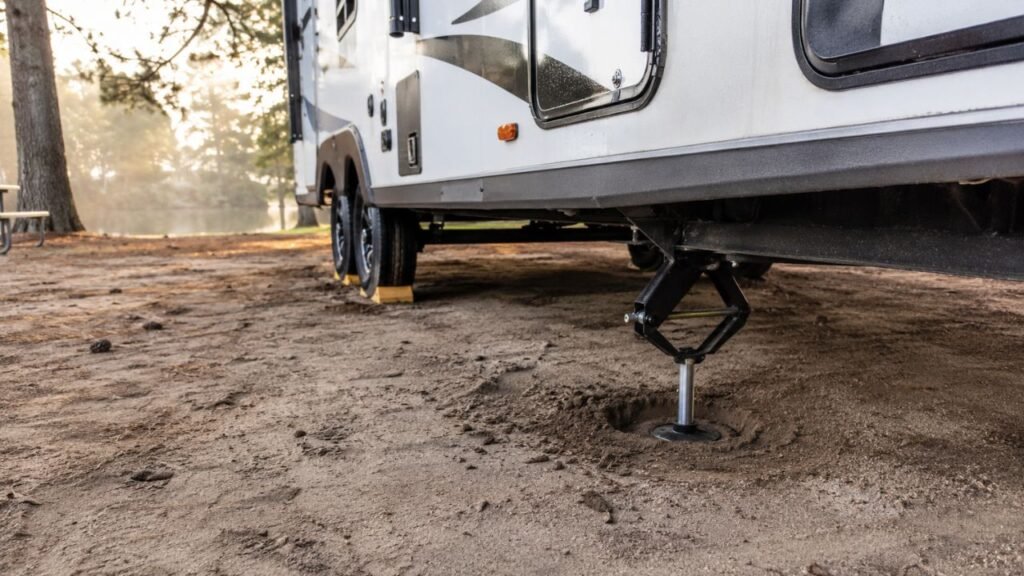
Stabilizer jacks usually sink overnight because their small feet concentrate pressure on soft, wet, sandy, gravelly, or heat-softened ground. As the surface slowly compresses, the jack settles lower and your RV may start rocking again.
The good news is that this usually does not mean your stabilizer jack has failed. I’ll show you why it happens, how to stop it, which pads work best, and how to tell ground movement from an actual jack problem.
Key Takeaways
- Soft, wet, sandy, or loose ground commonly causes stabilizer jacks to sink.
- Small jack feet concentrate pressure into a relatively small area.
- Wide, rigid stabilizer pads help distribute that pressure over more ground.
- Always level your RV before lowering the stabilizer jacks.
- Stabilizers should reduce movement, not lift or level your trailer.
- Keeping stabilizers shorter generally makes the RV feel more stable.
- Rain can soften previously firm ground and cause delayed sinking.
- Hot asphalt can also deform beneath small metal jack feet.
- Significant movement on solid concrete may indicate a mechanical problem.
Why Do My Stabilizer Jacks Sink Overnight?
Your stabilizer jacks usually sink because the surface underneath them is slowly compressing. The RV may look perfectly stable when you finish setting up, yet the ground keeps moving afterward.
A stabilizer foot has a fairly small contact area. When you tighten the jack against the ground, pressure becomes concentrated beneath that foot.
Soft soil cannot always resist that pressure indefinitely. It may gradually compress or move sideways during the next several hours.
That is why the problem often appears overnight.
You might wake up and notice the trailer rocking again. One corner may also look slightly lower than before.
The jack itself may not have moved mechanically at all. Instead, its foot has simply followed the ground downward.
This situation becomes especially common on:
- Soft campground dirt
- Wet grass
- Sandy campsites
- Loose gravel
- Recently disturbed soil
- Warm asphalt
- Muddy parking areas
The solution is usually straightforward. You need to spread that pressure across a larger, firmer area.
What Causes RV Stabilizer Jacks to Sink?
Several things can make a stabilizer settle after you park. I recommend checking the surface first because ground conditions cause many overnight sinking problems.
Soft or Loose Soil
Soft soil compresses when pressure remains on it for several hours.
You may initially think the campsite feels firm. However, the top inch can hide much softer soil underneath.
Campgrounds also frequently contain disturbed or filled soil. That material may not be as compact as natural ground.
Once the stabilizer presses downward, the soil particles move closer together. The jack then gradually follows them downward.
A wide stabilizer pad can reduce this problem significantly.
Wet or Saturated Ground
Wet ground loses some of its ability to support concentrated loads.
Rainwater fills spaces between soil particles and makes the surface easier to deform. The problem can become worse if water continues draining toward your campsite.
You may set up during a dry afternoon. Then overnight rain changes the conditions completely.
Morning dew alone usually causes less movement than heavy rain. However, already damp soil can become noticeably softer overnight.
If the ground feels spongy beneath your shoes, use larger pads.
Sandy Campsites
Sand is one of the easiest surfaces for stabilizer feet to penetrate.
Instead of simply compressing, sand also moves sideways. A narrow metal foot therefore pushes grains outward while moving downward.
The trailer may remain stable initially. Several hours later, one corner can start rocking.
For sandy campsites, I prefer a much wider footprint. Large rigid pads usually work better than small blocks.
Loose Gravel
Gravel looks solid, but loose gravel can still settle.
Individual stones can roll or rearrange beneath the stabilizer foot. Smaller gravel may also push into the soil underneath.
This can create a small amount of overnight movement.
A rigid board or stabilizer pad gives the stones a larger surface to support.
Hot Asphalt
Many RV owners assume asphalt behaves like concrete. It does not always.
Asphalt can become noticeably softer during hot weather. A small metal stabilizer foot may slowly press into it.
The indentation may become more noticeable after several hot afternoons.
Using stabilizer pads also helps protect campground pavement from damage.
Small Stabilizer Footpads
Small feet create more concentrated pressure than larger feet.
Imagine standing on soft ground wearing normal shoes. Now imagine applying the same weight through a much smaller point.
The smaller contact area sinks more easily.
Your stabilizer works under the same basic principle. Increasing its footprint reduces pressure on each square inch of ground.
Stabilizers Extended Too Far
An overextended stabilizer does not directly make soil softer. However, it can make movement much more noticeable.
The farther a stabilizer extends, the more leverage sideways forces can have.
That can produce additional flexing when someone walks inside the trailer.
Instead of extending the jack almost completely, place suitable blocks underneath it. The stabilizer then operates from a shorter, more rigid position.
Stabilizers Carrying Too Much Weight
This is one of the most important setup mistakes to avoid.
Conventional stabilizer jacks are designed primarily to reduce movement. They are not normally intended to lift or level the trailer.
If you crank them aggressively, you may transfer unnecessary load into the jack and ground.
That extra force can make soft soil compress faster.
Level the RV using its proper leveling method first. Then lower your stabilizers until they are firmly snug.
Stabilizer Jack Sinking Causes at a Glance
Different campsite surfaces behave differently under pressure. This table can help you quickly identify what is happening beneath your RV.
| Ground or Setup Condition | Why the Jack Sinks | What You May Notice | Best Fix |
| Soft dirt | Soil slowly compresses | Jack foot sinks into a depression | Use a large rigid pad |
| Wet soil | Water reduces ground stability | Trailer becomes unstable after rain | Use wider pads or move to firmer ground |
| Sand | Sand moves outward under pressure | Jack sinks or tilts | Use an extra-wide rigid pad |
| Loose gravel | Stones shift beneath the foot | Small overnight height change | Use a flat board or stabilizer pad |
| Hot asphalt | Pavement softens with heat | Metal foot leaves an indentation | Use a broad protective pad |
| Small jack foot | Pressure stays concentrated | Deep localized sinking | Increase the footprint |
| Excessive extension | Stabilizer becomes less rigid | More rocking inside the RV | Add blocks beneath the jack |
| Too much jack pressure | Excess load reaches the ground | Pad or jack sinks faster | Reset and apply less pressure |
How Ground Pressure Makes Stabilizer Jacks Sink
There is a simple reason larger stabilizer pads work so well. The same downward force becomes less concentrated when it spreads across a larger surface.
Think about walking across soft sand.
Your normal shoes may sink slightly. Wide snowshoes would spread your weight across a much larger area and sink less.
A stabilizer pad works similarly.
Suppose the jack foot contacts only a small section of soil. All the stabilizing force acts on that small area.
Place a much wider rigid pad underneath it, and that force spreads across more ground.
The soil beneath each square inch now handles less pressure.
This is why pad size matters so much on sand, mud, grass, and loose dirt.
However, size alone is not everything.
The pad also needs enough stiffness to distribute the load. A thin flexible mat may simply bend around the jack foot.
I prefer something broad, flat, and rigid enough to stay straight.
How to Stop Stabilizer Jacks From Sinking Overnight
Most sinking problems can be solved without replacing any RV equipment. The goal is to improve the surface underneath the jack and avoid excessive extension or pressure.
Put Wide Stabilizer Pads Under Every Jack
This is usually the first change I would make.
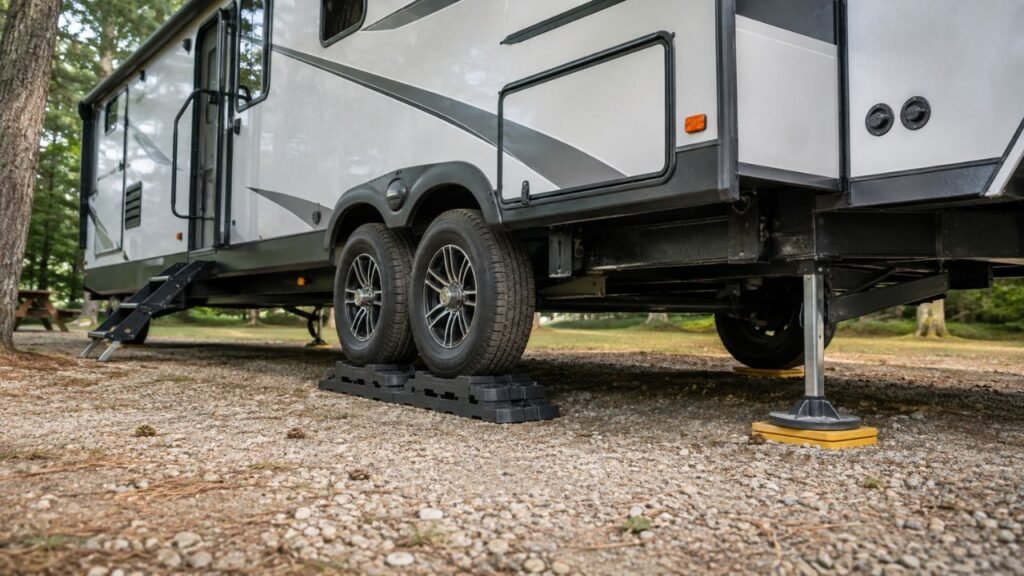
Place a wide stabilizer pad beneath each jack before lowering it.
The pad increases the contact area and distributes pressure more evenly.
Try using all your stabilizers with comparable support. If three jacks have large pads and one sits directly on soft dirt, that single corner can still settle.
Pads should also sit flat.
Remove large rocks, sticks, and other debris before positioning them.
Use Thick Wooden Boards When Necessary
Wood can work very well when proper stabilizer pads are unavailable.
A wide, thick board provides considerably more surface area than the jack foot alone.
Pieces of sturdy lumber can also reduce how far the stabilizer must extend.
Just inspect the boards regularly.
Avoid wood that is:
- Rotten
- Split
- Severely warped
- Waterlogged
- Too thin for the load
- Unstable when stacked
Never create a tall, shaky tower beneath a stabilizer.
A short, broad, stable stack is much better.
Level the RV Before Lowering the Stabilizers
Proper setup order makes a major difference.
Your stabilizers should not correct an RV that is already sitting noticeably unlevel.
For a typical travel trailer, I would use this general sequence:
- Position the trailer on the campsite.
- Level the trailer from side to side.
- Securely chock the wheels.
- Disconnect from the tow vehicle when appropriate.
- Level front to back using the tongue jack.
- Place pads beneath the stabilizers.
- Lower each stabilizer until firmly snug.
- Check the trailer for unwanted movement.
Your specific RV may require a different procedure. Always follow its manufacturer instructions when they differ.
Keep the Stabilizers Shorter
Long stabilizer extensions can contribute to a shaky feeling.
If there is a large gap between the stabilizer and ground, fill some of that distance with proper blocks.
This allows the stabilizer to remain shorter.
A shorter extension generally provides a more rigid setup.
It also means you spend less time cranking the jack.
Just make sure any blocks remain broad and stable.
Firm Up Loose Ground Before Setup
Take a few seconds to inspect each stabilizer location.
If you see loose gravel or deep sand, find the firmest nearby point.
Remove unstable stones that prevent the pad from sitting flat.
You can lightly compact loose surface material when appropriate. However, do not assume pressing down the top layer fixes deeply saturated soil.
Sometimes moving the RV slightly is the better option.
Recheck the Jacks After the Ground Settles
Fresh setups can experience a little initial settling.
After parking for several hours, walk around the trailer and inspect your pads.
Look for:
- One pad sitting lower
- Fresh depressions in the soil
- A tilted stabilizer foot
- A leaning block
- Loose stabilizer contact
If everything still looks good, you are probably set.
If one corner has already started sinking, correct it before bedtime.
How Much Pressure Should I Put on Stabilizer Jacks?
A stabilizer should normally make firm contact without trying to raise the trailer.
This difference sounds small, but it matters.
When the foot first contacts the pad, continue only enough to remove unwanted trailer movement.
You generally do not need to crank aggressively.
If you can see a trailer corner being lifted noticeably, you may be applying too much pressure.
Excessive force can strain the stabilizer mechanism and mounting points. It can also increase pressure against soft ground.
I like to think of stabilizers as braces.
They support the trailer against rocking rather than functioning as primary lifting equipment.
Automatic hydraulic or electric leveling systems are different. Those systems may be designed to carry substantial loads.
Always identify which system your RV actually has before applying this advice.
Should Stabilizer Jacks Carry the Weight of the RV?
Conventional stabilizer jacks should not be used as the primary supports for lifting or leveling your RV.
Your trailer’s tires, suspension, leveling blocks, tongue jack, and other approved equipment handle the primary load.
Stabilizers then reduce movement after the RV is already properly positioned.
This distinction is important because RVs use several different jack systems.
A tongue jack supports the front of a travel trailer during normal setup. Dedicated leveling systems may be designed to level and support a motorhome or fifth wheel.
Scissor-style or similar stabilizer jacks usually have a different purpose.
Do not assume a high weight rating automatically means a stabilizer should lift your trailer.
Follow the instructions provided for your specific RV and jack system.
What Should I Put Under My RV Stabilizer Jacks?
You have several good options for increasing the stabilizer footprint. The best choice depends on your campsite surface, storage space, and how frequently you travel.
Plastic Stabilizer Pads
Purpose-built stabilizer pads are one of the easiest solutions.
They are lightweight, relatively compact, and resistant to moisture.
Many can also be stacked when you need additional height.
Choose pads that are sufficiently rigid. A larger footprint provides more benefit on soft surfaces.
Plastic also avoids the rot and moisture problems associated with wood.
Wooden Boards
Wood remains popular because it is inexpensive and easy to replace.
A wide board can provide an excellent load-spreading surface.
You can also cut several pieces to the same size. That makes your setup easier to organize.
However, wood has some drawbacks.
It can absorb water, become muddy, crack, warp, and eventually rot.
Keep the boards reasonably dry between trips and replace damaged pieces.
Permanent Jack Foot Pads
Some RV owners install larger permanent feet or related pad systems.
These can save time because you do not have to position separate pads every time you camp.
The larger footprint may also reduce sinking on many campground surfaces.
However, even a larger permanent foot can sink into extremely soft soil.
You may still need additional support on sand or mud.
Rubber Pads
Rubber pads can help protect pavement and improve grip.
They are particularly useful when you want to avoid scratching a finished surface.
However, pay attention to stiffness.
A very soft rubber pad may flex considerably and provide less load distribution than a rigid pad.
For soft soil, I would prioritize a wide rigid base.
Best Stabilizer Pad Setup for Different Campsite Surfaces
There is no single pad setup that works perfectly everywhere. I adjust the footprint according to how much the surface can move or compress.
- Concrete: Sound concrete normally provides excellent support. Pads can still protect the surface and jack feet.
- Asphalt: Use broad pads, particularly during hot weather when asphalt may soften.
- Packed gravel: A rigid pad helps prevent individual stones from shifting beneath the jack.
- Loose gravel: Clear unstable stones first, then use a wider rigid footprint.
- Dry soil: Medium to large stabilizer pads usually provide sufficient support.
- Wet soil: Increase the pad area significantly and consider moving onto firmer ground.
- Sand: Use the widest practical rigid pad to reduce sinking.
- Grass: Remember that firm-looking grass can hide wet or loose soil underneath.
If I am unsure about a campsite, I prefer using larger pads immediately.
It is easier than resetting a sunk stabilizer later.
Why Do My Stabilizer Jacks Sink After Rain?
Rain changes the ground conditions underneath your RV.
Soil that supported your stabilizers yesterday can become considerably softer after prolonged rainfall.
Water can also flow underneath a stabilizer pad.
That may wash away fine soil or create a soft pocket beneath one side.
Once the support becomes uneven, the pad may tilt.
The jack can then appear to sink even faster.
After heavy rain, inspect each stabilizer before simply tightening it.
If the pad has sunk significantly, retract the stabilizer slightly and rebuild the footing.
Place the pad on the firmest available surface.
If the whole campsite has become muddy or unstable, additional tightening may make things worse.
Why Do My Jacks Sink Even When I Use Blocks?
Blocks only solve the problem when they spread the load properly. Small, flexible, or poorly supported blocks can sink along with the stabilizer.
The Blocks Are Too Small
A small block might not increase the footprint enough.
If the jack foot almost covers the entire block, very little load distribution occurs.
Choose something noticeably wider than the metal foot.
Softer ground usually requires a larger footprint.
The Bottom Surface Is Still Soft
Sometimes the jack is not sinking through the block.
The entire block is sinking.
Look closely at the edges.
If the block has dropped below the surrounding soil level, the ground underneath needs more support.
Use a larger base or move to firmer ground.
The Block Is Flexible
Thin plywood and lightweight plastic can bend.
Once the material bows, most pressure may still remain concentrated near the jack foot.
A rigid pad distributes pressure better.
Replace cracked, bent, or damaged supports.
The Ground Is Washing Out
Rainwater can flow underneath your blocks.
That can remove loose soil and leave a small void.
Eventually, the block drops into that space.
Watch where rainwater travels around your campsite.
If possible, avoid positioning stabilizers directly in drainage paths.
Too Much Stabilizer Pressure Is Being Applied
Even a decent pad can sink when excessive pressure reaches it.
If you keep cranking the stabilizer downward, something eventually has to give.
On soft ground, that is often the soil.
Retract the stabilizer and reset it correctly.
Let the trailer remain supported by its intended primary support points.
Can Overextending Stabilizer Jacks Make the RV Less Stable?
Yes, excessive stabilizer extension can make your RV feel less stable.
A long extended stabilizer can flex more than a short one.
Movement inside the trailer may therefore create additional sideways motion.
This does not always mean something is broken.
The geometry simply becomes less rigid as the stabilizer extends farther.
Whenever practical, use properly rated blocks beneath the foot.
This lets you reduce the extension while maintaining firm contact.
Keep those blocks wide and stable.
Avoid tall stacks that could shift sideways.
Why Does My RV Feel Unlevel the Next Morning?
A trailer can feel different the next morning even when it was perfectly comfortable at bedtime. Several support points can settle during the night.
One Stabilizer Pad Has Sunk
This is the most obvious possibility.
One corner loses contact as the soil underneath compresses.
You may notice more movement when walking near that corner.
Inspect all four stabilizers before making adjustments.
Leveling Blocks Beneath a Tire Settled
The stabilizers are not always responsible.
Leveling blocks underneath your tires can also sink into soft soil.
When that happens, the entire trailer changes position.
Look at the wheel blocks and surrounding ground.
A tire or leveling block sitting lower than before points toward ground settlement.
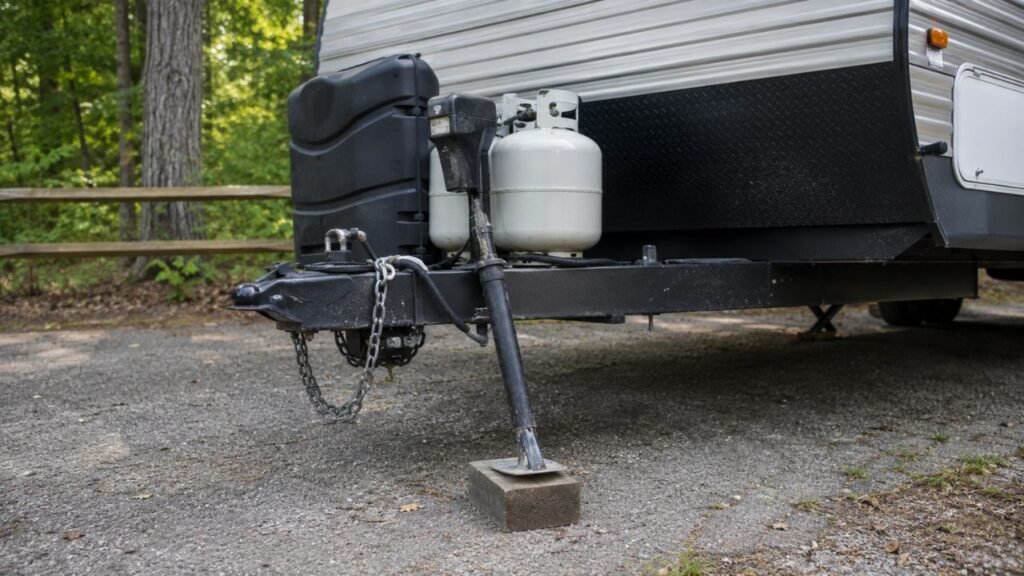
The Tongue Jack Settled
Your tongue jack can experience the same problem.
Its relatively small footprint can sink into dirt, grass, sand, or asphalt.
A sinking tongue jack changes front-to-back level.
Use an appropriate wide pad beneath it as well.
Tire or Suspension Position Changed Slightly
Small suspension movement can occasionally change how the trailer feels.
Tires also respond to temperature and pressure changes.
However, noticeable overnight changes usually deserve a closer look at the campsite footing first.
Ground settlement remains the more common explanation on soft surfaces.
How to Reset a Stabilizer Jack That Has Sunk
Do not simply crank a sunk stabilizer tighter. Reset the footing so the same problem does not continue.
- Keep people away from the affected stabilizer area.
- Check whether the trailer itself has shifted significantly.
- Make sure the wheels remain securely chocked.
- Retract the affected stabilizer enough to remove pressure.
- Inspect the soil beneath the jack.
- Remove loose or unstable material when practical.
- Place a wider, rigid stabilizer pad underneath.
- Lower the jack until it becomes firmly snug.
- Inspect the remaining stabilizers and support points.
- Recheck the trailer level before continuing your stay.
Never crawl underneath an RV supported only by stabilizer jacks.
If something requires you to work underneath the trailer, use proper lifting and support equipment for that task.
When Sinking May Actually Be a Stabilizer Jack Problem
If the ground remains firm and the jack foot has not moved downward, the stabilizer itself deserves closer inspection.
Bent Stabilizer Arms
A bent stabilizer can gradually change position under pressure.
Look at the arms from several angles.
They should move smoothly and remain properly aligned.
Visible bending or twisting deserves attention before further use.
Worn Screw Mechanism
Scissor-style stabilizers often use a threaded screw mechanism.
Wear, corrosion, damaged threads, or internal problems can create excessive play.
You might notice the stabilizer becoming loose even though the ground remains unchanged.
If the mechanism slips under normal stabilizing pressure, repair or replacement may be necessary.
Loose Mounting Hardware
Check where the stabilizer attaches to the RV frame.
Loose bolts or damaged mounting points can create movement that feels similar to sinking.
You may see the entire assembly move while the foot remains stationary.
Do not keep tightening the stabilizer to compensate.
Fix the loose mounting problem first.
Damaged Footplate
A bent footplate may not sit flat against the pad.
Instead, pressure becomes concentrated along one edge.
That can encourage tilting or uneven sinking.
Replace seriously bent or damaged components.
Frame or Mounting Movement
Watch the mounting area while the stabilizer is being deployed.
Significant or unusual frame movement deserves investigation.
Stabilizers should not be used to force a distorted setup into position.
If you suspect structural damage, have the RV inspected.
How Can I Tell Whether the Ground or Jack Is Moving?
A few simple observations can help separate ground settlement from mechanical movement.
- Mark the jack’s position after setup.
- Look for fresh depressions around the pad.
- Check whether the pad has tilted.
- Compare the jack foot with nearby ground height.
- Inspect stabilizer mounting bolts.
- Look for movement in the stabilizer arms.
- Compare all four corners of the trailer.
- Test the stabilizer later on firm concrete.
If the problem only happens on dirt, sand, or gravel, the ground is probably responsible.
If the same jack becomes loose on solid concrete, inspect the jack more carefully.
That comparison can save you from replacing a perfectly good stabilizer.
Should I Tighten Stabilizer Jacks Again the Next Morning?
A small adjustment after minor initial settling can be normal.
However, repeatedly tightening a jack that keeps sinking is not the right solution.
Every additional turn may push the pad farther into soft ground.
Eventually, you could transfer unnecessary force into the stabilizer or trailer.
If a jack has visibly sunk, reset the footing instead.
Retract it slightly, install a wider support pad, and lower it again.
Fix the reason for the movement rather than continually chasing it.
Can Stabilizer Jacks Sink Into Asphalt?
Yes, stabilizer jacks can sink into asphalt.
This becomes particularly common during hot weather.
Asphalt contains materials that soften as temperatures rise.
A concentrated load from a metal stabilizer foot can create a noticeable depression.
Sometimes the damage remains even after the trailer leaves.
A wide pad spreads the load and protects the surface.
I would use pads on asphalt even when the pavement initially feels solid.
It is a simple precaution that protects both your setup and campsite.
Are Bigger Stabilizer Pads Better?
Generally, a larger stabilizer pad provides better support on soft ground.
Increasing the footprint spreads the stabilizing force over more surface area.
However, bigger does not automatically mean better.
The pad also needs to be:
- Rigid
- Flat
- Durable
- Thick enough for the application
- Stable on the ground
A huge flexible sheet may bend around the jack foot.
A smaller but rigid pad can sometimes distribute pressure more effectively.
For very soft sand or wet soil, increasing both size and rigidity usually works best.
Common Mistakes That Make Stabilizer Jacks Sink Faster
Many sinking problems come from setup habits rather than faulty equipment.
- Lowering stabilizers before leveling the trailer
- Trying to level the RV using stabilizer jacks
- Applying excessive pressure
- Using tiny blocks beneath large loads
- Placing jacks directly on wet ground
- Ignoring loose sand or gravel
- Extending stabilizers farther than necessary
- Using cracked or flexible pads
- Building unstable stacks of blocks
- Ignoring water runoff after rain
- Tightening one stabilizer much more than others
- Assuming asphalt cannot soften
- Failing to inspect the setup during longer stays
Avoiding these mistakes makes your trailer more comfortable and protects the equipment.
How to Keep Your RV Stable for Several Days
A good initial setup usually prevents most problems during longer campground stays.
- Choose the firmest part of the campsite.
- Level the RV before deploying stabilizers.
- Chock the wheels securely.
- Place wide pads under each stabilizer.
- Keep stabilizer extension reasonably short.
- Avoid excessive downward pressure.
- Inspect the footing after heavy rain.
- Watch for pads slowly tilting or sinking.
- Reset unstable footing instead of tightening repeatedly.
- Check the setup occasionally during longer stays.
You do not need to obsess over the stabilizers every day.
A quick visual inspection usually tells you whether something has changed.
When Should I Stop Using a Sinking Stabilizer Jack?
Ground-related sinking can usually be corrected with a better pad. Mechanical movement requires a different approach.
Stop relying on the stabilizer until you inspect it if you notice:
- Bent stabilizer arms
- A cracked or distorted foot
- Loose mounting hardware
- A screw mechanism that slips
- Excessive side-to-side play
- Broken welds
- Severe corrosion
- Unusual frame movement
- A stabilizer that will not stay extended
Do not compensate for mechanical damage by tightening the jack harder.
That can place additional stress on both the stabilizer and RV frame.
Repair or replace the damaged component instead.
Final Verdict
If your stabilizer jacks sink overnight, the ground underneath them is usually the first thing I would inspect. Soft soil, sand, wet grass, loose gravel, and hot asphalt can all compress beneath a concentrated jack footprint.
The easiest fix is normally a wide, rigid stabilizer pad. Level your trailer first, keep the stabilizers reasonably short, and lower them only until they are firmly snug.
If the jack continues losing position on solid concrete, start looking at the equipment itself. Bent arms, worn mechanisms, loose mounts, or damaged feet can create movement that looks surprisingly similar to ground settlement.
Related FAQs
Is It Normal for RV Stabilizer Jacks to Settle Overnight?
A small amount of settling can happen on dirt, gravel, sand, or damp ground. Significant sinking is not something to ignore, though. Use wider pads and inspect the campsite surface before tightening the stabilizers again.
How Big Should Stabilizer Jack Pads Be?
There is no universal size that fits every RV and campsite. In general, softer ground benefits from a larger footprint. Choose a rigid pad that is considerably wider than the jack foot and suitable for your stabilizer system.
Can I Put Wood Under My Stabilizer Jacks?
Yes, sturdy wooden boards can work well under stabilizer jacks. Use wide, thick, undamaged boards that sit flat on the ground. Replace them when they become cracked, rotten, warped, or badly waterlogged.
Can Stabilizer Jacks Sink Into Gravel?
Yes, especially when the gravel is loose or sits over soft soil. Stones can shift beneath the jack and allow gradual settling. A broad rigid pad helps distribute pressure across several stones instead of only a few.
Can Stabilizer Jacks Sink Into Concrete?
A stabilizer should not normally sink into sound concrete. If one continually becomes loose while parked on solid concrete, inspect the jack mechanism, mounting hardware, footplate, and other trailer support points.
Do Stabilizer Jacks Need Pads on Asphalt?
Using pads on asphalt is a good idea, especially during warm weather. Asphalt can soften in heat, allowing narrow metal jack feet to leave depressions. Pads also help protect driveways and campground surfaces.
Should Stabilizer Jacks Be Tight?
Stabilizer jacks should be firmly snug rather than aggressively tightened. Their job is generally to reduce unwanted trailer movement. They should not normally be cranked hard enough to noticeably lift or level the trailer.
Can I Use Leveling Blocks Under Stabilizer Jacks?
Yes, suitable blocks can reduce stabilizer extension and increase the footprint. Make sure the blocks are strong, flat, properly positioned, and approved for the intended use. Avoid tall or unstable stacks.
Why Does My RV Still Rock With Stabilizers Down?
Your RV may still rock because the stabilizers are overextended, the footing has settled, the wheels can move slightly, or one jack lacks firm contact. Wheel chocks and proper stabilizer pads can often improve the setup.
Should I Recheck Stabilizer Jacks After Rain?
Yes, checking them after substantial rain is worthwhile. Water can soften the soil or wash material from beneath a pad. If one stabilizer has sunk, rebuild the footing rather than simply tightening the jack farther.

Scott Miller shares real-world RV road trip insights built from years of traveling open highways and backroads. He covers route planning, campground choices, and travel gear with a practical mindset. His content is written for RVers who value reliability over trends.