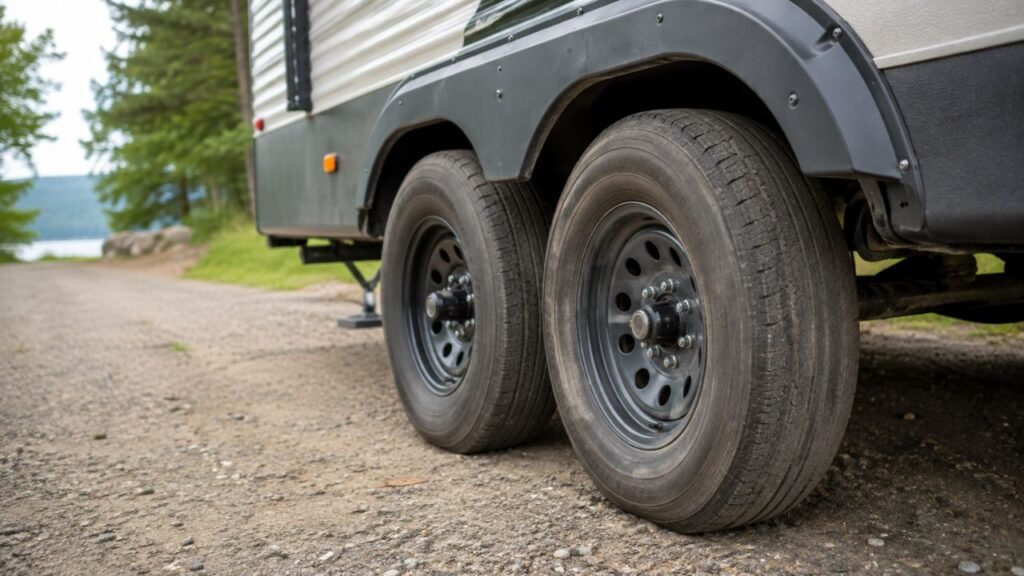
Uneven trailer tire wear usually comes from incorrect pressure, overloading, poor weight distribution, axle misalignment, bent components, worn suspension parts, bearing problems, or dragging brakes. The shape and location of the worn tread often reveal where the problem begins.
This guide will help you read each wear pattern correctly. I will also walk you through pressure, loading, alignment, bearing, suspension, and brake checks.
Key Takeaways
- Center tread wear often points toward excessive tire pressure.
- Wear across both shoulders commonly indicates low tire pressure.
- Inside-edge wear may signal overloading, camber loss, or axle damage.
- Feathered tread usually means the tire is not tracking straight.
- Cupping can develop from imbalance, bearing play, or suspension movement.
- Flat spots often result from skidding or trailer brake lockup.
- One damaged tire usually suggests a localized mechanical problem.
- Replacing the tire alone may not stop the wear.
- Severe tread damage requires attention before the trailer moves again.
What Does Uneven Trailer Tire Wear Look Like?
Uneven wear does not always appear as a completely bald tire. It may begin as a small difference across the tread surface. Checking the inner, middle, and outer sections helps you find it early.
Center Tread Wear
Center wear means the middle tread is becoming shallow faster. The outer shoulders may still look relatively healthy.
This pattern often suggests excessive pressure for the tire’s actual load. Too much pressure can reduce contact across the wider tread surface.
However, do not lower pressure based only on appearance. First, check the trailer placard and tire manufacturer’s pressure guidance.
Wear on Both Outer Shoulders
When both shoulders wear faster, the tire may be underinflated. Low pressure allows the sidewalls to flex more than intended.
The shoulders then carry a greater share of the load. This also creates additional heat inside the tire.
Overloading can produce a similar pattern. Check pressure and trailer weight before deciding which problem caused it.
Inside-Edge Wear
Inside-edge wear appears along the tread nearest the trailer frame. It may affect one tire, one axle, or every tire.
Common causes include axle camber loss, overloading, bent spindles, or alignment problems. Worn suspension parts can also change the wheel angle.
This pattern deserves prompt attention. The inner edge is difficult to see during a quick walk-around.
Outside-Edge Wear
Outside-edge wear affects the tread nearest the outer sidewall. It may indicate excessive positive camber or damaged axle components.
Incorrect axle installation can also create this pattern. A wheel alignment check may be necessary to confirm the cause.
Do not confuse single-edge wear with both-shoulder wear. They usually point toward different problems.
Feathering or Toe Wear
Feathered tread feels smooth when rubbed in one direction. It feels sharp or raised when rubbed the opposite way.
This happens when the tire scrubs sideways instead of rolling straight. Incorrect toe alignment is a common reason.
The axle may have shifted, bent, or moved out of square. Damaged suspension mounts can create the same tracking problem.
Cupping or Scalloped Wear
Cupping creates repeating dips or shallow bald spots around the tread. Some tread blocks remain higher than neighboring sections.
This pattern develops when the wheel repeatedly bounces or wobbles. Imbalance, bearing looseness, or suspension wear may be responsible.
A bent wheel or excessive hub runout can also cause cupping. The tire may need replacement after correcting the mechanical problem.
Flat Spots
A flat spot is one localized area worn smoother than everything else. It normally forms when the tire stops rotating while moving.
Brake lockup is a common cause on electric-brake trailers. Hard emergency braking or skidding may also create flat spots.
A severe flat spot can cause vibration and repeated bouncing. Inspect the brake system before installing another tire.
Random or Diagonal Wear
Some trailer tires develop diagonal strips or mixed irregular patches. These patterns often involve more than one problem.
For example, low pressure may combine with alignment or bearing movement. A detailed inspection is usually needed to separate the causes.
Trailer Tire Wear Pattern Diagnosis Chart
This chart gives you a useful starting point. Still, inspect the complete trailer before replacing or adjusting anything.
| Wear pattern | What it looks like | Likely causes | What to check first |
| Center wear | Middle tread wears fastest | Excessive pressure for the load | Cold pressure and manufacturer specifications |
| Both shoulders worn | Inner and outer shoulders wear fastest | Low pressure or excessive load | Pressure, leaks, and loaded weight |
| Inside-edge wear | Inner shoulder becomes smooth | Overloading, camber loss, bent axle or spindle | Weight, axle shape, and wheel angle |
| Outside-edge wear | Outer shoulder wears fastest | Excessive camber or axle damage | Axle position and suspension geometry |
| Feathering | Tread feels sharp in one direction | Incorrect toe or axle misalignment | Axle alignment and tracking |
| Cupping | Repeating dips around the tread | Imbalance, bearing play, or suspension wear | Bearings, wheel balance, and runout |
| Flat spot | One section becomes noticeably smooth | Brake lockup or skidding | Brake adjustment and controller settings |
| One tire wears faster | One wheel differs from others | Bent spindle, dragging brake, or bearing fault | Hub temperature, play, and wheel angle |
| One axle wears faster | Both tires on one axle wear quickly | Trailer not level or unequal axle loading | Hitch height and axle weights |
Why Are My Trailer Tires Wearing Unevenly?
The tire is where you see the damage, but it may not be the original problem. The real cause may sit within the trailer’s loading, axle, suspension, bearing, wheel, or brake system.
Incorrect Tire Pressure
Trailer tires work under heavy loads with relatively stiff sidewalls. Correct pressure helps them maintain their intended shape and load capacity.
Low pressure increases sidewall movement and heat. It commonly wears both shoulders and may weaken the tire internally.
Excessive pressure for the actual load may concentrate wear through the center. It can also make the trailer feel harsher over uneven roads.
Check pressure when every tire is cold. A cold tire has not recently traveled or sat in direct heat.
Use the pressure recommended for your specific trailer and tires. Do not copy pressure settings from another trailer.
Also inspect for slow leaks around the tread and valve stem. Pressure loss can happen gradually without looking obvious.
Trailer Overloading
An overloaded trailer places more force on tires, wheels, bearings, and axles. Tire temperatures may rise even when pressure looks correct.
Heavy loads can also reduce the axle’s normal upward camber. The wheels may then lean inward at their upper edges.
That position places extra force along the inside tread shoulders. All tires may show similar inner-edge wear when overloading is severe.
Check the trailer’s loaded weight, not its empty weight. Include water, propane, batteries, tools, food, and personal belongings.
You must also respect the ratings for each tire and axle. Staying below the trailer’s total rating is not always enough.
One axle or individual tire can remain overloaded. This happens when weight is concentrated in one location.
Uneven Weight Distribution
Cargo placement changes how much work each tire performs. A trailer may be legal overall but badly unbalanced internally.
Heavy equipment stored on one side can overload those tires. Water tanks and batteries may create a permanent side-to-side imbalance.
Rear-heavy loading can reduce tongue weight and increase instability. Front-heavy loading may overload the tow vehicle or front axle.
Place dense cargo low and near the intended loading area. Secure everything so it cannot shift during travel.
For persistent wear, weigh individual wheel positions when possible. This reveals problems that an overall scale ticket may hide.
The Trailer Is Not Towing Level
A tandem-axle trailer should normally sit reasonably level when loaded and connected. A nose-high or nose-low position changes axle loading.
When the front sits high, the rear axle may carry more weight. A nose-low trailer may place more weight forward.
The heavily loaded axle can develop faster tire wear. Its bearings, springs, and brakes also work harder.
Check the trailer on level ground while fully loaded. Look at the frame rather than decorative body panels.
Correcting the hitch height may require an adjustable ball mount. A fifth wheel may need hitch or pin-box adjustments.
Any adjustment must preserve adequate clearance and correct towing geometry. Do not solve one problem by creating another.
Axle Misalignment
A correctly positioned axle should sit square to the trailer frame. Tandem axles must also remain properly aligned with each other.
When an axle sits crooked, the tires travel slightly sideways. That scrubbing produces feathering and rapid edge wear.
Misalignment can follow a curb strike or deep pothole. Loose U-bolts may also allow an axle to shift.
Damaged spring hangers or frame sections can change axle position. Previous repair work may leave an axle installed incorrectly.
Alignment should be checked with the trailer properly loaded. Measurements taken on uneven ground may provide misleading results.
Bent Axle or Damaged Spindle
Trailer axles can bend after overloading or hard road impacts. A spindle may also bend without obvious axle tube damage.
A bent axle changes camber or toe across both wheels. A damaged spindle usually creates a problem at one wheel.
Inside-edge wear on one tire deserves close spindle inspection. Outside-edge wear may also appear depending on the bend.
Look for a wheel that visibly leans differently. Compare it with the matching wheel on the opposite side.
Do not attempt to straighten structural components without proper knowledge. An axle specialist should assess questionable damage.
Worn Suspension Components
The suspension keeps each axle positioned beneath the trailer. Worn parts can let the wheels move outside their intended angles.
Inspect these common problem areas:
- Leaf springs
- Spring-eye bushings
- Shackles
- Shackle bolts
- Equalizers
- Spring hangers
- U-bolts
- Torsion suspension arms
- Shock absorbers, when equipped
- Suspension mounting brackets
Elongated holes, cracked hangers, and worn bushings create uncontrolled movement. This can cause toe changes, axle movement, and tire scrubbing.
Rust around a bolt may also indicate movement. Compare every suspension part with the matching opposite-side component.
Loose or Worn Wheel Bearings
Wheel bearings keep the hub rotating smoothly in a controlled position. Excessive play allows the wheel to wobble under load.
The wheel angle may change continuously while traveling. This can create cupping, irregular edges, and heat.
A loose bearing may produce noticeable movement when the wheel is raised. It may also create grinding or humming sounds.
An overtightened bearing can overheat and fail prematurely. Bearing adjustment must follow the correct procedure and specifications.
Always support the trailer securely before checking wheel play. Never work beneath a trailer supported by a jack alone.
Wheel Imbalance or Excessive Runout
An unbalanced trailer wheel may repeatedly hop at road speed. This movement can produce cupped or scalloped tread wear.
Some trailer owners assume balancing is unnecessary. However, balancing can reduce vibration and stress on nearby components.
A bent wheel may create similar movement even after balancing. Hub or wheel runout should be checked when the problem continues.
The tire must also sit evenly around the wheel. Poor bead seating can make the assembly rotate irregularly.
Balancing will not repair misalignment or damaged suspension. Treat it as one part of the complete diagnosis.
Brake Drag or Brake Lockup
A dragging brake keeps applying friction while the trailer moves. That wheel may become hotter than the others.
Brake drag can develop from incorrect adjustment or damaged hardware. Electrical problems may also keep a brake partially engaged.
A locked wheel slides across the road instead of rolling. Even a brief lockup can create a noticeable flat spot.
Aggressive brake controller settings may lock lightly loaded trailer wheels. Mechanical adjustment problems can affect only one wheel.
After a careful test drive, compare hub temperatures. One unusually hot hub needs immediate inspection.
Avoid touching a hot hub directly with your hand. Use safe temperature-checking methods and allow components to cool.
Tire Defects, Aging, or Internal Damage
Not every unusual pattern begins with the trailer. An aging or damaged tire may lose its intended shape.
Separated belts can create bulges, vibration, or irregular tread height. Heat damage may weaken the casing internally.
Check the sidewall date code and overall condition. Age matters even when tread depth remains acceptable.
Inspect for cracks, bulges, exposed material, and tread separation. Replace any tire showing structural damage.
Confirm that every tire has the correct size and load rating. Mixed construction or mismatched sizes can affect load sharing.
Tight Turns and Normal Tandem-Axle Scrubbing
Tandem-axle trailer tires cannot follow identical paths during sharp turns. Some tires must scrub slightly across the pavement.
You may see minor scuffing after tight campground maneuvers. This does not always mean the axle is damaged.
However, normal turning scrub should not destroy tires quickly. Severe edge wear during highway use needs further investigation.
What Uneven Wear on One Tire, One Side, or One Axle Means
The number and location of affected tires can narrow your search. Compare every tire before deciding what needs repair.
Only One Trailer Tire Is Wearing Unevenly
One unusual tire usually suggests a localized issue. Possible causes include a bent spindle, loose bearing, brake drag, bent wheel, damaged suspension part, or defective tire.
Compare that wheel’s angle, temperature, and movement with the others. A single worn tire rarely comes from overall trailer pressure alone.
Both Tires on One Side Are Wearing Faster
This pattern may indicate side-to-side weight imbalance. Heavy appliances, tanks, batteries, or storage can overload one side.
A sagging spring or damaged frame section may also lower that side. Measure trailer height and inspect the suspension carefully.
Both Tires on One Axle Are Wearing Faster
Faster wear across one complete axle often suggests unequal axle loading. The trailer may be towing nose-high or nose-low.
A damaged equalizer can also prevent proper load sharing. Compare spring positions and loaded axle weights.
All Trailer Tires Have Inside-Edge Wear
Inside wear across every tire often points toward overloading. Multiple axles may have lost their intended camber under excessive weight.
Incorrectly rated axles can create similar results. Confirm the actual loaded weight and component ratings.
New Tires Are Wearing Unevenly
New tires should not develop rapid irregular wear. When they do, the original problem probably remains unresolved.
Replacing tires cannot correct a bent axle or dragging brake. Diagnose the trailer before sacrificing another set.
How Can I Diagnose Uneven Trailer Tire Wear?
Start with simple checks before taking measurements or removing components. Work carefully and record what you find at every wheel.
- Park the trailer on firm, level ground.
- Connect or secure it against unexpected movement.
- Chock the wheels before beginning your inspection.
- Look across the full tread of every tire.
- Inspect the hidden inner shoulders with adequate lighting.
- Measure inner, center, and outer tread depth.
- Check cold tire pressure with a reliable gauge.
- Look for punctures, leaking stems, and damaged valve cores.
- Confirm matching tire sizes and load ratings.
- Review the trailer’s actual loaded weight.
- Check whether heavy cargo favors one side.
- Confirm the trailer sits level when hitched.
- Inspect springs, shackles, equalizers, and hangers.
- Check each raised wheel for bearing play.
- Look for bent wheels or unusual wheel angles.
- Compare hub temperatures after controlled driving.
- Check the brakes for dragging or lockup.
- Measure axle alignment when basic checks reveal nothing.
Do not continue towing when the tire has exposed cords or bulges. These conditions can lead to sudden tire failure.
How Do I Read Trailer Tire Wear Accurately?
Small differences can be difficult to judge by sight. Measuring and recording the tread gives you more reliable information.
Measure Tread Depth in Three Places
Measure each tire at several positions around its circumference. Record these areas separately:
- Inner tread section
- Center tread section
- Outer tread section
- Front and rear positions around the tire
- Matching positions on every other tire
One measurement may land on an unusually worn patch. Multiple readings show the complete pattern more accurately.
Check for Feathering by Hand
Run your hand lightly across the tread in both directions. Feathered tread feels smoother one way and sharper the other.
Be careful around exposed wires or damaged rubber. Wear gloves when the tire condition is questionable.
Compare Wear Across the Complete Trailer
Do not inspect one damaged tire in isolation. Compare it with the same axle, opposite side, and remaining tires.
The comparison shows whether the problem is local or widespread. This saves time during the mechanical inspection.
Record Pressure, Mileage, and Measurements
Write down each tire’s pressure and tread depth. Add the date and trailer mileage when available.
Repeat the measurements after correcting a suspected problem. Stable tread readings indicate the repair may be working.
Can I Check Trailer Wheel Alignment at Home?
Basic measurements may reveal an obvious alignment problem. Precise diagnosis still requires consistent references, level ground, and careful technique.
Check Whether the Axle Is Square
You can compare distances from a fixed trailer reference point. The coupler or frame may provide a suitable reference.
Measure toward matching locations at each hub or axle end. Large differences may indicate an axle sitting out of square.
Measurements must use identical points on both sides. Decorative panels and irregular body edges are unreliable references.
Compare Axle Position on Tandem Trailers
Measure the spacing between corresponding axle or hub locations. The relationship should remain consistent from side to side.
Unequal spacing may indicate shifted suspension hardware. Bent or cracked hangers can also change axle position.
Check Camber and Toe
Camber describes how the wheel leans vertically. Toe describes whether the wheels point inward or outward.
Both angles affect how the tire contacts the road. Small errors can cause major wear over long distances.
Home measurements may identify a severe problem. Professional equipment provides more accurate results for final diagnosis.
When Home Measurements Are Not Enough
Arrange professional alignment or axle inspection when:
- One tire repeatedly wears out early.
- The trailer recently struck a curb.
- A wheel visibly leans or tracks sideways.
- The axle or spindle may be bent.
- Spring hangers show cracks or movement.
- Wear continues after correcting pressure.
- The trailer pulls noticeably while towing.
- Your measurements remain inconsistent.
How Do I Fix Uneven Trailer Tire Wear?
The correct repair depends on the confirmed cause. Fix the trailer problem before installing replacement tires.
| Confirmed problem | Corrective action |
| Incorrect pressure | Set the correct cold pressure and repair leaks |
| Overloaded trailer | Remove weight and confirm all component ratings |
| Side-to-side imbalance | Redistribute cargo and verify wheel-position loads |
| Trailer not level | Correct hitch height and loaded towing position |
| Wheel imbalance | Balance the assembly and inspect wheel runout |
| Loose bearing | Inspect, service, adjust, or replace bearing components |
| Worn suspension | Replace worn bushings, shackles, springs, or equalizers |
| Misaligned axle | Identify the cause and realign the axle properly |
| Bent axle or spindle | Have it professionally repaired or replaced |
| Brake lockup | Inspect brakes, wiring, and controller settings |
| Brake drag | Repair sticking or incorrectly adjusted components |
| Damaged tire | Replace it after correcting the underlying problem |
Do not assume a pressure adjustment fixes every pattern. Inside wear, feathering, and repeated cupping often require mechanical inspection.
Can I Keep Driving With Unevenly Worn Trailer Tires?
Whether you can continue depends on the wear severity. Mild early wear may allow a careful trip to a repair facility.
Before moving, confirm that pressure remains stable. Also check for heat, bulges, deep cracks, and exposed materials.
Stop towing when you find:
- Exposed cords or internal belts
- Bulges along the tread or sidewall
- Visible tread separation
- Deep cracking around the casing
- Rapid pressure loss
- Severe inside-edge wear
- Wheel wobble or bearing looseness
- An unusually hot hub
- Repeated brake lockup
- A visibly bent wheel or spindle
- Tire contact with the trailer body
A tire can look acceptable from outside while its inner edge is nearly bald. Always inspect the hidden side carefully.
Should I Replace an Unevenly Worn Trailer Tire?
Correcting the cause cannot restore missing tread. A damaged tire may still need replacement after the trailer is repaired.
Replace tires with exposed cords, separated tread, bulges, or serious cracking. Replacement is also necessary when tread depth becomes unsafe.
Consider how much usable tread remains across the entire surface. The shallowest section matters more than the deepest section.
Use compatible tires across the same axle. Match size, construction, load range, and intended trailer use.
Do not install a lower-rated tire as a temporary substitute. It may become overloaded even during a short trip.
Why Did My Replacement Trailer Tire Wear Unevenly Again?
Repeated tire wear usually means the original cause was missed. The new tire simply displayed the same unresolved problem.
Common reasons include:
- The bent axle was never corrected.
- The trailer still tows at an angle.
- The hitch height remains incorrect.
- Cargo still overloads one wheel.
- The bearing remains loose.
- The brake continues dragging.
- The wheel is bent or unbalanced.
- Suspension bushings remain worn.
- Pressure is not checked regularly.
- The replacement tire has the wrong rating.
- Alignment was measured incorrectly.
- Only the damaged tire was replaced.
Repeated wear should not be treated as normal tire aging. Stop replacing tires until the trailer receives a complete inspection.
How Can I Prevent Uneven Trailer Tire Wear?
Regular inspections help you find small problems before they destroy tires. The complete towing setup needs attention, not only the rubber.
- Check every tire while cold before traveling.
- Use a dependable tire pressure gauge.
- Inspect inner shoulders with a flashlight.
- Repair slow leaks before the next journey.
- Confirm trailer weight after major loading changes.
- Keep each axle and tire within its rating.
- Balance cargo from side to side.
- Secure cargo against movement.
- Maintain suitable tongue or pin weight.
- Keep the loaded trailer reasonably level.
- Inspect suspension hardware regularly.
- Service wheel bearings at appropriate intervals.
- Check brake adjustment and controller operation.
- Inspect the trailer after pothole impacts.
- Record tread measurements during maintenance.
- Replace damaged valve stems and caps.
- Use a tire-pressure monitoring system for added warning.
- Investigate new vibration or pulling immediately.
A pressure monitor can warn you about air loss and heat. It cannot identify a bent axle or worn suspension part.
Trailer Tire Inspection Checklist
A consistent inspection routine makes developing wear easier to spot. Use the following checks throughout the towing season.
Before Each Trip
- Measure cold tire pressure.
- Look for cuts, cracks, or bulges.
- Inspect outer and inner tread edges.
- Check for embedded objects.
- Confirm the trailer is not leaning.
- Look for tire-to-body contact.
- Check visible suspension hardware.
- Confirm the load has not shifted.
During Travel Stops
- Walk around the complete trailer.
- Look for pressure loss or distortion.
- Compare tire and hub temperatures safely.
- Check for smoke or burning smells.
- Listen for grinding or unusual noises.
- Watch for a leaning wheel.
- Confirm cargo remains secure.
During Scheduled Maintenance
- Measure tread depth across each tire.
- Inspect and service wheel bearings.
- Check brake adjustment and wiring.
- Inspect springs and equalizers.
- Check shackles and suspension bushings.
- Tighten hardware to correct specifications.
- Check axle position and alignment.
- Inspect wheel balance and runout.
- Review tire age and condition.
- Confirm the trailer still tows level.
When Should I Take the Trailer to a Professional?
Some tire wear problems need more than a pressure gauge. Axle geometry and structural damage require accurate equipment and experience.
Seek professional help when:
- New tires develop rapid uneven wear.
- One wheel visibly leans differently.
- The axle may be bent.
- A spindle may have impact damage.
- The trailer recently hit a curb.
- Spring hangers appear cracked.
- Bearings repeatedly loosen or overheat.
- Brakes continue locking or dragging.
- The trailer tracks sideways.
- Alignment measurements fall outside specifications.
- The cause remains unclear after basic checks.
A trailer or axle specialist may be more suitable than a basic tire shop. Ask whether the facility checks loaded trailer alignment and suspension geometry.
Final Verdict
Uneven trailer tire wear is usually a warning, not simply an appearance issue. The pattern helps you identify whether pressure, loading, alignment, suspension, bearings, or brakes need attention.
Start by comparing every tire and checking cold pressure. Then inspect weight distribution, trailer level, bearings, brakes, suspension, and axle alignment.
Correct the root cause before replacing damaged tires. Otherwise, the next tire may wear in exactly the same way.
Related FAQs
The following answers address common questions about trailer tire wear and diagnosis.
Is Uneven Wear Normal on Tandem-Axle Trailer Tires?
Minor scrubbing can happen during tight, low-speed turns because tandem tires follow different paths. Rapid edge wear, cupping, feathering, or repeated bald spots are not normal and need inspection.
Why Are My Trailer Tires Wearing on the Inside?
Inside wear commonly results from overloading, lost axle camber, a bent axle, damaged spindle, or alignment problems. Compare all tires to determine whether the issue is local or trailer-wide.
Why Is Only One Trailer Tire Wearing on the Inside?
Inside wear on one tire usually suggests a localized problem. Check that wheel’s spindle, bearing, brake, suspension parts, wheel angle, and tire condition before replacing it.
Why Are Both Tires on One Trailer Axle Wearing Faster?
One axle may be carrying too much weight because the trailer is not level. A damaged equalizer, shifted axle, or poor cargo position can also reduce proper load sharing.
Can Low Tire Pressure Cause Uneven Trailer Tire Wear?
Yes. Low pressure lets the sidewalls flex excessively and transfers more load toward both shoulders. It also creates heat, which can damage the casing internally.
Can Overinflation Cause Center Tread Wear?
Excessive pressure for the actual load may concentrate contact through the tread center. Always verify the correct pressure before lowering it because trailer tire requirements vary.
Can an Overloaded Trailer Cause Inside Tire Wear?
Yes. Excessive load can flatten the axle’s intended camber and tilt the wheels inward. This places greater pressure on the inner tread shoulders.
Can a Bent Trailer Axle Be Realigned?
Some axles may be repairable, while others require replacement. The correct decision depends on axle design, damage severity, and manufacturer guidance, so professional assessment is important.
Do Trailer Tires Need to Be Balanced?
Balancing can reduce vibration, bouncing, and cupping. However, it cannot correct a bent spindle, loose bearing, damaged suspension, or axle alignment problem.
Can Loose Wheel Bearings Cause Uneven Tire Wear?
Yes. Bearing play lets the wheel wobble and change its running angle. This movement can produce cupping, irregular edges, heat, and unstable wheel tracking.
Will Rotating Trailer Tires Fix Uneven Wear?
Rotation may redistribute normal wear when the trailer manufacturer permits it. It will not correct pressure, alignment, axle, bearing, suspension, brake, or loading problems.
How Often Should I Inspect Trailer Tire Wear?
Check the tires before every towing trip and during travel stops. Measure tread depth periodically, especially after long journeys, impacts, loading changes, or newly discovered vibration.

Scott Miller shares real-world RV road trip insights built from years of traveling open highways and backroads. He covers route planning, campground choices, and travel gear with a practical mindset. His content is written for RVers who value reliability over trends.