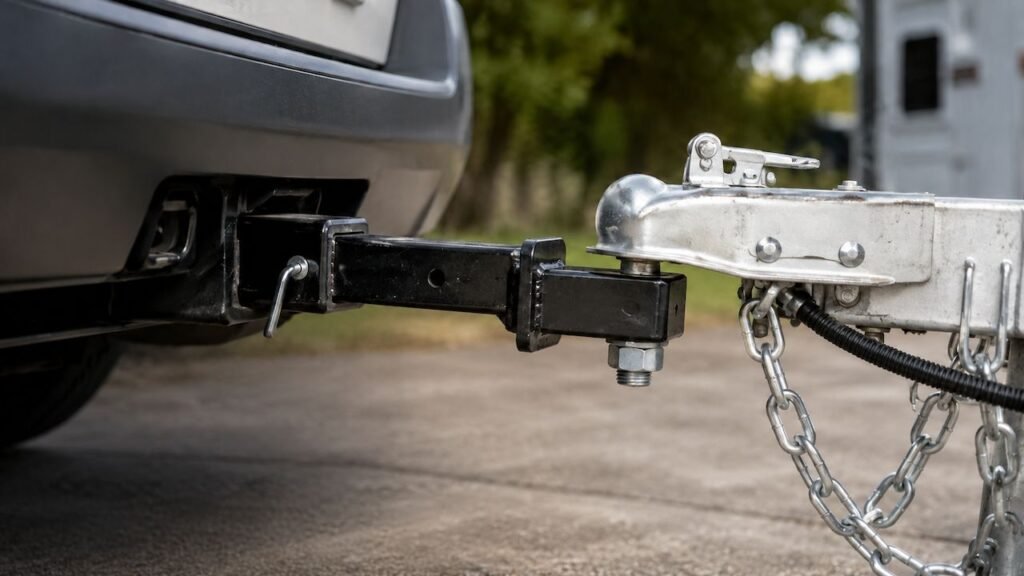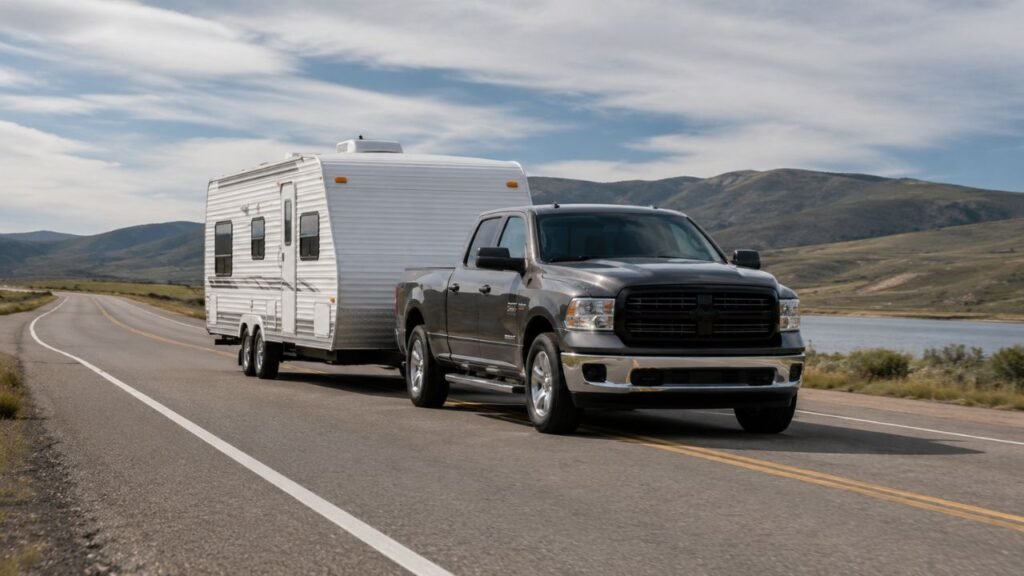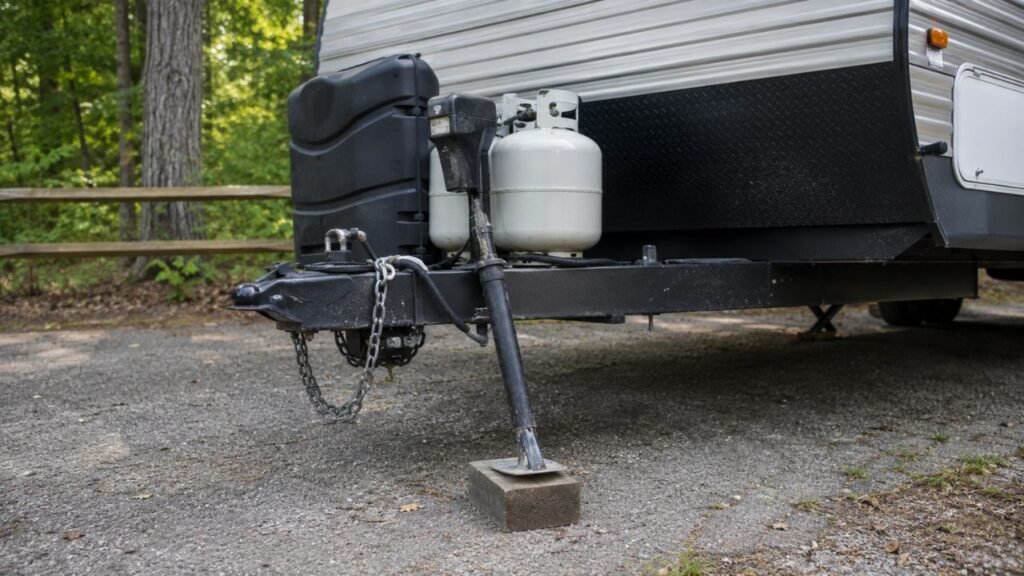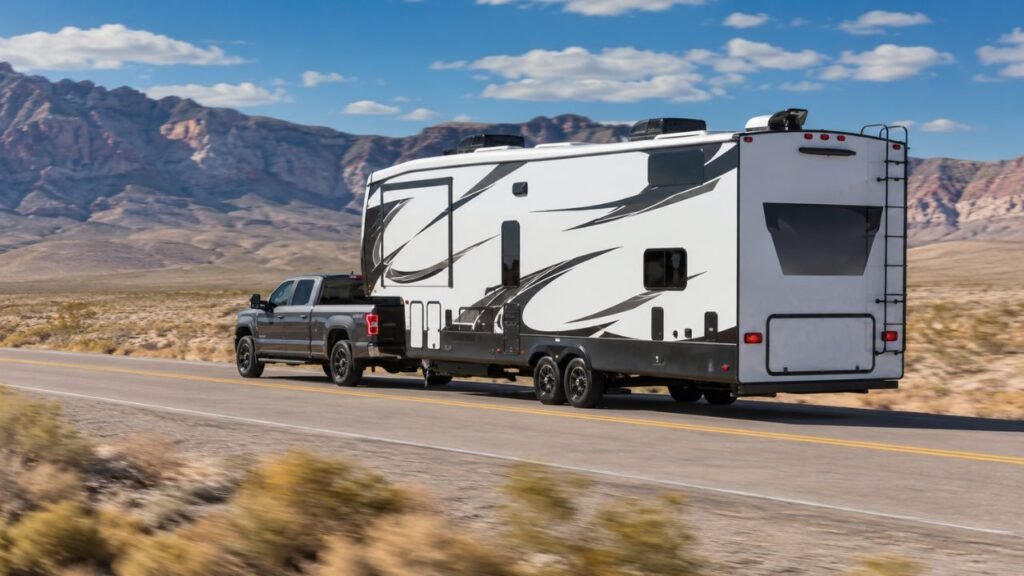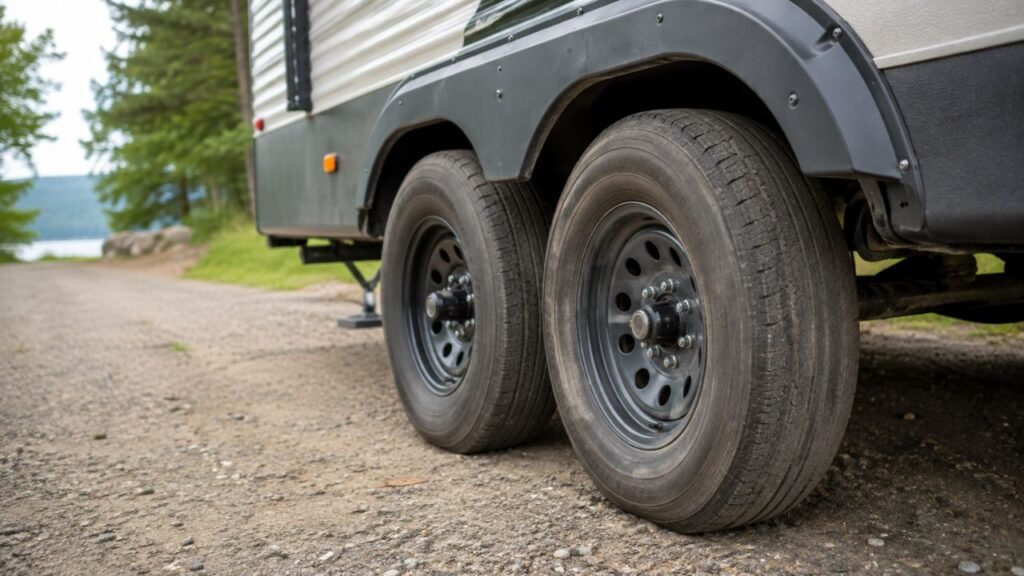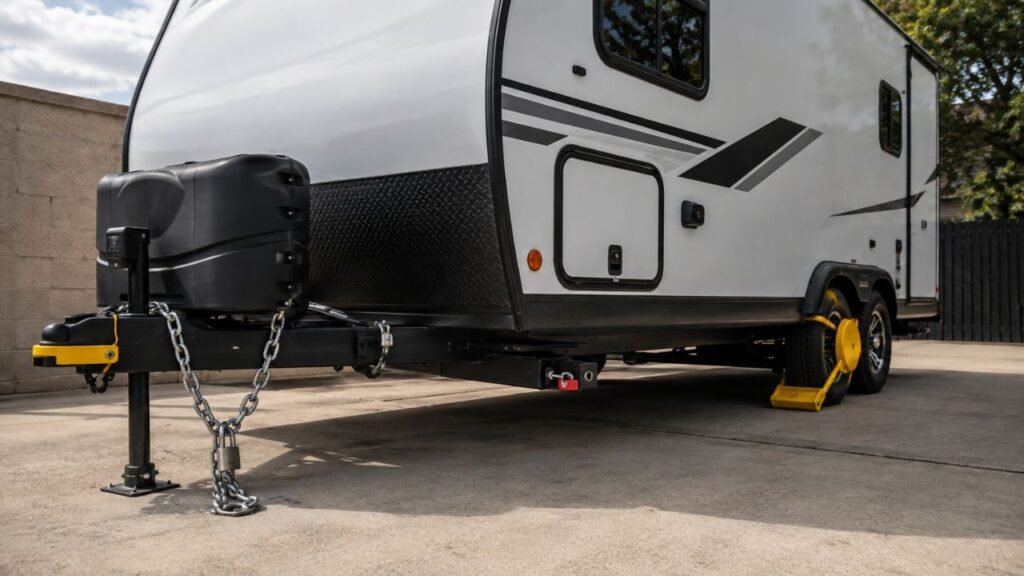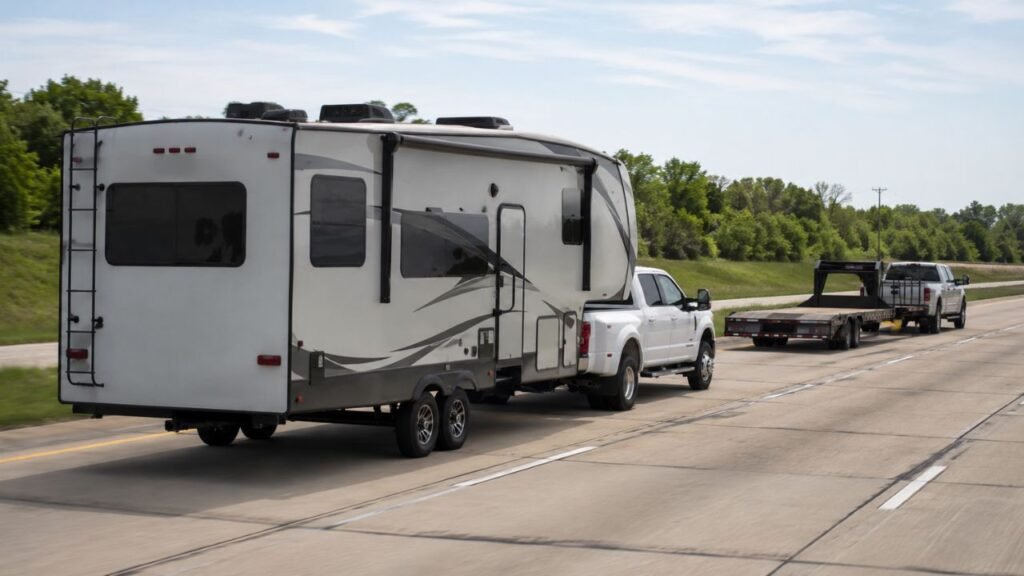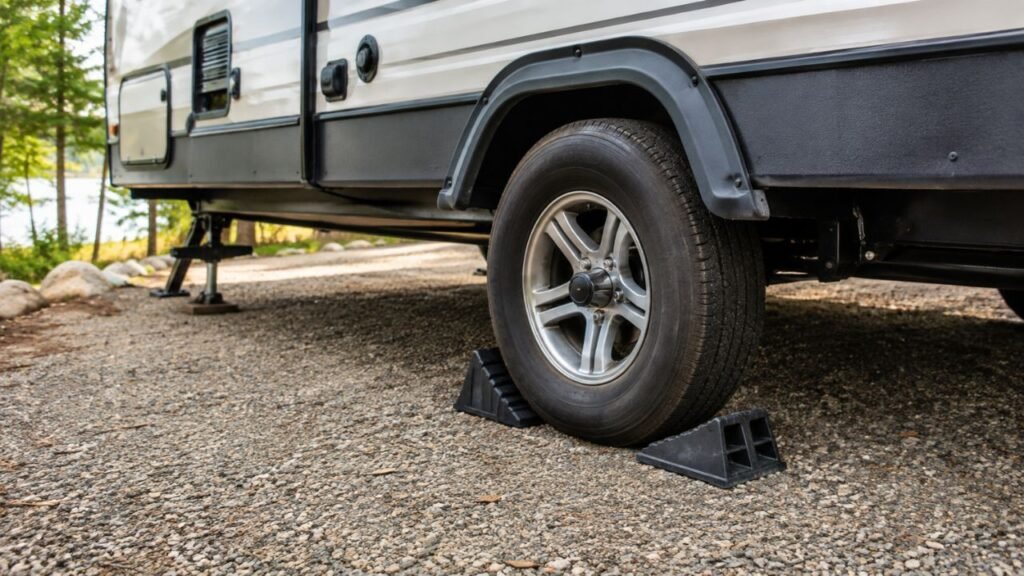
Wheel chocks keep sliding when they cannot create enough grip between the chock and the ground. Smooth concrete, wet pavement, loose gravel, undersized chocks, poor placement, and excessive slope can all cause a chock to move instead of holding the tire.
If your RV or trailer keeps shifting after you chock the wheels, I’ll help you figure out why. We’ll also cover proper placement, better chock materials, sizing, and a safer setup that keeps your trailer where you parked it.
Key Takeaways
- Wheel chocks need good ground friction to resist trailer movement.
- Wet, oily, dusty, or loose surfaces make sliding more likely.
- Small or lightweight chocks may struggle with larger trailer tires.
- The chock should normally sit firmly against the tire.
- Rubber chocks often grip pavement better than hard plastic ones.
- Steep slopes put considerably more force against your wheel chocks.
- Stabilizer jacks should not replace properly positioned wheel chocks.
- Recheck the chocks after leveling, unhitching, or shifting trailer weight.
Why Do Wheel Chocks Keep Sliding?
A wheel chock does more than simply block the tire. It needs enough friction against the ground to stay stationary while the tire pushes against its angled face.
When that grip is too weak, the tire does not necessarily climb over the chock. Instead, the tire can simply push the entire chock across the ground.
This is particularly noticeable with travel trailers and fifth wheels. These vehicles can place substantial force against relatively small wheel chocks.
The problem becomes worse when the trailer sits on a slope.
Your chocks may also slide because of the surface underneath them. Concrete dust, loose stones, sand, rainwater, mud, oil, or even grass can reduce their ability to stay planted.
Chock size matters too. A tiny chock designed for a passenger car may not provide enough height or tire contact for a large trailer tire.
So, if your chocks keep moving, don’t automatically assume they are defective. Start by looking at the surface, positioning, size, material, and slope.
Common Reasons Wheel Chocks Slide
Several small setup problems can create the same frustrating result. Here are the most common reasons I would check first when wheel chocks refuse to stay where you put them.
The Ground Is Too Smooth
Smooth concrete looks like an ideal parking surface, but it can actually create problems with certain wheel chocks.
A hard plastic chock placed on polished or sealed concrete may have surprisingly little grip.
Instead of biting into the surface, the bottom can slide across it when your trailer starts pushing against the chock.
Garage floors can be particularly troublesome because painted or sealed concrete is often smoother than outdoor pavement.
The Surface Is Wet, Icy, or Oily
Anything sitting between the chock and pavement can reduce traction.
Water is one example. Oil, mud, algae, snow, and ice can make the situation considerably worse.
Even a good rubber chock can struggle when it sits on a contaminated surface.
Before placing your chocks, look underneath them. A quick sweep or wipe can sometimes solve the entire problem.
Gravel or Dirt Moves Under the Chock
Gravel creates a slightly different problem.
Sometimes the chock itself is gripping perfectly well. The rocks underneath it are what actually move.
As the trailer pushes against the chock, loose stones can roll or shift. The entire chock then moves along with them.
Soft dirt can behave similarly.
A heavy trailer may compress the soil or push the chock into it instead of creating a solid stopping point.
The Wheel Chock Is Too Small
I see this overlooked quite often.
Wheel chocks may look fairly similar, but they are not necessarily designed for the same tires or vehicles.
A small passenger-car chock may sit very low against a large RV tire.
Trailer tires also deform slightly under load. If the chock is too small, the tire may push heavily into it without getting the resistance you expected.
A larger chock generally gives you a taller barrier and larger contact area.
However, don’t choose chocks based on appearance alone. Check the manufacturer’s recommended tire size and application.
The Chock Is Too Lightweight
Weight alone does not make a chock safe or unsafe.
However, very lightweight hollow plastic chocks can be easier to displace on smooth surfaces.
This becomes particularly noticeable if the chock doesn’t have a good traction pattern underneath.
A heavier rubber chock often stays planted more easily because it combines weight with a high-friction surface.
That doesn’t mean every rubber chock is suitable for every trailer. Size and load capability still matter.
The Chock Material Does Not Suit the Surface
Different chock materials behave differently against the ground.
Rubber generally provides good friction on asphalt and concrete.
Hard plastic can also work well when properly designed, but some inexpensive models have relatively smooth bottoms.
Metal chocks may rely on teeth or serrations that grip suitable surfaces.
Your parking environment should influence the type of chock you use.
The Chock Is Positioned Incorrectly
Your wheel chock should not be sitting several inches away from the tire.
That gap gives the wheel room to move before hitting the chock.
Once the trailer starts moving, the tire has momentum behind it. That can shove the chock across the ground.
I prefer placing traditional chocks snugly against the tire after the trailer has stopped moving.
Also keep the chock centered with the tire rather than sitting partly off to one side.
The Trailer Is Parked on Too Much of a Slope
The steeper your parking spot becomes, the harder gravity tries to move the trailer downhill.
That means more force is transferred through the tire and into the wheel chock.
Eventually, the chock may no longer have enough ground traction to resist that force.
This is why wheel chocks should never be treated as permission to park on an unsafe slope.
Whenever possible, choose a reasonably level campsite before you start leveling and stabilizing.
The Trailer Moves Before the Chocks Fully Seat
Sometimes your chocks are installed correctly, but the trailer moves afterward.
Leveling the trailer, raising or lowering the tongue jack, unhitching, and adjusting stabilizers can slightly change how the trailer sits.
That movement may shift the tires and reduce contact with your original chock position.
After your setup is complete, take another look at the chocks.
If one has developed a gap, reposition it before settling into camp.
How to Stop Wheel Chocks From Sliding
You usually don’t need a complicated solution. Start with the basic setup and correct anything reducing the chock’s grip.
- Park on the flattest practical surface available.
- Bring the trailer or vehicle to a complete stop.
- Set the parking brake where applicable.
- Remove loose rocks, dirt, water, and debris beneath the chocks.
- Check that the chocks are facing the proper direction.
- Place each chock firmly against the tire.
- Keep the chock centered across the tire tread.
- Use chocks appropriately sized for your tires and trailer.
- Chock against possible movement in both directions when needed.
- Recheck every chock after leveling and unhitching.
- Replace cracked, flattened, or badly worn chocks.
- Move to a safer location if the slope overwhelms your setup.
If your existing chocks repeatedly slide despite correct placement, don’t keep accepting the movement as normal.
Your chocks may simply be unsuitable for your trailer or parking surface.
How Should Wheel Chocks Be Positioned?
Correct positioning depends on where the trailer could move. The basic idea is to create a barrier in the direction the tire would naturally roll.
On Level Ground
On reasonably level ground, your trailer may potentially move forward or backward.
Chocking both directions helps prevent that movement.
For an RV trailer, I don’t like relying on one randomly placed chock while the remaining tires stay unsecured.
Use an arrangement appropriate for your trailer, tire configuration, and chock manufacturer.
When Facing Uphill
If the trailer could roll downhill, position the chocks where they resist that movement.
The chock should be securely seated against the tire rather than waiting several inches away.
Remember that the tow vehicle’s parking brake and transmission should still do their jobs where applicable.
The chock adds another layer of protection.
When Facing Downhill
The same principle applies when the trailer faces downhill.
Put the chock on the side where it blocks the tire’s likely rolling direction.
If movement in either direction is possible, properly chocking both directions offers better restraint.
On Tandem-Axle Trailers
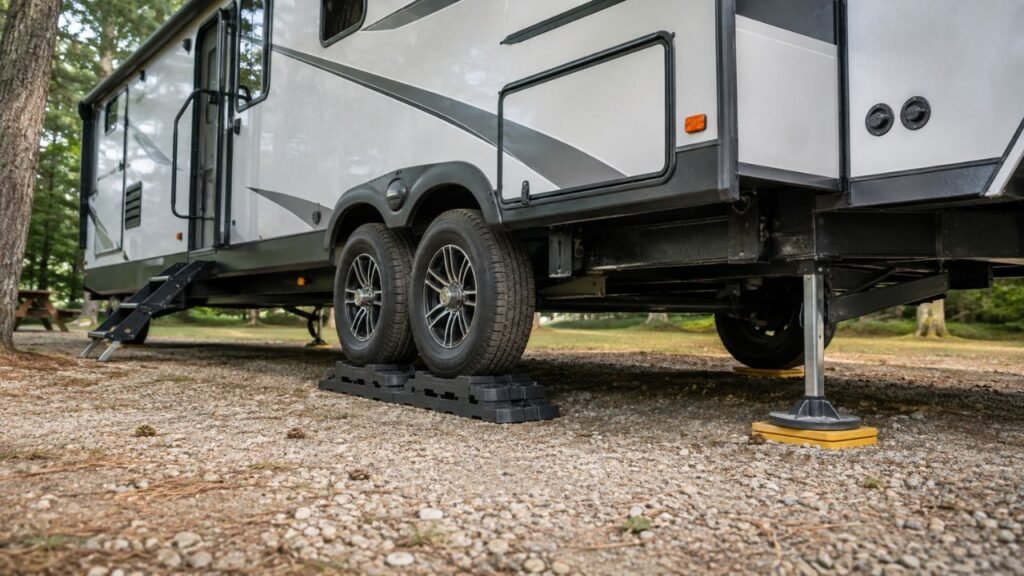
Tandem-axle travel trailers give you several chocking options.
Traditional ground chocks prevent the tires from rolling across the campsite.
Between-wheel locking chocks can also reduce movement between closely spaced tandem tires.
These devices can make the trailer feel noticeably firmer while you’re inside.
However, I would not automatically use a between-wheel stabilizing device as a complete replacement for conventional wheel chocks.
Use each product according to its intended purpose.
Should Wheel Chocks Touch the Tires?
Yes, traditional wheel chocks should normally sit snugly against the tire once the vehicle or trailer has stopped moving.
Leaving a large space between the tire and chock makes the chock less effective.
The trailer can begin rolling before the tire reaches it.
That movement creates additional force when the tire finally contacts the chock.
Instead, position the chock directly against the tire while everything is stationary.
You don’t need to hammer it underneath the tire. Just make sure it is firmly seated and properly aligned.
Always follow the placement instructions provided with your particular wheel chocks.
Are Rubber Wheel Chocks Less Likely to Slide?
Rubber wheel chocks often grip concrete and asphalt very well.
The rubber surface tends to create more friction than smooth, hard plastic on many paved surfaces.
Their additional weight can also help them stay planted while you’re positioning the trailer.
That makes heavy rubber chocks a popular choice for RV and trailer owners.
Still, I wouldn’t say rubber automatically solves every sliding problem.
A rubber chock can still move on ice, oil, mud, loose gravel, or a severe slope.
An undersized rubber chock can also be a poor choice for a large tire.
Think about the complete setup rather than the material alone.
Rubber vs Plastic vs Metal Wheel Chocks
Each chock material has strengths and weaknesses. The best option depends on your trailer size, tires, parking surface, and how you normally travel.
| Wheel Chock Type | Ground Grip | Durability | Weight | Best Use | Main Limitation |
| Rubber | Usually high on pavement | High | Medium to heavy | RVs, trailers, asphalt, concrete | Heavier and bulkier |
| Plastic or composite | Varies by design | Moderate to high | Light | General camping and vehicle use | Some lightweight models slide easily |
| Metal | Depends heavily on bottom design | Very high | Medium | Industrial and specialty applications | Smooth metal needs proper gripping features |
| Between-tire locking chock | Depends on design | Moderate to high | Medium | Reducing movement on tandem axles | Doesn’t automatically replace ground chocks |
For most RV owners parking primarily on concrete or asphalt, a properly sized rubber chock is a straightforward option.
If you regularly camp on gravel, dirt, or unusual surfaces, look for a chock specifically suited to those conditions.
How Big Should Wheel Chocks Be for an RV or Trailer?
There isn’t one universal wheel chock size that works for every RV.
The correct chock should match the tire size, vehicle application, and expected load.
When you’re choosing one, check:
- Recommended tire diameter.
- Recommended tire width.
- Vehicle or trailer application.
- Manufacturer load information.
- Chock height.
- Chock width and footprint.
- Bottom traction design.
- Surface compatibility.
Be particularly careful with very small chocks sold for passenger cars.
They may physically fit under an RV tire but still be poorly suited to holding a heavier trailer.
Your wheel chocks are inexpensive compared with the trailer they’re supposed to secure. This isn’t an accessory where I would deliberately choose the smallest option just to save storage space.
Can a Trailer Roll Over Wheel Chocks?
Yes, a trailer can potentially roll over a wheel chock.
One common cause is using a chock that is much too small for the tire.
Tires are flexible rather than completely rigid. Under enough load, the tire can deform around a small obstacle.
A trailer may also push the chock forward before climbing over it.
Steep slopes increase this risk because more force is acting against the chock.
Damaged or partially collapsed chocks make things worse.
The answer isn’t simply buying the tallest object you can find.
Use wheel chocks designed for your tire size and trailer application, then park on a reasonable surface whenever possible.
Why Do Wheel Chocks Slide on Concrete?
Concrete can be surprisingly slippery for wheel chocks.
This is especially true when the surface is sealed, polished, dusty, painted, or wet.
Concrete dust acts almost like tiny rolling particles underneath a hard chock.
Oil and water reduce grip even further.
If your chocks consistently slide on concrete, clean the contact area first.
Then inspect the bottom of the chock.
A smooth plastic base may provide much less traction than a deeply textured rubber surface.
Switching to a properly sized high-grip chock can make a noticeable difference.
Why Do Wheel Chocks Slide on Gravel?
Loose gravel moves when pressure is applied to it.
That’s why your wheel chock may seem to slide even when its bottom has plenty of texture.
The chock grips the stones, but the stones roll or move across the soil underneath.
Try clearing away loose surface gravel until you reach a firmer base.
A chock with a larger footprint may also distribute pressure more effectively.
If the ground is extremely loose, sandy, or unstable, moving the trailer to a firmer parking position may be the better solution.
You don’t want your entire setup depending on a few loose rocks staying in place.
Can I Put a Rubber Mat Under Wheel Chocks?
A suitable high-friction rubber traction surface can sometimes help when a chock keeps slipping across smooth pavement.
However, I wouldn’t put random materials underneath the chock simply to create extra height or grip.
Folded carpet, cardboard, soft foam, loose wood scraps, or thin plastic can create another moving layer underneath the chock.
Whatever you place there must remain flat and stable under pressure.
Before adding anything, make sure the chock itself is appropriately sized and designed for your trailer.
Fixing the wrong chock with improvised materials isn’t my preferred solution.
Should I Chock Both Sides of an RV Tire?
If your RV could move forward or backward, securing against movement in both directions is a sensible approach.
This is particularly useful on campsites that appear level but still have a slight grade.
A trailer can also shift slightly while you’re unhitching or adjusting the tongue jack.
Chocks positioned to resist both directions help control that movement.
The exact arrangement depends on your axle configuration, terrain, and chock design.
Don’t focus only on how many chocks you own. Focus on whether your setup actually prevents the trailer from moving in every likely direction.
Wheel Chocks vs X-Chocks: Are They the Same?
Standard wheel chocks and X-style chocks both reduce trailer movement, but they work differently. Knowing that difference helps you avoid using one tool for a job it wasn’t designed to perform.
Standard Wheel Chocks
Traditional wheel chocks sit on the ground beside the tire.
Their main job is resisting rolling.
The tire presses against the angled face while the bottom of the chock grips the campsite surface.
This is the type of chock most directly involved when you’re trying to prevent your trailer from rolling away.
X-Chocks or Between-Tire Chocks
X-style chocks fit between the tires on many tandem-axle trailers.
As you tighten them, they press against both tires.
This limits movement between those tires and can reduce the rocking or shifting you feel while walking around inside the RV.
They’re especially useful when you’re trying to make a parked trailer feel more stable.
Which One Should You Use?
For many tandem-axle RV setups, the two products perform complementary jobs.
Traditional wheel chocks resist rolling at ground level.
Between-tire chocks help limit movement between tandem tires.
I wouldn’t automatically eliminate your standard wheel chocks just because you’ve installed X-style chocks.
Follow the manufacturer’s intended use for both products.
Wheel Chock Mistakes That Make Sliding More Likely
A few simple mistakes can turn a good wheel chock into an ineffective one.
- Leaving several inches between the chock and tire.
- Using tiny automotive chocks on large RV tires.
- Setting chocks directly on loose stones.
- Installing chocks while the trailer is still moving.
- Using cracked or badly deformed chocks.
- Placing the chock off-center from the tire.
- Ignoring oil, water, mud, or debris underneath it.
- Depending on stabilizer jacks instead of chocking the wheels.
- Forgetting to recheck after leveling.
- Parking on an excessively steep campsite.
- Assuming every plastic chock has the same rating.
- Using damaged chocks that have previously been driven over.
If you’re fighting sliding chocks every camping trip, go through this list before buying anything new.
You may discover that one small setup mistake is causing most of the trouble.
When Should You Replace Wheel Chocks?
Wheel chocks don’t last forever, especially if they’re frequently exposed to sun, road dirt, moisture, and heavy trailer loads.
Consider replacing yours when you notice:
- Deep cracks or splits.
- Severe deformation.
- A flattened chock profile.
- Broken structural sections.
- Worn bottom traction.
- Damaged tire-contact surfaces.
- Chemical or oil deterioration.
- Brittle plastic.
- Missing pieces.
- Damage after being driven over.
- Repeated slipping during correct use.
A chock may still look usable while its gripping surface has become badly worn.
If a previously reliable chock suddenly starts sliding everywhere, inspect it carefully.
A Safer Wheel-Chocking Routine for RVs and Travel Trailers
A consistent parking routine helps prevent mistakes. I recommend treating wheel chocking as part of the entire campsite setup rather than something you remember at the end.
- Choose a reasonably firm and level campsite.
- Position the trailer where you want it.
- Keep the tow vehicle secured.
- Level the trailer side-to-side when necessary.
- Confirm the trailer has stopped moving.
- Clean loose debris around the tires.
- Place appropriately sized wheel chocks against the tires.
- Confirm each chock sits flat and centered.
- Make sure the trailer cannot roll unexpectedly.
- Unhitch according to your normal safe procedure.
- Adjust the tongue jack as needed.
- Deploy stabilizers for stability.
- Check the wheel chocks again.
- Recheck them if the trailer settles into soft ground.
That final check takes only a few seconds.
It can catch a chock that moved while the tongue jack changed the trailer’s angle.
Can Stabilizer Jacks Stop a Trailer From Rolling?
Stabilizer jacks are not intended to replace properly installed wheel chocks on most travel trailers.
Their primary purpose is reducing movement after the trailer is already parked and secured.
They help control bouncing, rocking, and movement when someone walks around inside.
Trying to make stabilizers carry loads they weren’t designed for can also damage the jacks, brackets, or trailer structure.
Secure the wheels first.
Then use your stabilizers for the job they were designed to perform.
The same principle applies to leveling. Don’t try to turn a stabilization component into a substitute for proper leveling or wheel restraint.
What If My Wheel Chocks Still Slide?
If you’ve positioned everything correctly and the chocks still move, work through the setup systematically before continuing to use the trailer.
Try these checks:
- Move to flatter ground when possible.
- Sweep debris away from the tires.
- Dry wet pavement where practical.
- Check whether loose ground is moving underneath.
- Confirm the chock faces the correct direction.
- Push the chock snugly against the tire.
- Verify the chock suits your tire diameter.
- Check its intended vehicle application.
- Inspect the bottom traction pattern.
- Replace worn or damaged chocks.
- Try a more appropriate chock material.
- Use additional properly positioned chocks where appropriate.
- Recheck after unhitching and leveling.
If you still cannot confidently stop the trailer from moving, don’t just accept a little sliding.
Move the trailer or change the setup.
A parked trailer should feel securely restrained before you start treating the campsite as home.
Final Verdict
Wheel chocks usually keep sliding because they don’t have enough grip against the ground or aren’t properly matched to the trailer. Smooth concrete, wet pavement, loose gravel, poor positioning, small chocks, and steep slopes can all contribute.
Start with the easy fixes. Clean the surface, place the chocks snugly against the tires, check their size, and make sure the trailer isn’t sitting on an excessive grade.
If the problem continues, upgrading to appropriately sized high-grip chocks may be worthwhile. Most importantly, don’t rely on stabilizer jacks or improvised blocks to compensate for a trailer that isn’t properly secured.
Related FAQs
Here are a few quick answers to other common questions RV owners have when their wheel chocks don’t seem to hold properly.
Can Wheel Chocks Slide on Wet Pavement?
Yes. Water reduces friction between the chock and pavement, particularly when the surface is smooth. Clean the area, remove standing water when possible, and use chocks designed to provide reliable grip on paved surfaces.
Are Rubber Wheel Chocks Better for RVs?
Rubber wheel chocks are a good option for many RVs because they usually provide strong grip on concrete and asphalt. However, the chock still needs to match your trailer’s tire size and intended application.
Should Wheel Chocks Be Placed in Front or Behind the Tire?
Place the chock where it blocks the direction the tire could naturally roll. On surfaces where movement could occur in either direction, properly securing both directions provides better protection.
How Many Wheel Chocks Do I Need for a Travel Trailer?
There is no single number that fits every trailer and parking situation. You need enough appropriately positioned chocks to prevent the trailer from moving in the directions it could reasonably roll.
Can I Use Wood Instead of Wheel Chocks?
A random piece of wood is not my preferred replacement for a purpose-built wheel chock. Wood can split, slide, rotate, or have an unsuitable shape, while proper chocks are specifically designed to resist tire movement.
Do Wheel Chocks Work on Steep Hills?
Wheel chocks can provide additional restraint on slopes, but their ability to hold is limited by their design, surface grip, and application. Avoid parking on an unsafe grade rather than relying on chocks to overcome an excessive slope.
Why Does My Trailer Move Even With Wheel Chocks?
A small amount of movement can come from gaps around the chocks, tire flex, loose ground, suspension movement, or poor chock placement. Reposition the chocks snugly and confirm that the ground underneath them is stable.
Can Wheel Chocks Be Used on Leveling Blocks?
They can be used with some leveling setups, but the arrangement must provide secure tire support and proper chock contact. Follow the leveling system and chock manufacturer’s instructions rather than improvising a combination that can slip.
Do I Need Wheel Chocks When My Trailer Is Level?
Yes. Leveling and preventing rolling are different jobs. A trailer can be perfectly level and still move, so properly securing the wheels remains important after leveling.
Are X-Chocks Enough to Stop a Trailer From Rolling?
X-style chocks are primarily useful for limiting movement between tandem tires. Don’t automatically treat them as replacements for conventional ground wheel chocks unless the product manufacturer specifically approves that use.

Scott Miller shares real-world RV road trip insights built from years of traveling open highways and backroads. He covers route planning, campground choices, and travel gear with a practical mindset. His content is written for RVers who value reliability over trends.