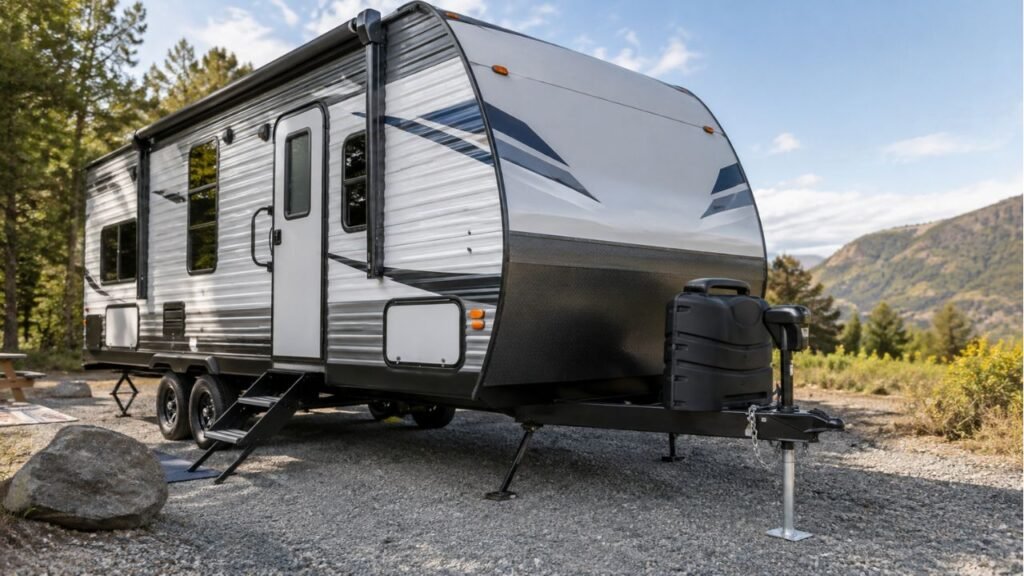
A trailer jack that drops overnight usually has a worn internal gear, damaged screw thread, failing brake or clutch, hydraulic seal leak, or holding valve problem. If the jack itself is retracting under tongue weight, that is not normal and should be inspected before you continue relying on it.
The good news is that you can usually narrow the problem down without tearing the entire jack apart. Below, I’ll help you determine whether the jack is actually dropping, what is causing it, and whether you should repair or replace it.
Key Takeaways
- A healthy trailer jack should hold its normal load without noticeably retracting overnight.
- Worn gears or screw threads commonly cause mechanical jacks to slip.
- Electric jacks may drop when their internal brake, clutch, or gearbox wears out.
- Hydraulic jacks usually sink because fluid bypasses a seal or holding valve.
- Soft ground can make the trailer lower even when the jack itself is fine.
- Overloading and side-loading can accelerate internal jack damage.
- A jack that cannot reliably hold weight should not be trusted as primary support.
- Severe gear, thread, tube, or structural damage usually makes replacement the safer choice.
Why Does My Trailer Jack Drop Overnight?
Your trailer jack has to do more than lift the tongue. Once you stop operating it, the internal mechanism also needs to hold that weight securely. If something inside can move backward under load, the trailer may gradually settle lower.
Here are the most common reasons this happens.
Worn or Stripped Internal Gears
Internal gear wear is one of the first things I would suspect if an electric trailer jack operates but slowly lowers afterward.
The gears transfer power from the motor to the lifting screw. Their teeth have to remain properly engaged while the jack is under load.
As those teeth wear down, the jack may still raise and lower normally at first. However, the gears may no longer resist reverse movement effectively.
You might also notice clicking, grinding, hesitation, or occasional jumping while operating the jack.
Severely damaged gears can eventually skip completely. At that point, the trailer may suddenly drop instead of settling slowly.
Worn Lead Screw or Acme Threads
Most mechanical tongue jacks depend on a large threaded screw inside the jack tube.
Turning that screw moves the inner leg up or down. Those threads also help prevent the jack from moving backward when you stop operating it.
Over time, lubrication can dry out. Dirt, moisture, corrosion, and heavy loads can then wear the thread surfaces.
If the threads become flattened or badly damaged, they may begin slipping under tongue weight.
A worn screw can also make the jack feel rough or inconsistent when raising the trailer.
If you hear scraping or feel unusual resistance through the manual override, the screw deserves closer inspection.
Failed Internal Brake or Clutch
Some powered trailer jacks use an internal holding mechanism to prevent the drivetrain from back-driving.
Depending on the jack design, this may involve a friction brake, clutch, worm gear arrangement, or another mechanical locking system.
When that mechanism wears out, gravity can slowly force the drivetrain backward.
The interesting part is that the motor itself can still work perfectly.
You may press the switch and see the trailer raise normally. Then several hours later, the tongue sits noticeably lower.
That makes this problem easy to mistake for an electrical issue when the actual problem is mechanical.
Hydraulic Fluid Bypassing the Piston
Hydraulic trailer jacks fail differently.
Instead of relying mainly on gears and screw threads, a hydraulic jack uses pressurized fluid to hold the load.
Inside the hydraulic cylinder is a piston with seals around it.
If one of those seals becomes worn or damaged, hydraulic fluid can slowly move past the piston.
This is called internal bypass.
You may not see any fluid outside the jack because the leak is happening inside the cylinder.
The main symptom is a jack that gradually sinks even though everything looks dry externally.
Leaking Hydraulic Valve or Solenoid
A hydraulic jack also depends on valves to keep pressurized fluid where it belongs.
After the trailer reaches the desired height, the holding valve should close and trap hydraulic pressure inside the cylinder.
If that valve does not seal completely, fluid can slowly return toward the reservoir.
The result is another form of gradual jack sinking.
Depending on the hydraulic system, the problem may come from contamination, damaged seals, a faulty solenoid, or wear inside the valve itself.
Jack Is Carrying Too Much Weight
An overloaded jack can also behave poorly under sustained pressure.
Every trailer jack has a maximum rated lifting capacity. That capacity should comfortably exceed the actual load the jack needs to handle.
Remember that trailer GVWR and tongue weight are different measurements.
A travel trailer might weigh several thousand pounds while the tongue places only a portion of that weight onto the jack.
However, when hitching or unhitching, the jack may temporarily lift additional weight while raising the rear of the tow vehicle.
Running close to the jack’s capacity repeatedly puts extra stress on gears, bearings, threads, motors, and hydraulic components.
Eventually, that stress may contribute to slipping.
Jack Is Bent or Side-Loaded
Trailer jacks are designed primarily to handle vertical loads.
Sideways pressure creates a completely different type of stress.
This can happen when:
- The trailer moves after being unhitched.
- The wheels are not properly chocked.
- The trailer sits on uneven ground.
- The jack foot slips sideways.
- The tow vehicle pushes against the coupler.
- The jack was damaged during travel.
A bent inner tube may bind during operation and place abnormal pressure on internal components.
Even if the jack still works, I would not ignore visible bending.
Once structural parts are compromised, replacement is usually safer.
Is It Normal for a Trailer Jack to Settle Overnight?
A trailer may settle slightly overnight, but the jack itself should not continuously retract under a normal load.
This distinction matters because the tongue can appear lower for reasons unrelated to jack failure.
For example, a jack pad can sink slightly into gravel, soil, asphalt, or soft campground surfaces.
Wooden blocks can also compress under weight.
Trailer tires and suspension components may shift slightly after parking. Temperature changes can alter tire pressure as well.
So before blaming the jack, determine whether the inner jack tube actually moved.
If the tube retracted noticeably without anyone operating it, I would consider that a mechanical or hydraulic problem rather than normal settling.
How to Tell Whether the Jack or Ground Is Actually Dropping
Before opening a gearbox or ordering a replacement jack, confirm exactly what is moving. A simple reference test can save you a lot of unnecessary work.
- Park the trailer on firm, reasonably level ground.
- Chock the wheels securely.
- Measure the height from the trailer frame to the ground.
- Place removable tape on the exposed jack tube.
- Align the tape with a fixed point on the outer tube.
- Measure the exposed portion of the inner jack tube.
- Inspect the jack pad and supporting blocks.
- Record the measurements.
- Check everything again several hours later.
- Compare the jack extension with your original reference mark.
If the frame lowers but the jack tube remains in exactly the same position, look closely at the ground, jack pad, suspension, tires, or support blocks.
If the inner jack tube physically retracts, the problem is inside the jack or its drive system.
Trailer Jack Types and What Usually Makes Them Drop
Different jack designs fail in different ways. Knowing which type you have can quickly point you toward the most likely problem.
| Jack Type | Common Reason It Drops | Typical Clue | Likely Solution |
| Manual tongue jack | Worn screw or internal gears | Handle feels loose or rough | Lubricate, rebuild, or replace |
| Electric tongue jack | Gear, brake, clutch, or screw wear | Clicking, grinding, or gradual lowering | Inspect drivetrain or replace |
| Hydraulic jack | Internal seal bypass | Slowly sinks without visible leakage | Repair seals or cylinder |
| Hydraulic jack | Holding valve leak | Loses height over time | Service valve or hydraulic system |
| Fifth-wheel landing gear | Gearbox or screw wear | One leg behaves differently | Inspect gearbox and drive components |
| Drop-leg jack | Pin or locking damage | Loose or sudden movement | Replace damaged pin or locking parts |
The table gives you a starting point, but symptoms should always be considered together. Grinding, visible bending, leakage, and sudden movement usually deserve more immediate attention than a jack that simply operates slower than normal.
How to Diagnose a Trailer Jack That Drops Overnight
You do not need to start by dismantling the jack. Work from the simplest possibilities toward the internal components, and you will usually narrow the problem down fairly quickly.
Step 1: Confirm the Trailer Is Safely Positioned
Safety comes first because a jack that is already slipping should never be treated as dependable support.
Park the trailer on stable ground and securely chock the wheels.
Do not crawl underneath a trailer supported only by a jack you suspect is failing.
If additional support is needed during diagnosis, use equipment specifically rated and positioned according to the trailer manufacturer’s recommended procedures.
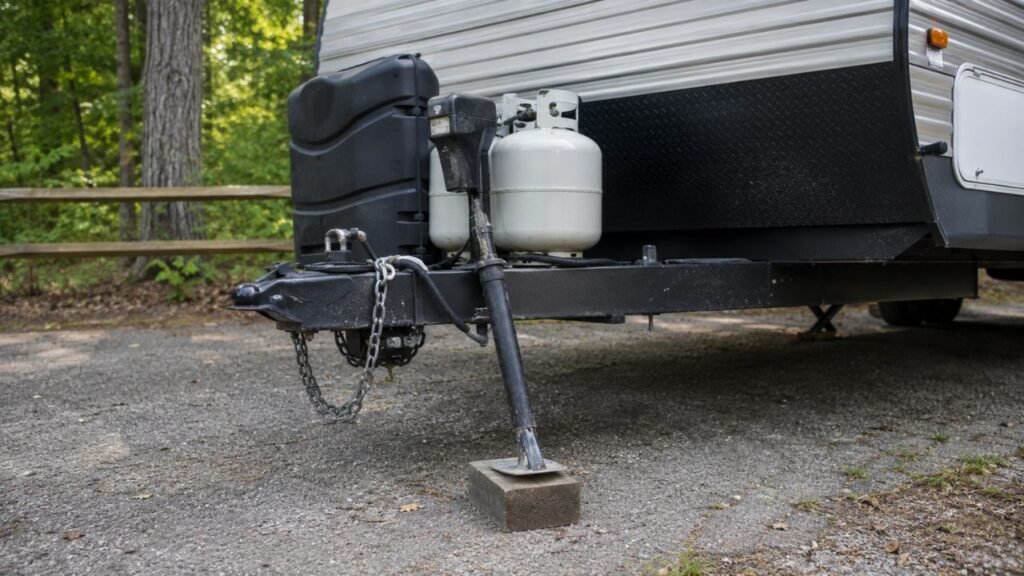
Step 2: Check the Jack Foot and Ground
Look closely at what the jack is sitting on.
Soft soil is an obvious problem, but gravel, hot asphalt, wet grass, and even certain wooden blocks can compress gradually.
A wider jack pad spreads the load across more surface area and reduces sinking.
If the jack’s extension stays constant while the foot moves downward, you have a ground-support issue rather than internal jack failure.
Step 3: Check the Jack’s Rated Capacity
Find the capacity label or model specifications for your jack.
Then compare that rating with the load the jack is expected to lift.
You do not need a jack rated for the trailer’s entire GVWR because the jack normally supports the tongue portion of the trailer.
However, I would avoid choosing a jack with a capacity barely above the expected load.
Having additional capacity gives the jack more operating margin and reduces stress.
Step 4: Watch the Jack Tube
This is one of my favorite simple checks because it removes much of the guesswork.
Place a small piece of removable tape where the inner tube enters the outer jack housing.
Do not put anything where it could interfere with operation.
Leave the trailer overnight.
If the mark clearly shifts relative to the jack body, you know the inner tube is retracting.
That strongly points toward an internal holding problem.
Step 5: Listen While Operating the Jack
Sounds can reveal a lot about what is happening inside the jack.
Pay attention to these symptoms:
- Grinding: Possible worn gears, damaged screw threads, or poor lubrication.
- Repeated clicking: Possible gear engagement or clutch problems.
- Popping: Possible damaged teeth, binding, or internal movement.
- Motor runs but jack barely moves: Possible stripped drivetrain components.
- Rough manual operation: Possible screw, tube, or gear damage.
- Sudden free movement: Possible serious internal mechanical failure.
A healthy jack should operate relatively smoothly and predictably.
New noises usually mean something has changed.
Step 6: Inspect for Rust, Bending, and Damage
Look at the entire jack rather than focusing only on the motor.
Inspect the:
- Inner jack tube
- Outer tube
- Mounting plate
- Mounting bolts
- Welds
- Jack foot
- Electrical housing
- Manual override area
Surface corrosion may only need cleaning.
Deep rust, cracked welds, a bent tube, or distorted mounting components are much more serious.
Step 7: Check Hydraulic Fluid and Fittings
If you have a hydraulic jack or hydraulic landing system, inspect the cylinder, reservoir, fittings, hoses, and valves.
Look for:
- Wet fittings
- Hydraulic fluid on the cylinder
- Drips beneath the trailer
- Damaged hoses
- Loose connections
- Low reservoir level
Keep in mind that a jack can have internal bypass without showing an external leak.
So a completely dry hydraulic system can still slowly sink.
Step 8: Test the Jack Under Reduced Load
A jack that holds a light load but slips under normal tongue weight may have worn internal components.
Reducing the load during testing can sometimes help identify this difference.
However, do not improvise unsafe lifting arrangements just to perform this test.
Only redistribute or support the trailer using appropriate equipment and procedures.
Signs the Internal Gears Are Failing
Gear problems often develop gradually before complete failure. Watch for changes in how the jack sounds, moves, or holds weight.
Common warning signs include:
- The jack lifts normally but settles afterward.
- The motor runs without consistent jack movement.
- Grinding appears while raising the trailer.
- The jack moves in small jumps.
- Clicking becomes more frequent under load.
- The manual override feels unusually loose.
- The jack works better with lighter loads.
- The jack occasionally slips while lifting.
- Metal or plastic debris appears inside the gearbox.
- The motor runs but the lifting screw stops moving.
Once gears begin skipping under load, I would avoid repeatedly testing them with the trailer’s full tongue weight.
Every slip can damage the remaining gear teeth further.
Why an Electric Trailer Jack Can Drop Even When the Motor Is Off
It is easy to assume the electric motor is what holds your trailer in the raised position, but that is not necessarily how the system works.
The motor provides the power needed to move the jack.
Once you release the switch, the mechanical drivetrain normally prevents the jack from moving backward.
Depending on the jack, that holding function may come from screw geometry, gears, a clutch, a brake, or another mechanical arrangement.
If one of those parts becomes worn, tongue weight can gradually force the mechanism backward.
That means an electric jack can lower even when the switch is off.
Disconnecting the battery will not fix worn gears or damaged screw threads either.
A healthy mechanical system should normally remain in position without electrical power constantly being supplied to the motor.
Can a Low Battery Make a Trailer Jack Drop?
A weak trailer battery can cause plenty of electric jack problems, but overnight dropping usually is not one of them.
Low voltage commonly causes:
- Slow jack operation
- Clicking from the motor or relay
- Motor stalling
- Weak lifting performance
- Overheating
- Blown fuses under heavy load
However, once a healthy mechanical jack reaches the desired height, its internal mechanism should hold the load.
The battery does not normally need to keep powering the motor all night.
If your jack raises properly and then physically retracts several hours later, I would inspect the mechanical holding components rather than immediately replacing the battery.
Can Lubrication Stop a Trailer Jack From Dropping?
Lubrication can help some jack problems, but it is not a cure for damaged parts.
A dry lead screw or gearbox can create excessive friction and accelerate wear.
Using the lubricant recommended for your particular jack may improve operation and help prevent additional damage.
Lubrication can be useful when you are dealing with:
- Dry gears
- Light surface corrosion
- Stiff screw operation
- Poorly lubricated bearings
- Dirt around moving surfaces
However, grease cannot rebuild missing gear teeth.
It also cannot repair flattened threads, failed hydraulic seals, cracked components, or a damaged clutch.
If the jack is already slipping under load, adding grease and hoping it holds is not a repair I would rely on.
How to Fix a Trailer Jack That Keeps Dropping
The right repair depends heavily on what you found during diagnosis. Some problems are simple maintenance jobs, while others mean the jack has reached the end of its dependable service life.
Clean and Lubricate the Jack
If the jack is mechanically sound but dry or rusty, cleaning and lubrication may restore smoother operation.
Remove dirt from accessible moving surfaces and inspect for corrosion.
Then lubricate only the service points recommended for your jack model.
Different jack designs use different lubricants and service procedures, so avoid filling the housing with random grease.
After lubrication, operate the jack through a reasonable range and check whether movement becomes smoother.
Tighten Mounting Hardware
A jack can sometimes appear to move when the actual problem is the mounting system.
Inspect mounting bolts and brackets for looseness.
Look closely while the jack is under moderate load.
If the jack housing shifts relative to the trailer tongue, the mounting hardware may need attention.
Loose hardware should be tightened to the appropriate specification.
Also inspect the mounting area for cracked metal or elongated bolt holes.
Replace Damaged Gears
Some electric trailer jacks have serviceable gearboxes.
Replacement gear kits may be available for certain models.
If inspection shows damaged gears but the motor, screw, tube, bearings, and housing remain in good condition, replacing the gears can make sense.
However, do not assume new gears will solve everything.
If worn gears were caused by a damaged lifting screw or bent tube, replacing only the gears may lead to another failure.
Repair Hydraulic Seals or Valves
Hydraulic jacks may be repairable when the problem comes from seals, valves, fittings, or hoses.
Possible repairs include:
- Replacing piston seals
- Rebuilding the cylinder
- Servicing the holding valve
- Replacing damaged hoses
- Repairing leaking fittings
- Servicing a faulty hydraulic solenoid
Hydraulic repairs require cleanliness because dirt entering the system can damage valves and sealing surfaces.
For complicated hydraulic systems, professional servicing is often worthwhile.
Replace the Complete Jack
Sometimes replacing the jack is simply the better decision.
I would strongly consider replacement if you find:
- Badly worn screw threads
- A visibly bent jack tube
- Cracked structural components
- Severe internal corrosion
- Multiple damaged gears
- Repeated slipping under normal load
- Unavailable replacement parts
- Damage to both the gearbox and lifting mechanism
A trailer jack is a load-handling component.
Saving a little money by continuing to use one that cannot reliably hold weight is rarely worth the risk.
Repair vs. Replace a Trailer Jack
Not every problem justifies buying a new jack. Minor maintenance issues can often be corrected, while structural or load-holding problems usually deserve a more cautious approach.
| Jack Condition | Repair May Make Sense | Replacement Usually Better |
| Dry gears or screw | Yes | Usually unnecessary |
| Minor surface corrosion | Yes | If corrosion is structural |
| Loose mounting bolts | Yes | Usually unnecessary |
| Replaceable gear damage | Sometimes | If other components are also worn |
| Stripped lifting screw | Rarely | Yes |
| Bent inner or outer tube | No | Yes |
| Internal hydraulic seal leak | Often | If cylinder surfaces are badly worn |
| Damaged hydraulic hose | Usually | If wider system damage exists |
| Severe gearbox damage | Sometimes | Often |
| Cracked structural components | No | Yes |
| Jack repeatedly slips under load | Limited | Usually the safer choice |
When deciding, consider the age of the jack as well.
Putting several replacement parts into an old jack with corrosion, worn bearings, and a tired motor may cost nearly as much as replacing the whole assembly.
Is a Trailer Jack That Drops Overnight Dangerous?
Yes, a trailer jack that cannot reliably hold its position can become dangerous.
The biggest concern is unpredictability.
A slow half-inch drop today could eventually become a much faster movement if damaged gears, threads, or hydraulic seals continue deteriorating.
A failing jack can:
- Change the trailer’s level.
- Place additional force on other supports.
- Allow the coupler to move unexpectedly.
- Damage stabilizer jacks.
- Create pinch points.
- Make hitching unpredictable.
- Drop suddenly if internal parts fail completely.
One important point deserves mentioning here.
Stabilizer jacks are generally designed to reduce trailer movement after setup. They are not automatically substitutes for the tongue jack or landing gear used as primary lifting equipment.
Always use each support component for its intended purpose.
Can I Leave the Trailer Supported by a Jack That Slowly Drops?
I would not continue relying on a trailer jack once you know it cannot hold its position.
Even if the jack only drops slightly overnight, the movement tells you something in the load-holding system may no longer be working correctly.
The problem can become worse without much warning.
If the trailer needs temporary additional support while you diagnose or replace the jack, use properly rated equipment positioned according to the trailer manufacturer’s recommendations.
Avoid improvised blocks, makeshift stands, or equipment that was never designed to support the trailer.
And never place yourself underneath a trailer supported only by a questionable jack.
How to Prevent Your Trailer Jack From Dropping Again
Once you repair or replace the jack, a few habits can greatly reduce the chance of the problem returning.
- Use a jack comfortably rated for your trailer’s expected tongue or pin load.
- Keep the trailer properly chocked before unhitching.
- Avoid pushing sideways against an extended jack.
- Use a wide jack pad on soft surfaces.
- Keep approved lubrication points serviced.
- Clean road dirt and moisture from exposed jack components.
- Protect electric motor housings from excessive water exposure.
- Inspect hydraulic hoses and fittings regularly.
- Keep mounting bolts properly tightened.
- Do not continue operating a jack that grinds or skips.
- Fully retract the jack before towing.
- Inspect the jack after any impact.
- Check for corrosion before long storage periods.
Preventive maintenance is especially valuable because many jack failures begin as small symptoms.
Catching rough operation or minor corrosion early is much easier than dealing with stripped gears while trying to hitch your trailer.
Trailer Jack Maintenance Schedule
A basic maintenance routine can help you spot trouble before the jack reaches the point where it cannot hold weight.
| Interval | What to Check |
| Before each trip | Operation, mounting, visible damage, unusual noises |
| During regular use | Jack foot, tube condition, wiring, corrosion |
| Every few months | Manufacturer-approved lubrication points |
| About twice yearly | Mounting bolts, gearbox condition where serviceable |
| For hydraulic systems | Hoses, fittings, reservoir level, cylinder leakage |
| Annually | Full operation and load-holding inspection |
| After an impact | Alignment, mounting area, tube condition, welds |
| After unusual slipping | Stop normal use and inspect immediately |
Your jack manufacturer’s maintenance schedule should take priority if it specifies different intervals.
Some jacks are designed for regular internal servicing, while others have largely sealed drive assemblies.
When You Should Stop Using the Jack Immediately
Some symptoms move the problem beyond routine maintenance.
Stop relying on the jack if:
- The jack suddenly drops under load.
- The inner or outer tube is visibly bent.
- Mounting metal or welds are cracked.
- Gears repeatedly skip.
- The jack cannot hold normal tongue weight.
- Hydraulic fluid is leaking heavily.
- The jack binds badly during travel.
- The inner leg moves unpredictably.
- The jack foot or drop leg will not lock securely.
- The gearbox produces severe grinding.
- The jack has obvious structural damage.
A jack that gives you these warnings is no longer something I would trust simply because it still moves when you press the switch.
Final Words
If your trailer jack drops overnight, start by confirming that the jack itself is actually retracting. Soft ground, compressed blocks, tires, and suspension movement can sometimes make the trailer appear lower without anything being wrong inside the jack.
Once you confirm that the jack tube is moving, focus on its load-holding components. Mechanical and electric jacks usually point toward worn gears, damaged screw threads, or a failed brake or clutch. Hydraulic systems are more likely to have internal seal bypass or a leaking holding valve.
Minor lubrication or mounting problems may be repairable. However, a jack that repeatedly slips, has damaged threads, contains badly worn gears, or shows structural bending is usually better replaced. Your trailer jack has one important job: lift the trailer and keep it where you put it. If it can no longer do that reliably, fix the problem before depending on it again.
Related FAQs
Why Does My Electric Trailer Jack Slowly Lower?
An electric trailer jack can slowly lower when worn gears, damaged screw threads, or a failing internal brake or clutch allow the drivetrain to back-drive under tongue weight. The motor can still operate normally even when the mechanical holding system is failing.
Should a Trailer Jack Hold Weight Overnight?
Yes. A properly functioning trailer jack should hold its intended load without noticeably retracting overnight. Small changes caused by soft ground or compressed support blocks can occur, so confirm whether the jack tube itself has actually moved.
Can a Trailer Jack Fail Suddenly?
Yes. Severely worn gears, stripped screw threads, damaged locking pins, structural cracks, or hydraulic failures can sometimes progress from gradual movement to sudden failure, which is why slipping under load should not be ignored.
Why Does My Hydraulic Trailer Jack Keep Sinking?
A hydraulic trailer jack commonly sinks because fluid is bypassing a worn piston seal or leaking through a holding valve. Internal bypass may occur even when there is no visible hydraulic fluid leaking outside the cylinder.
Can Too Much Tongue Weight Damage a Trailer Jack?
Yes. Repeatedly operating near or above the jack’s rated capacity increases stress on its motor, gears, screw, bearings, hydraulic components, and mounting structure, which can accelerate wear and eventually cause slipping.
Can Cold Weather Make a Trailer Jack Drop?
Cold weather can make grease thicker and change how hydraulic fluid behaves, which may affect operation. However, a jack that consistently retracts under load should still be inspected for worn mechanical parts, leaking seals, or valve problems.
Can I Rebuild an Electric Trailer Jack?
Some electric trailer jacks can be rebuilt because replacement gears, switches, motors, bearings, or other parts are available. However, badly worn screw threads, bent tubes, corrosion, or several failed components can make complete replacement more practical.
Why Does My Trailer Jack Slip Only Under Heavy Load?
A jack that holds light loads but slips under normal tongue weight often has worn gears, damaged screw threads, a weak clutch or brake, or insufficient capacity. The increased load exposes wear that may not be noticeable when the jack is lightly loaded.
Can a Low Trailer Battery Cause the Jack to Lower Overnight?
A low battery can make an electric jack slow, weak, or difficult to operate, but it normally should not make a healthy jack retract after it stops moving. Overnight lowering more commonly points toward a mechanical holding problem.
Can I Use Stabilizer Jacks If My Tongue Jack Is Dropping?
Stabilizer jacks should generally not be treated as replacements for a damaged tongue jack unless the trailer manufacturer specifically allows that use. Stabilizers are primarily intended to control movement rather than act as primary lifting or load-support equipment.

Scott Miller shares real-world RV road trip insights built from years of traveling open highways and backroads. He covers route planning, campground choices, and travel gear with a practical mindset. His content is written for RVers who value reliability over trends.